

By Caleb Stein February 10, 2026
These photographs were made in Paris nearly a century ago, by a man living between wars, at a moment when fascism was consolidating power across Europe and the city’s social life felt newly exposed. Brassaï turned to the night not as a picturesque subject or symbolic refuge, but as a condition in which social relations reorganized themselves. After dark, Paris loosened its rules. Bodies gathered differently. People touched, waited, lingered. What emerged was not spectacle, but a provisional form of social life, one that could not be taken for granted.
Between 1931 and 1933, Brassaï walked the city almost every night. He did not chase crises or climaxes. He stayed with intervals: the time before something happens, the moment after it has passed. In the photograph of dancers backstage at the Folies Bergère, a row of women stands pressed against a patterned wall while a large mirror above them reflects the scene at an angle. Shot from the upper gallery, the image collapses floor, wall, and reflection into a single unstable plane. Elsewhere, people talk, smoke, rest, touch. In a lesbian bar, a woman in a tailored suit holds her partner close; in a crowded dance hall, a turning head registers as a blur, time briefly inscribed into the body. Brassaï moves with a consistent attentiveness across studios, bars, streets, and clubs. And he did it repeatedly, in the same streets, the same bars, the same rooms.
This attention to duration distinguishes Brassaï from other contemporaneous approaches to nocturnal photography. Figures such as Weegee moved quickly through scenes of disruption and emergency, producing images structured around impact and aftermath. Brassaï stayed. Night, in his photographs, is not theatrical. It is social. Its dramas unfold slowly, through posture, gesture, and the negotiated closeness of bodies sharing space over time. Night also gathers different historical tempos into a single field, where monument, labor, pleasure, and exhaustion coexist without resolution.
Brassaï is often aligned with surrealism, and he did exhibit alongside the surrealists. Yet his photographs resist the movement’s emphasis on constructed shock or rupture as privileged routes to meaning. He insisted that he invented nothing, that the world itself was already strange enough. He frequently cited Goethe’s line, “the world is richer than I am” as a guiding principle. The task was not to transform reality into symbol, but to remain open to its instability, to the way ordinary facts can slip into something fantastic through attention alone. In this sense, his work anticipates a formulation later associated with Garry Winogrand: that nothing is as strange as a fact clearly described. What distinguishes Brassaï is the patience required to let such facts appear at all, even when photographs of queer couples, prostitutes, and dance halls were made but withheld from the book “Paris de nuit”, not simply because of who appeared in them, but because of the degree of intimacy they allowed.
That patience extended across media. During these years, Brassaï drew and painted. He photographed what he called “sculptures involontaires”: toothpaste pressed into a sink, scraps of paper, bits of debris that briefly resembled figures or landscapes. These images clarify his refusal to separate the strange from the ordinary. Strangeness was not separate from the world; it was recognized within it. Even so, these experiments never displaced his central commitment, which was to photograph the city as he encountered it, repeatedly and without dramatization.
That commitment found its most complete form in “Paris de nuit”. Conceived as a book rather than an exhibition, it relied on sequencing, adjacency, and photogravure reproduction to produce meaning across images in addition to within any single frame. As Brassaï assembled the book, photographing Paris night after night, his standards tightened, images fell away, and the shape of the book helped determine what the work would become. Streets, interiors, monuments, and bodies form a continuous nocturnal field, with images accumulating significance through repetition and return. When the book appeared in 1933, accompanied by a text from Paul Morand, it established Brassaï’s reputation quickly. Although he exhibited photographs during this period, including with Julien Levy in New York, it was the book that allowed the work to unfold as a sustained experience rather than a set of discrete images.
Brassaï continued to revisit these photographs for decades, republishing and recontextualizing them in different formats. He understood that photographs do not settle at the moment they are made. Their meanings shift through circulation, grouping, and use. What once read as attentive can later appear descriptive, historical, or archival. This instability was not a flaw, but a condition of photographic meaning.
Brassaï’s photographs remain instructive not because they offer a model to imitate, but because they insist on a way of working grounded in time. Their consistency does not arise from style, but from staying with the same places long enough for their social textures to emerge. The intensity of those early years depended on repetition, proximity, and patience. In an image culture now driven by speed and instant legibility, Brassaï’s work offers a quieter proposition: that what matters in photography is not what it captures, but what it is willing to remain with long enough to recognize.
Caleb Stein is a photographer who is represented by Palo Gallery in New York and Rose Gallery in Los Angeles, and who is also a part of Orejarena+Stein, a collaborate effort.

BRASSAÏ "Le Monocle, the bar. On the left is Lulu de Montparnasse (Au Monocle, le bar. à gauche Lulu de Montparnasse)" 1932. © ESTATE OF BRASSAÏ COURTESY OF HOWARD GREENBERG GALLERY/GROB GALLERY.

BRASSAÏ "The Rainbow at the Folies-Bergère (Vue plongeante sur la scène des Folies-Bergère)" 1932. © ESTATE OF BRASSAÏ COURTESY OF HOWARD GREENBERG GALLERY/GROB GALLERY.
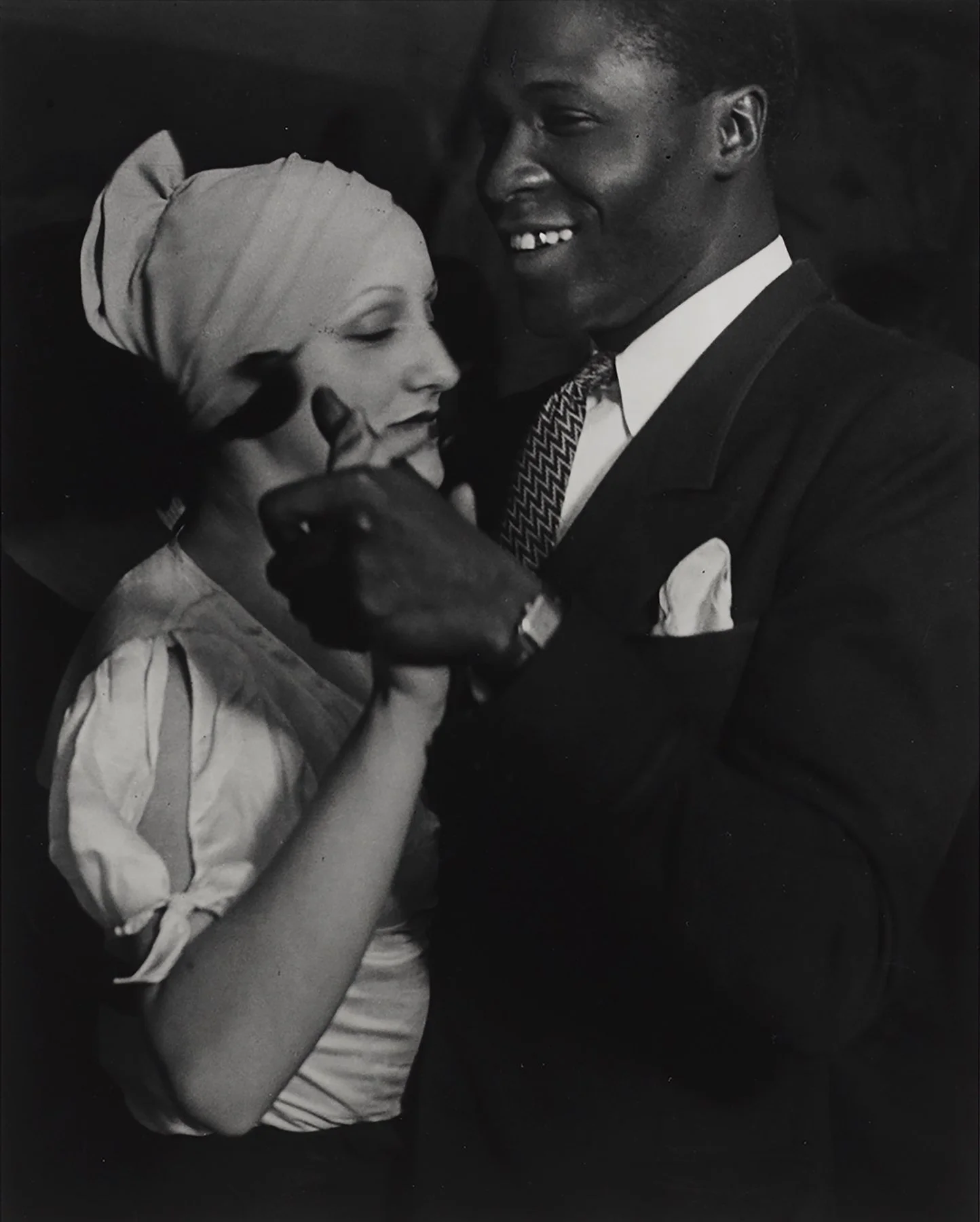
BRASSAÏ, "Couple at the Bal Nègre, Rue Blomet (Couple au Bal Nègre, Rue Blomet)" 1932. © ESTATE OF BRASSAÏ COURTESY OF HOWARD GREENBERG GALLERY/GROB GALLERY.

BRASSÏ "Homeless person sleeping in Marseille (Clochard dormant à Marseille)" 1937. © ESTATE OF BRASSAÏ COURTESY OF HOWARD GREENBERG GALLERY/GROB GALLERY.