

By Marcus Civin, September 10, 2025
Edward Burtynsky’s survey exhibition, “The Great Acceleration,” at the International Center of Photography through September 28, takes as its title the term for the rapid increase in human activity which has had an outsized impact on the earth. Curated by David Campany, the show is full of juxtapositions—excesses and their hangovers. It casts our environmental crisis as a logical and obvious consequence, or basic math. In the seventy-year-old Canadian artist’s accounting, the baffling size of oil refineries and container ships is directly proportional to human appetites and ambitions, the span of highways, and the growth of cities and suburbs. In slick, mostly large-format photographs, Burtynsky shows that even the common conveniences of industrial civilization are dependent on substantial labor, waste, and redefinition of the landscape. The damning evidence is extensive. A few steps into the galleries, “Breezewood, Pennsylvania, USA” (2008) shows a busy highway junction with a wide array of options for gas and food. Upstairs, a picture of a crowd at a NASCAR pre-race ceremony, “Talladega Speedway #1, Aaron Race, Talladega, Alabama, USA” (2009), is installed next to “Auto Wreckers #1, Tucson, Arizona, USA” (2006), a gloomy line-up of junked passenger vehicles. Back downstairs, “Oxford Tire Pile #1, Westley, California” (1999) depicts a sprawling rubber graveyard.
In works like “Manufacturing #10a, Cankun Factory, Xiamen City, China” (2005), there are mind-numbingly massive assembly lines. In “Nickel Tailings #34, Sudbury, Ontario, Canada” (1996), a river runs red-orange, thick with particles of ore from mining. The label accompanying the image “Super Pit #1, Kalgoorlie, Western Australia, Australia” (2007), explains that the rock in this chasm contains one-tenth of an ounce of gold per ton; crews use one hundred liters of fuel to pulverize each ton and retrieve the precious metal. In the main gallery at ICP, a quote in vinyl on the wall from a 2003 piece in “The Nation” by Rebecca Solnit suggests that Burtynsky’s efforts to present facts about the environment could counteract industrial civilization’s dependence on the public’s ignorance about what goes on in factories and mines. The trouble with facts, though, is that they are not always as persuasive as they should be. These days—despite the thankless toil of activists—when people attempt to downplay environmental crises, it is in large part, perhaps, because they believe that meaningfully addressing ecological problems could threaten their material comforts or short-term gain. It seems that many people can willfully maintain their ignorance about the environment because, on some level, they feel that this ignorance is essential to their way of life. Self-interest and fear are sometimes stronger than truth.
Maybe Burtynsky should be considered a war photographer. After all, he ventures to the front lines of the battle against the earth and records the devastation whether people can handle it or not. In that light, his gearhead cowboy persona could perhaps be forgiven. (Burtynsky will apparently hang out of a helicopter or go deep underground to get a shot. He uses the latest equipment and runs his own print shop to achieve maximum detail, saturated color, and sometimes fanatical polish.) Still, bombast seems to get him in trouble and muddy his agenda. He blew up an image of industrial farming, “Pivot Irrigation #8, High Plains, Texas Panhandle, USA” (2012), to cover a two-story monolithic wall (a fixture at ICP). It’s unclear if this approach to art installation is meant to underscore the enormity of agricultural production and express frustration with it. Or is it just showing off and filling up space? The approach comes across as needlessly overassertive, like someone yelling themself hoarse when, at a lower volume, they could communicate just fine, which makes one wonder: especially when it comes to size of the imagery generally, is Burtynsky critiquing excess or simply aping it?
Some of the most effective works in the exhibition are the subtlest. Take a modestly sized early work such as “Food Processing #2, Carrots, United Farms, Holland Marsh, Ontario, Canada” (1982). It peers into such a soupy, grimy, farmstead jumble, and the memory of it will make you pause the next time you consider which ingredients from the produce aisle you want to bring home. The occasional people represented in the show feel like afterthoughts, though, a curious discrepancy of what is considered ‘concerned’ photography. Burtynsky’s human figures are sometimes tiny or blurry as if to underscore the point that civilization as a whole is out of control. Other times, they’re reduced to types, like lost elements from larger classification systems as in “Kitchen Staff, Liling Rd, Shanghai, Hongkou, China” (2005) or “China Recycling #22, Portrait of A Woman in Blue Zeguo, Zhejiang Province, China” (2004).
In interviews, Burtynsky attempts unsuccessfully to preserve a semblance of journalistic objectivity. He will oddly claim to be somewhat impartial and refuse to assign blame for negative circumstances, apparently leaving it up to others to hold corporations and governments accountable, propose overarching solutions, document initiatives that protect the environment and promote sustainability, or experiment with nontoxic photo processing. Walking through the exhibition at ICP does feel like a journalistic experience akin to browsing a glossy magazine special issue on land use, one that claims criticality.
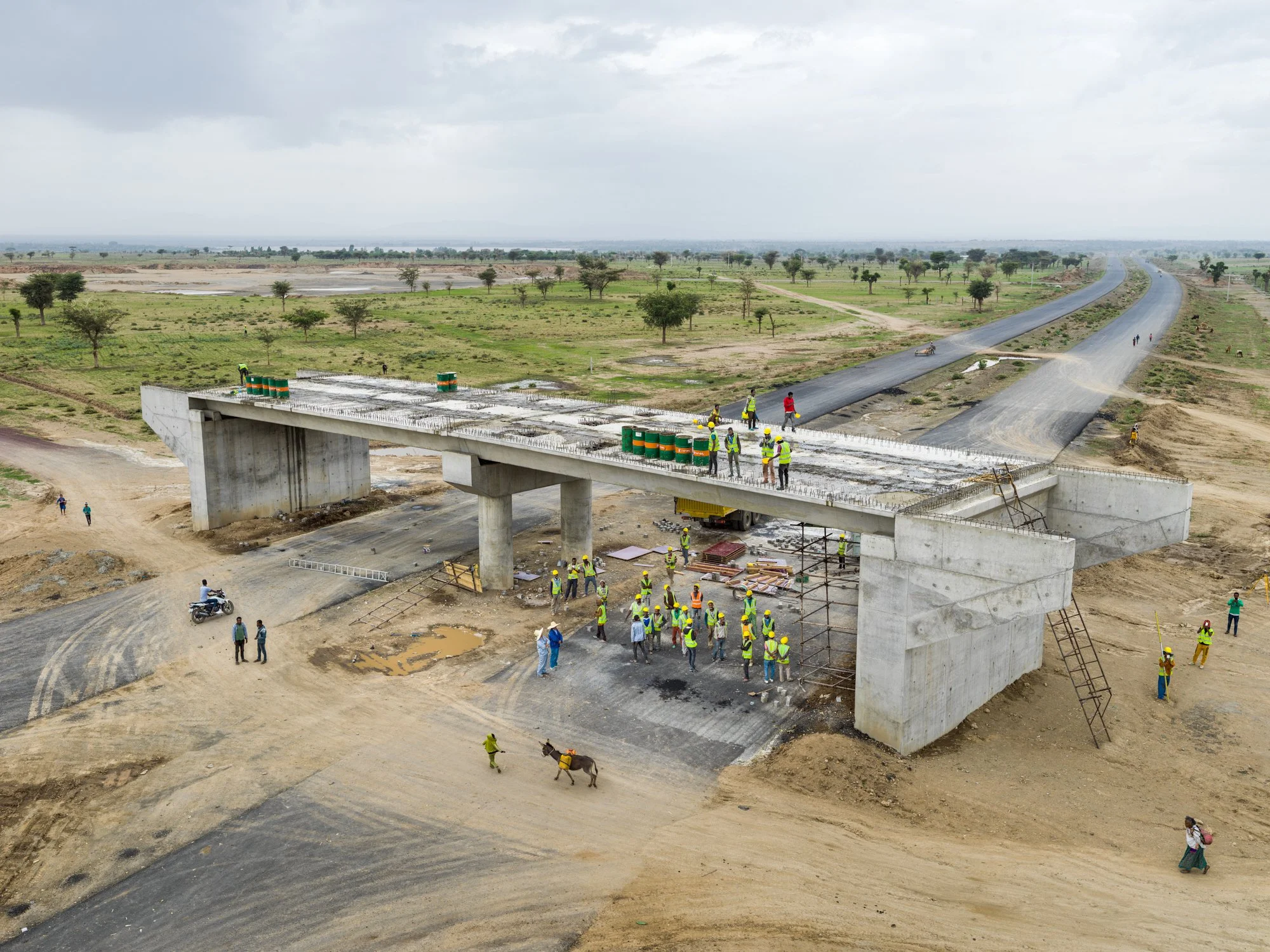
EDWARD BURTYNSKY "Modjo-Hawassa Expressway #1 Alem Tenam Ethiopia", 2018.© Edward Burtynsky, courtesy Howard Greenberg Gallery, New York.
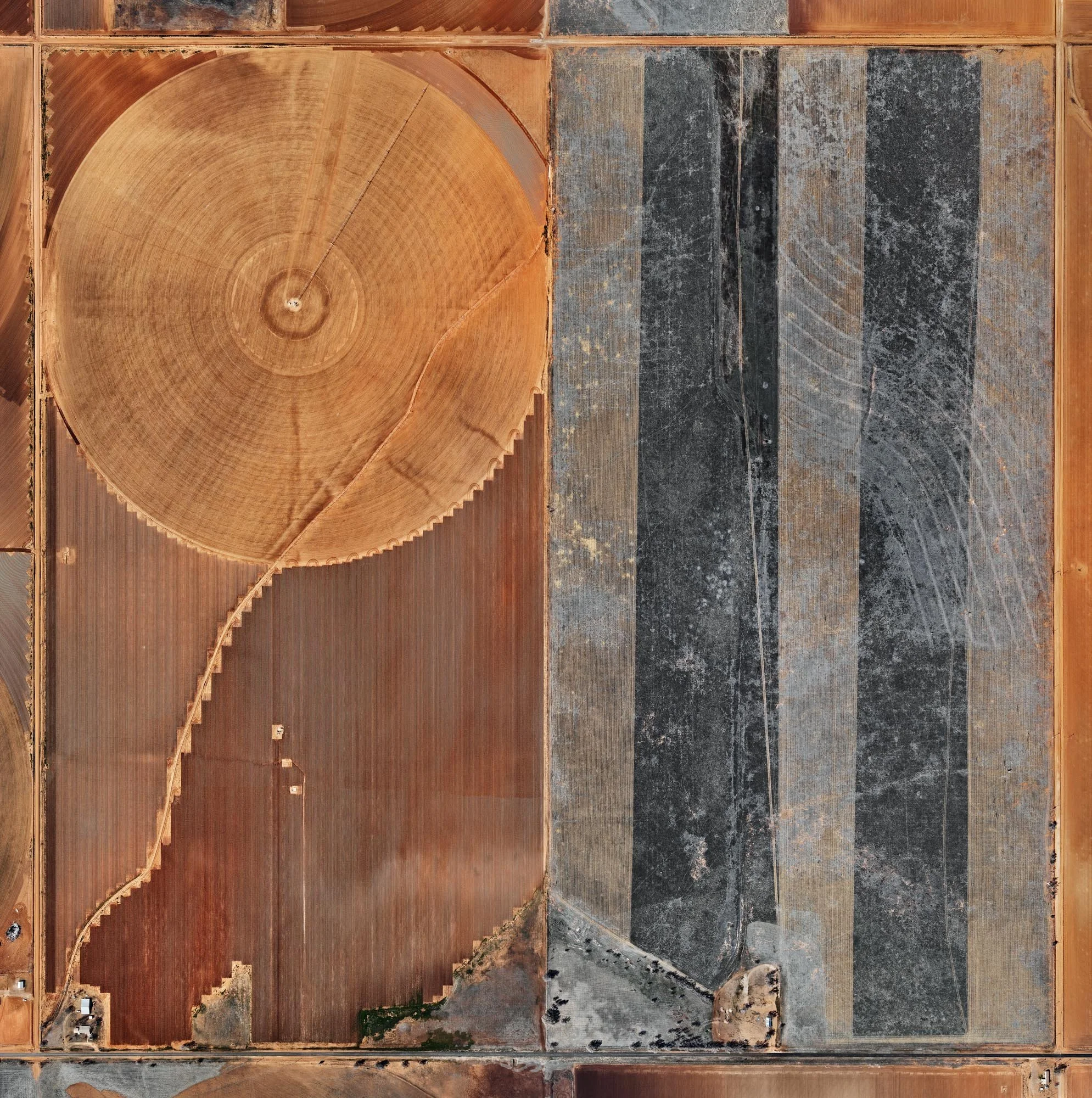
EDWARD BURTYNSKY "Pivot Irrigation #8 High Plains, Texas Panhandle USA" 2012. © Edward Burtynsky, courtesy Howard Greenberg Gallery, New York.

EDWARD BURTYNSKY "Salt River Pima and Maricopa Indian Community/Suburb, Scottsdale Arizona, USA 2011 © Edward Burtynsky, courtesy Howard Greenberg Gallery, New York.

EDWARD BURTYNSKY "Shipbreaking #49 Chittagong, Bangladesh" 2001. © Edward Burtynsky, courtesy Howard Greenberg Gallery, New York.