

By Evan Moffitt, March 10, 2026
Luigi Ghirri was a professional wanderer. After studying geometry in Modena, he spent ten years working as a land surveyor, analysing the shape and grade of his home province, Emilio-Romagna. When he dedicated himself to photography full-time in 1974, at the age of 31, it was only natural that he should turn his lens on the landscape. But Ghirri was more interested in what lay outside the frame – in the cognitive gaps that can’t be surveyed.
In the introduction to his 1978 book “Kodachrome,” Ghirri described finding such a gap in “The Blue Marble”, the first colour photograph of Earth from space, taken by the Apollo 17 crew six years earlier. “It was not only the picture of the world, but the picture which contained all the pictures of the world: graffiti, frescoes, prints, paintings, photographs…” he wrote. “On the other hand, this total view, this redescription of everything, destroyed once more the possibility of translating the hieroglyphic whole. The power of containing everything vanished in front of the impossibility of seeing everything at the same time.” No single image can capture both the macro and the micro. All photography comes down to this essential choice.
One half of the exhibition of Luigi Ghirri’s work at Thomas Dane Gallery through May 9, curated by Alessio Bolzoni and the filmmaker Luca Guadagnino, is all in pieces. Or perhaps more accurately, of pieces: found scraps of newspaper, ripped pornographic photographs, closeups of constellations in children’s astronomy books. A bare-breasted woman smiles back at us from the torn, black-and-white page of a girlie magazine, lying on a gravel road. Atop a disintegrating poster on wet asphalt dotted with poplar seeds, we read the word which provides the title for this exhibition: the Italian term for happiness, “Felicitá”.
Most of these photographs were taken between 1970 and 1973, while Ghirri was still working as a surveyor, and are simply titled “Modena”, after the place where he shot them. It’s a small city, though small is relative in Emilia-Romagna – but each image is also a picture of the world. I’m reminded of Jorge Luis Borges’s story “Tattered Ruins”, of the map so large it covered the entire land it depicted, which can still be found in “the Deserts of the West”. In each of these works, we are looking at the impossibility of representation through photography and language.
Along one wall, a line of photographs captures torn wheat pasted bills on brick walls in closeup, their jagged edges redolent of décollage works by Mimmo Rotella. Another grouping depicts walls with various signage: an arrow advising “Senso Unico”, or “One Way”; a notice for something called “ProgettiArcobaleno”, or “Rainbow Projects”. Guadagnino and Bolzoni have teased out erotic humor from these minimal details: a photograph of a mail slot in a wooden door hangs beside a photograph of a small water spigot on a brick wall, like complementary genitalia.
And then, in the middle of it all, like a shiny Easter egg, is a work by Felix Gonzalez-Torres. “Untitled (Key West)” is from the artist’s puzzle series. A C-print of light glinting off water, printed on a jigsaw puzzle and displayed in a plastic bag, its presence appears to literalise the problem, laid out by Ghirri and Borges, of piecing it all together.
In his landmark book “Simulations”, Jean Baudrillard referred to Borges’s map as a simulacrum, or an image that becomes more real than the thing it represents. In the second half of the exhibition, which features landscape photographs more typical of Ghirri’s oeuvre, I found it hard to look at their overexposed Kodachrome colours and not think of film’s simulacrum. How to separate that soft light, which seems to find pastel tones everywhere under the warm Italian sun, from the filters I began to use when I came of age on a new social media platform called Instagram? They reminded me, too, of the disposable cameras my friends and I used to buy for special occasions – their well-expired film offering us store-bought nostalgia, though we weren’t old enough to remember what it was we were missing.
Most of all, though, the sun-bleached beach scenes and empty cafe terraces recall the simulacrum of Guadagnino’s own films, from “A Bigger Splash” to “Call Me By Your Name”, which are saturated with nostalgia for the 1970s. Those movies lend aesthetics which would have been mundane in Ghirri’s time all the slickness of a Loewe campaign. And yet, as the years go by, they color our perception.
I wonder what Ghirri would have thought about all this. Next month, astronauts in the Artemis II rocket will take the first photograph of the dark side of the moon. We are still trying to put the puzzle together.
Evan Moffitt has written for The Guardian, The New York Times, Financial Times, Artforum, Aperture, 4 Columns and Frieze. He currently serves as Fronts Editor for The Observer.

LUIGI GHIRRI "Modena" 1973. © The Estate of Luigi Ghirri. Courtesy Thomas Dane Gallery.

LUIGI GHIRRI "Modena" 1973 © The Estate of Luigi Ghirri. Courtesy Thomas Dane Gallery..

LUIGI GHIRRI "Modena", 1972-73 ©The Estate of Luigi Ghirri. Courtesy Thomas Dane Gallery.
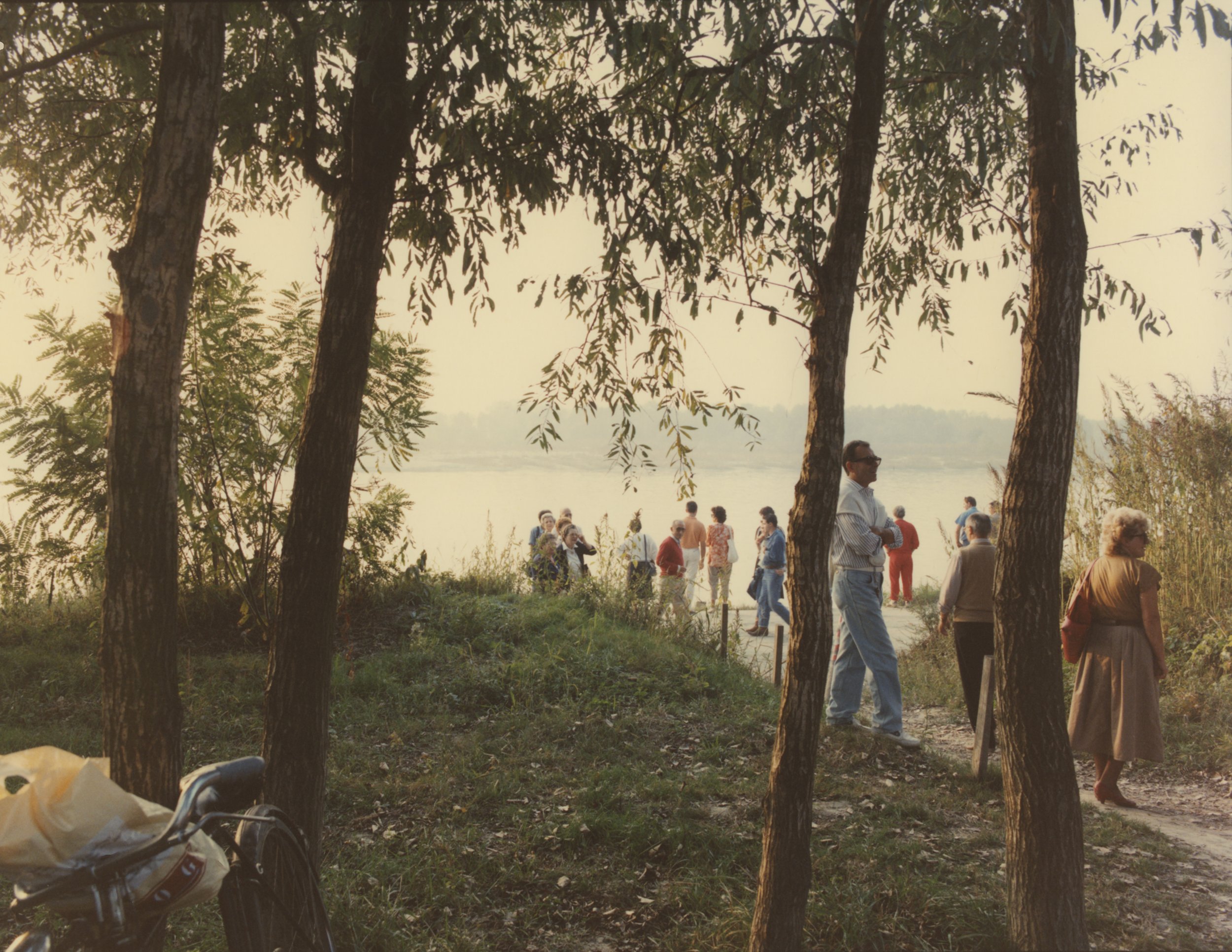
LUIGI GHIRRI "Verso la Foce", 1988-89. ©The Estate of Luigi Ghirri. Courtesy Thomas Dane Gallery.
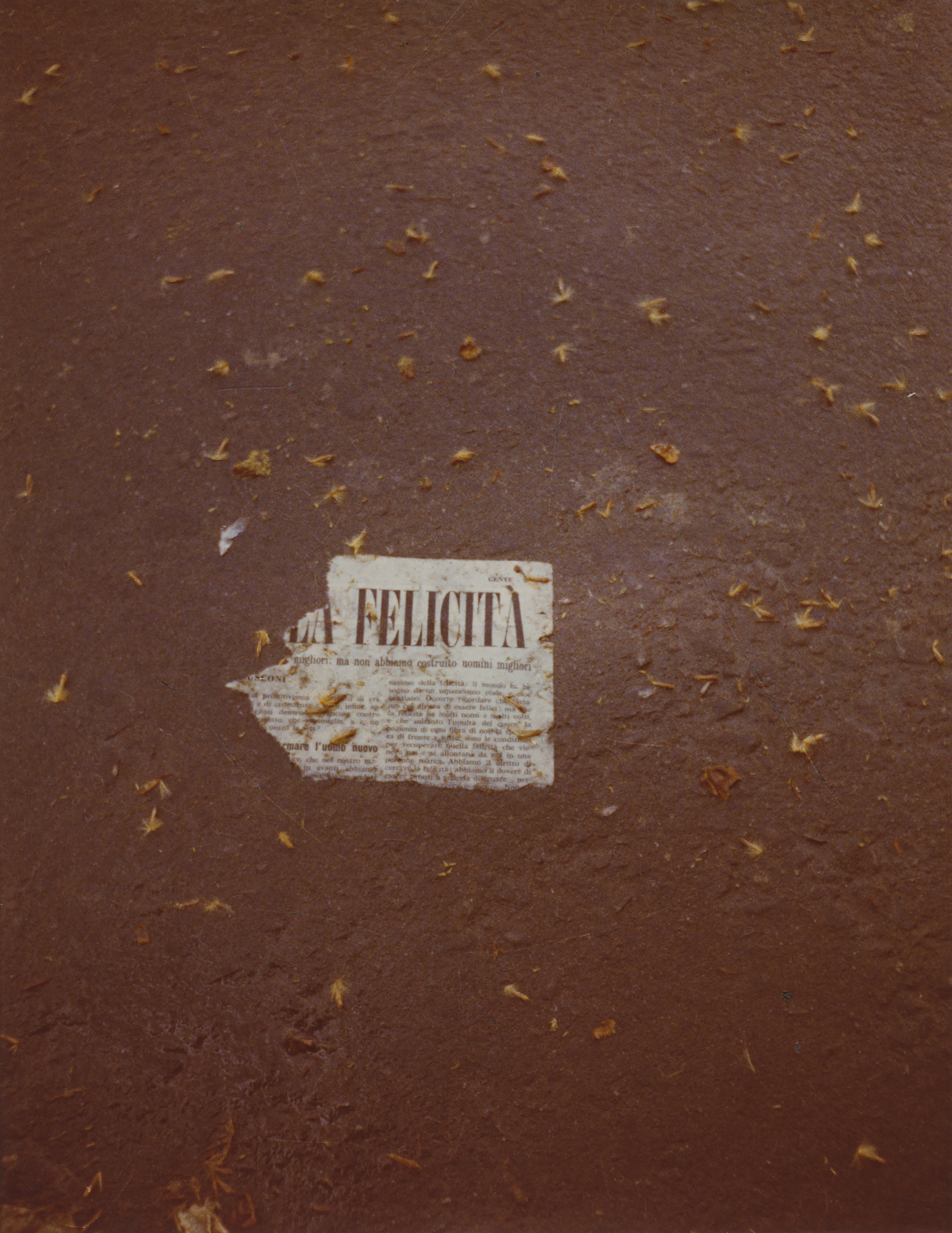
LUIGI GHIRRO "Modena", 1971. © The Estate of Luigi Ghirri. Courtesy Thomas Dane Gallery.