

By Keren Moscovitch, March 10, 2026.
Nona Faustine is best known for the series “White Shoes” (2012–21) in which she inserted herself, often nude, and always wearing a pair of white pumps, into public and civic sites in New York City to reveal the hidden histories of chattel slavery embedded in the city’s urban spaces. CPW also presents two other series, “Young Mothers” (1992–94) and “Mitochondria” (2008–16), through which a more complete vision emerges of the complex intersections of radical intimacy and politics in Faustine’s life and work.
The exhibition, through May 10, is noteworthy not only for placing Faustine’s major bodies of work in conversation, showing her trajectory and coherent vision. It provides her historical research on each site in “White Shoes”, and an audio library of commentary by Faustine’s sister Channon Anita, who is featured in the photographs and collaborated on their creation. The audio, as well as a series of behind-the-scenes pairings by the sisters, provides viewers with rich and valuable insight into the process behind the work, and the familial solidarity required for its making.
In “Young Mothers”, completed as an undergraduate, delicate silver gelatin prints show a closeness between the photographer and her subjects as they let her into the interiority of their domestic spaces and family lives. Fathers seem absent, highlighting the isolation of this young motherhood and particularly for women living in economically stressed conditions. However, other family members seem to hold up the space from the edges. In one striking photograph, Faustine captures the moment of a baby’s birth, its head emerging from its mother’s body as she is flanked by older relatives. Unlike the exhaustion, ambivalence and resignation that seeps out of the other photographs in the series, this image speaks of the familial bonds that are carried through generations, even in the face of conflict, fear and hardship.
On its surface, Mitochondria is the most personal of Faustine’s series, but its political power is no less potent. The photographs feature Faustine, her mother Queen Elizabeth Simmons, her sister Channon Anita, and her daughter Queen Ming, from Faustine’s pregnancy to the early days of Queen Ming’s infancy and through her early childhood. Images such as “Last of the Baby Days” (2011) and “Never Enough” (2010) reveal the closeness and love among this matrilineal group but eschew the cliches that can plague photography of intimacy. The females gaze confrontationally at the camera from personal spaces such as the bed, as in “Just Another Day In Motherhood” (2010), or the foyer of their home, as in “The Two Queens” (2011). Their bodies, arranged in stoic formality, carry physical and emotional weight. “Champion” and “Battle” (2011) both feature the artist bandaged with her fist raised, evoking her fighting spirit and pride. “By the Shore I Found Her” (2013) shows Faustine and her daughter on seaside rocks, echoing “Like a Pregnant Corpse The Ship Expelled Her Into the Patriarchy, Atlantic Coast, Brooklyn, NY 2012,” a photograph made for “White Shoes”. Repeatedly, symbols and narratives overlap in time, expressing the interplay between the personal and political in the work. The exhibition design is notable for its gallery within a gallery, echoing an architectural motif of an archway in the family’s home, the walls painted in deep burgundy. Carved African figures sit on shelves in the corners of the microgallery, sanctifying the space and contextualizing the work as produced by descendants of enslaved Africans. Their spirits are ever-present in the work and the family’s consciousness.
Faustine’s explorations of maternal Black subjectivity transformed in her final years into a cutting critique of the perceived neutrality of public space, peeling back the edges of public forgetting. In “White Shoes”, her body is a central figure, and she uses language in the form of long titles to coax out the hidden histories of the sites, the emotional resonance of a Black woman occupying the sites, and the poetic possibilities of a future in which Black histories are acknowledged and honored. The iconic “They Tagged The Land With Trophies and Institutions From Their Rapes And Conquests, Tweed Courthouse, NYC 2013” features Faustine naked, pushing against the enormous and immovable white marble pillars of the institution built over the bodies of enslaved people whose bones sit beneath its foundation. In the audio, Channon reveals that titles were often conceived collectively. One image features Faustine nude, reclined in a thicket of greenery, camouflaged by the play of shadows and donning an African mask. The photograph’s title, “She Gave Them Everything They Asked And Still They Asked For More, Brooklyn Botanical Garden, NY 2015” was written in collaboration with Faustine’s mother and points to the ways that Black women’s bodies have been instrumentalized, abused, and exploited for hundreds of years. Channon also reveals the pair’s negotiations with security and staff at various locations, through which Faustine attempted to assuage the concerns, anxieties and rules of authority while still taking what she needed from the sites---reclaiming, through her body and the photograph, places that had been built on the pain and suffering of her ancestors. The titular white shoes of the series remain intentionally ambiguous, and imply white complicity while asserting the purity, sanctity, and dignity of Black bodies. Nona Faustine seems to walk in the footsteps of both her African ancestors and their enslavers, embodying the exchange of labor for survival.
What My Mother Gave Me is as much a tribute to Faustine’s mother, as it is a posthumous tribute to the artist herself, who died before her own daughter reached adulthood, and who left so much to those willing to confront painful histories through her poetic lens. It is also a tribute to Channon and Queen Ming, who are tasked with carrying the legacy of these tremendous women, and to all Black mothers of the past, present and future.
Keren Moscovitch is a multimedia artist and scholar. She holds a PhD from the Institute for Doctoral Studies in the Visual Arts and is on the faculty of Parsons School of Design at The New School. Her volume “Radical Intimacy in Contemporary Art” was published by Bloomsbury in 2023.

Installation image "Nona Faustine" CPW Kingston, New York 2026. Photograph by Ryan Rusiecki.

NONA FAUSTINE “Ye Are My Witness,” Brooklyn, New York, 2018.

NONA FAUSTINE AND CHANNON ANITA "She was a culmination of all things in heaven and earth, how many times had she been here before, Seneca Village, Central Park, NYC", 2021, (diptych)

NONA FAUSTINE AND CHANNON ANITA "They Tagged the Land With Trophies and Institutions From Their Rapes and Conquests, Tweed Courthouse, NYC", 2013.
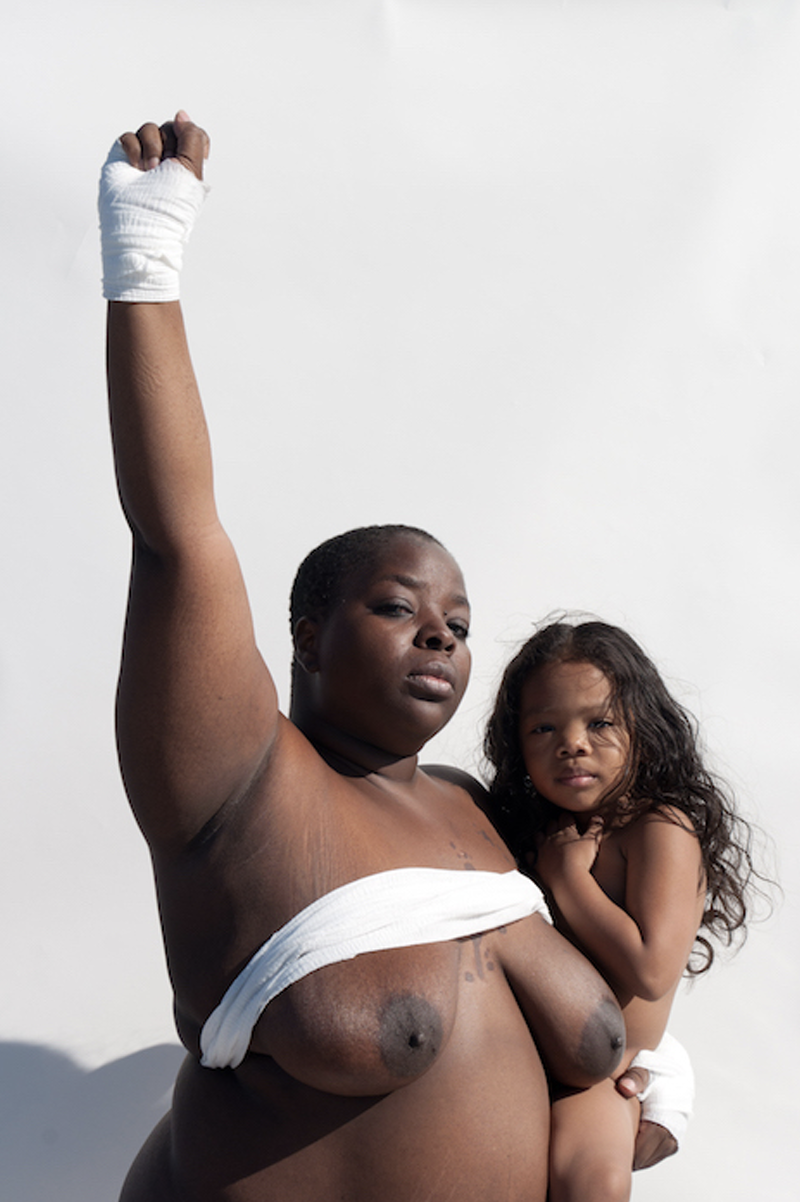
NONA FAUSTINE “Champion," 2012.