
By Caleb Stein ‘Curled Together as Foxes for Warmth’, April 10, 2026
When Emmet Gowin was sixteen, he came across an Ansel Adams photograph of a burned tree stump with fresh shoots sprouting from its base. He said, out loud, in a dentist’s waiting room: this is the Christ. He went home and borrowed the family camera. Gowin has spent the last sixty years making pictures as acts of spiritual attention, saved from contrivance or cliché by the depth of his intelligence and curiosity.
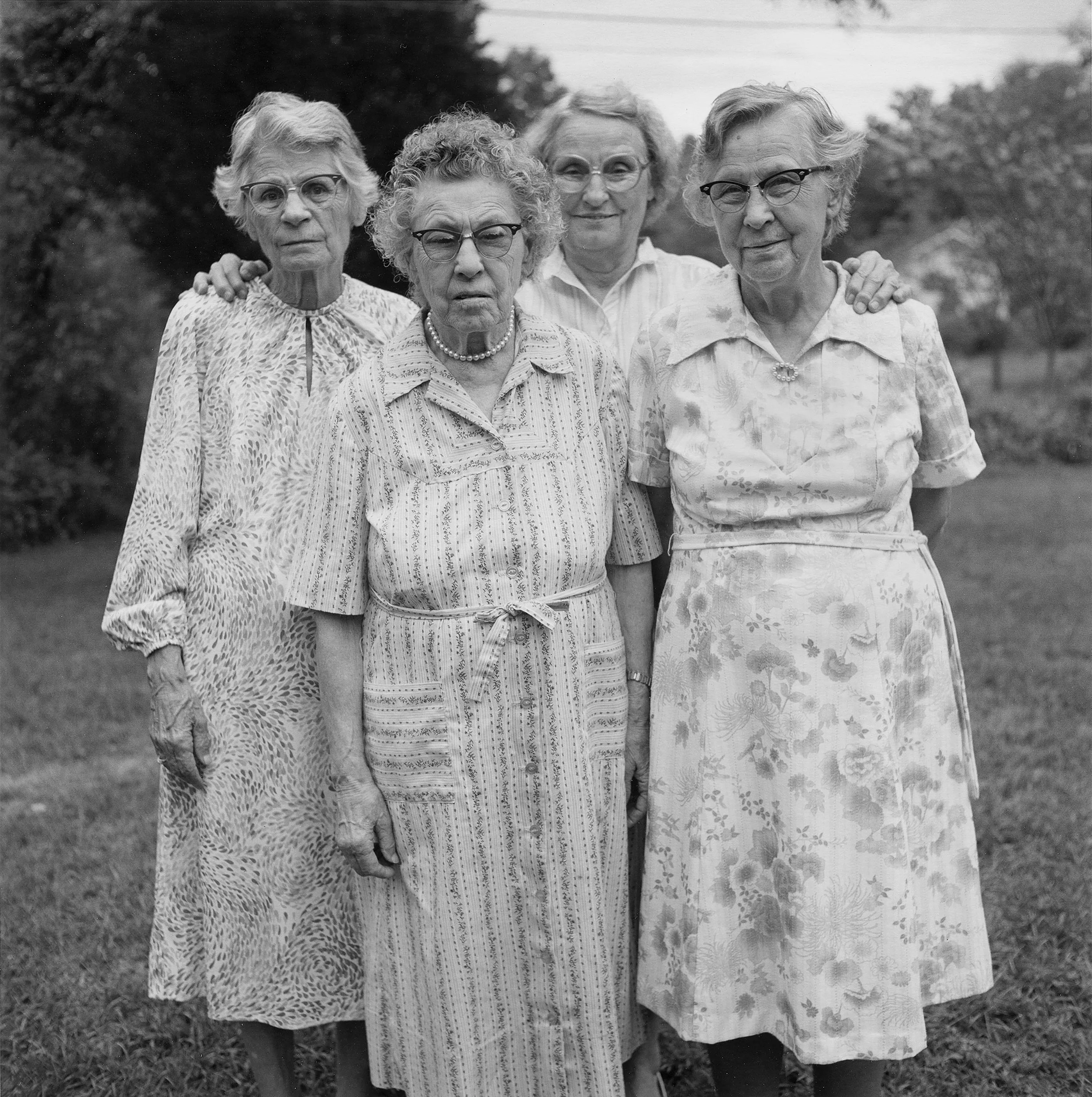
“Baldwin Street: Photographs 1966–1994” on view at Pace Gallery through April 26, depicts the family of Gowin’s wife, Edith Morris, at their home on a dead-end street in Danville, Virginia — the same small Southern city where both Gowin and Edith were born, about a year and a mile apart. Most of the photographs have never been published and were printed for the first time during the pandemic. In his written statement for the show, Gowin describes entering Edith’s family as entering “a family freshly different from my own,” and writes that he “thought of the pictures I made as agreements. I wanted to pay attention to the body and personality that had agreed out of love to reveal itself. My attention was a natural duty that could honor that love.” The night before I saw the show I revisited his 1976 Knopf monograph, which carries a dedication that reads: “To Edith: My mind and heart following her through gestures, rooms, and days. At night, we have curled together as foxes for warmth.” In a 2014 interview with The Guardian, reflecting on the public-private dichotomy of his photographs, Gowin said: “What's great is that the picture is already taken before it goes public. It's in secret. The trust that develops from such a habit engenders risk, and you realise you're not as vulnerable as you thought.”
Gowin studied under Harry Callahan at RISD in the ‘60s, and the comparison between the two men’s use of their wives as primary subjects is instructive. Callahan’s pictures of Eleanor are rarely about her. She’s a stand-in for his investigations into light, structure, the medium itself — a document of their love through the repeated presence she has across decades of his work, and through the gentle serenity of the pictures. But it’s Callahan’s love of the photograph that drives the enterprise. Gowin is more subtle and there’s more of a person present in his work than in Callahan’s — we see Edith first holding babies, sometimes pregnant, sometimes exhausted, sometimes in reverie, sometimes in the midst of household work or child-rearing. Gowin’s photographs of Edith carry within them an ongoing duration piece, notes on a wife and a woman, and a portrait of a half-century marriage.
Gowin uses the square format to balance clear-eyed description of surface with something dynamic. The exhibition’s framed prints— grouped into pairs, trios, fours, with the occasional picture rising a few inches above the standard hang line — become more complicated the longer you stay with it. A porch with a vertical hand-hewn wood beam slicing the view in half, a laundry line running along the middle forming a not-very-hidden crucifix. A boy sitting in front of a white-light television screen, his legs dangling from the sofa and mirrored in reverse by the slightly askew antennae. A pair of dogs looking at a dead bird hung outside on a screen door. These three, hung as a trio, open onto the different frames of one domestic space: partitions, death, unending curiosity. Gowin's photographs have a way of hitting a few marks at once. The dogs and the dead bird could be a detail from a Bruegel painting; the boy with the dangly legs next to the TV could have come from Friedlander's “Little Screens”; the porch with the laundry line crucifix could belong in a family album. In the top left corner of the photograph of the front porch is a small black shape, two overlapping hooked Ls with another black line, almost cut off by the top edge of the photograph as if it’s in movement. It could be wings, or a plane, or, now, a drone, and it is looking down on the scene; underneath a tree, directly below the hovering shape, are two children, playing, one reaching up, maybe to pick an apple. The photograph has enough to go on without religious mannerism.
Gowin writes that the work is “in praise of small things we all see.” Some of these small things are rendered magnificent through Gowin’s attention. Among these is a photograph of a young Edith and two children lying on a blanket with a delicately stitched series of braille-like bumps, topographies on a miniature scale that rise and fall with vivid detail. The tonality is so gentle and luminous that one can feel the morning light in that bedroom. Through Gowin’s lens the view of Edith and her children becomes a type of landscape, not dissimilar from his later, and much less hopeful, aerial views of atomic crater sites in Nevada, which, strangely enough, through his lens, double up as a portrait and a landscape. Gowin’s photographs move like an octopus caught in a short-circuit of expansion and contraction: it is his ability to see the enormous within the tiny without losing the tiny within the enormous. Next to it, Edith appears beside an older family member — her mother, perhaps — aged twenty years from one print to the next. In both pictures you feel, as Gowin writes, the trust and acceptance of the person who has agreed out of love to be looked at. Gowin’s photographs of Edith never seem particularly erotic, even in famous photographs like the one of Edith peeing on the barn floor (not in the show) that in someone else’s hands could be sexually charged. Instead, the photographs of Edith feel like an act of communing, extended throughout a lifetime.
The show has outlier moments that jar the domestic tenor. An enormous metal car bumper has landed in Edith’s Victorian bedroom — with its quaint oval frames and wainscotting— like a monolith from another planet. Edith is reflected in it, the patterns of the room warped across this enormous sheet of industrial metal. Even if we can place it as a bumper tilted up against the bed frame, it’s so out of place it feels like it could only have intruded from elsewhere. The surrounding pictures are ordinary: children playing in backyards, multiple generations hanging out together, a melon with a saltshaker on a porch. Elsewhere, Edith holds a ladder leaning against pure air — it has the levity of the Yves Klein falling picture. Across the gallery, a photograph of two men in suits talking in a well-kept graveyard, one facing us, portly, darker hair, the other facing away, wire-thin, white hair blowing in the wind, a lean in his stance, something passing between them that they’re not looking at each other to say. It could be a scene from a spy film, but it belongs completely to Gowin’s Baldwin Street.
Death and age and time have a way of sitting close to life in Gowin's work. Grandparents aren't just visited a few times a year — there's the sense in his photographs that three, even four generations of a family are inextricably linked. In “Crack the Whip, Danville, Virginia, 1966”, a child in the foreground plants their weight while a second child bows toward them, one hand extended, the other holding Edith, who leans toward us and the children both; upper right, two more figures hover, hand in hand. The figures lean into each other like a strand of DNA flexing, articulating itself. In “Family, Chatham, Virginia, 1981”, generations form a loose circle — a young man with big hair and tight curls tilts back precariously in a metal fold-out chair, his foot braced against an older woman firmly planted in her wood and weave chair, her head resting in her crossed arms; above her a man leans forward to readjust the shoe of a man lying on the bench, a young woman sitting on top of him, the circle closing back at the knee of the young man in the fold-out chair, his curls brushing against a dog, beside a woman looking out toward the mountain ridge and the tall grasses. Such different chairs in such a tight circle, with everybody angled toward another. Gowin’s photographs show no legible physical or emotional alienation, but they are filled with a sense of imminent loss, built into everything. Same with the photographs of dead animals that show up in Gowin's body of work — death isn't something slotted away into an assisted living facility or the refrigerated aisle at the supermarket. Gowin honors these cycles without flinching.
Gowin is 84. His best-known pictures from this period — the girl with the twisted arms, the two children next to birds, the two children embracing in the grass — are not in this show. But some of what is here is just as good as the pictures many of us know and love, and there is a legible tie between what we know and the new work collected in this exhibition. I do not think of Gowin without thinking of his most well-known photograph, “Nancy Wells, Danville, Virginia, 1969”. The photograph shows Gowin’s niece, her arms wrapped around each other, her hands holding two eggs, brushing up against a rough linen white shirt, Nancy’s head tilted back and eyes closed with a half-smile on her face, against a dark background, so that Nancy seems to be of the world but apart from it. Four years later, Gowin made another photograph of Nancy. The word haunted is overused, but it applies here. Nancy has come through the other side of a hole in a patchwork, decrepit blanket. Nancy has two sets of arms – one that rests below her waist, her hands clasped, one finger clenching a seam in the cloth. The other pair of hands is frenetic – one hand reaches up to scratch her eyes (half closed, almost rolled back), while the other hand cups around her ribs in a balletic gesture, with visible motion blur, and half the arm missing. Gowin writes about the photograph’s genesis in the exhibition’s accompanying monograph (Princeton University Press, 2025); we learn that the photograph is a composite of two negatives that Gowin put together, “borrowing the extra set of arms”. Gowin is exploring how to remake his best images, bringing wildly unconventional, digital processes into conversation with work (like the 1969 portrait of Nancy) often held up as a classical example of lyrical documentary, darkroom rigor. The photograph, like the exhibition, brings together epochs into something that reads as if it was just of that one moment. Perhaps one of the keys to this process is Gowin’s willingness to print negatives he could not previously see the value in, which is itself a statement about duration and reckoning. Every blade of grass and every stitch of cloth is rendered in exquisite detail, and the prints tend towards an upper tonal register without feeling washed out; these prints are not an afterthought. They show us the connection and the distance between the young man who made the work and the older man who printed it. The work becomes a document of these two lives. In the space between these two lives, lived by the same man, a reputation was built.
Sally Mann named her son Emmett after Gowin — the debt is direct. And yet Gowin’s reputation has never fully crossed into the wider culture despite serious institutional recognition: a MoMA solo in 1971, a Philadelphia Museum retrospective in 1990, the Morgan in 2015. That gap may have something to do with the quiet he trusts. Gowin belongs to a tradition of Southern image-making —William Christenberry, Ralph Eugene Meatyard, William Eggleston — but where those photographers embody the Gothic, Gowin reports on the South from a warmer remove. A photograph in this show of a man wearing a paper bag over his head next to a garden spigot could be Meatyard, but it's too playful, too affectionate. That's the difference.
One of Gowin’s final wall texts describes loading his Rolleiflex inside the house while the children played in the yard, running back outside quickly “concerned that I’d miss something important. On days when things were happening,” Gowinwrites, “I might be taking seven, eight rolls of film in one huge deluge of wanting to see.” Gowin is a man running toward what he loves, terrified it will be gone before he gets back.
Caleb Stein is a photographer who is represented by Palo Gallery in New York and Rose Gallery in Los Angeles, and who is also a part of Orejarena+Stein, a collaborate effort.

EMMET GOWIN "Crack the Whip, Danville Virginia", 1966 © Emmet Gowin, courtesy Pace Gallery
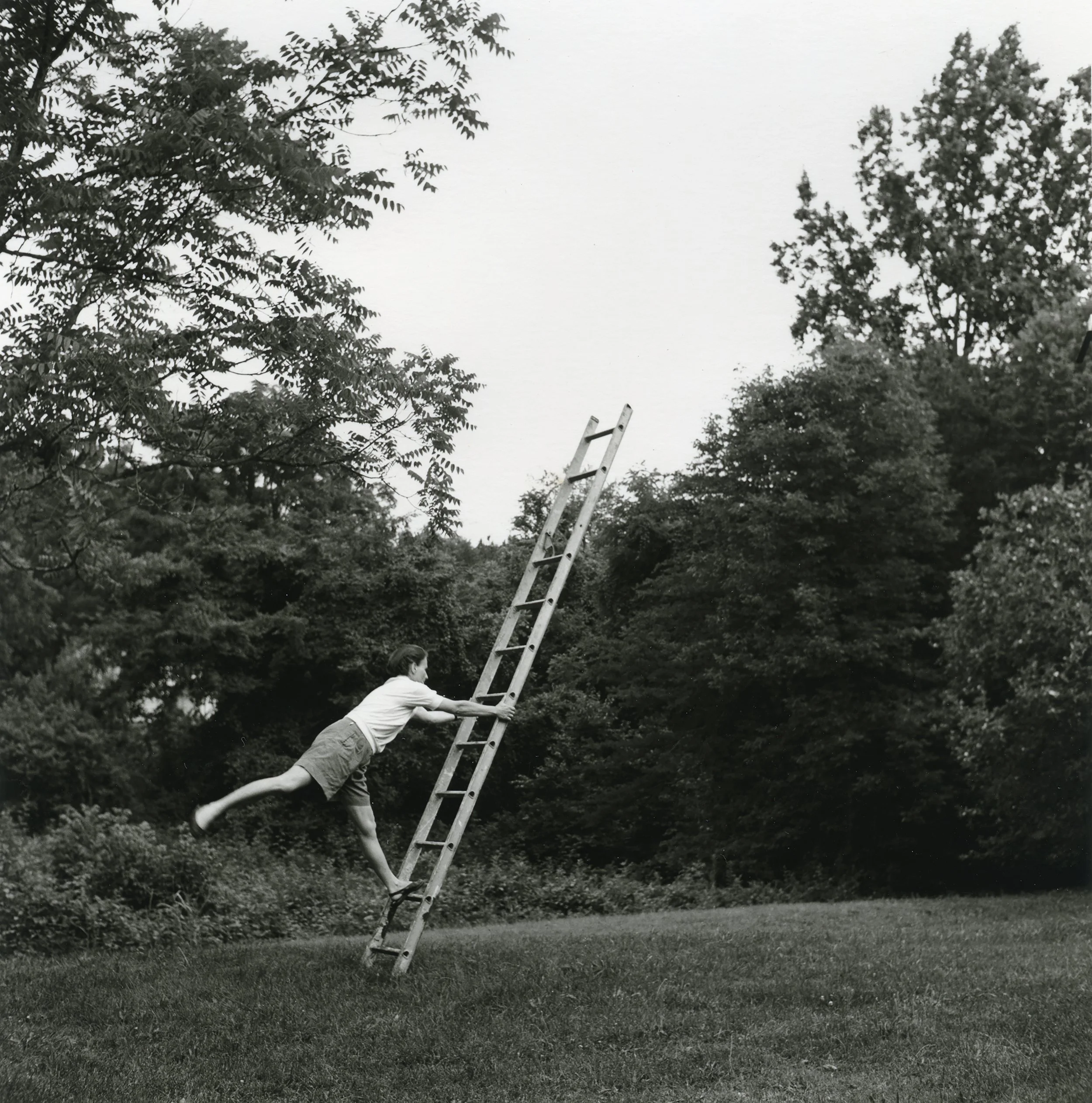
EMMET GOWIN "Edith, Danville, Virginia" 1991 © Emmet Gowin, courtesy Pace Gallery
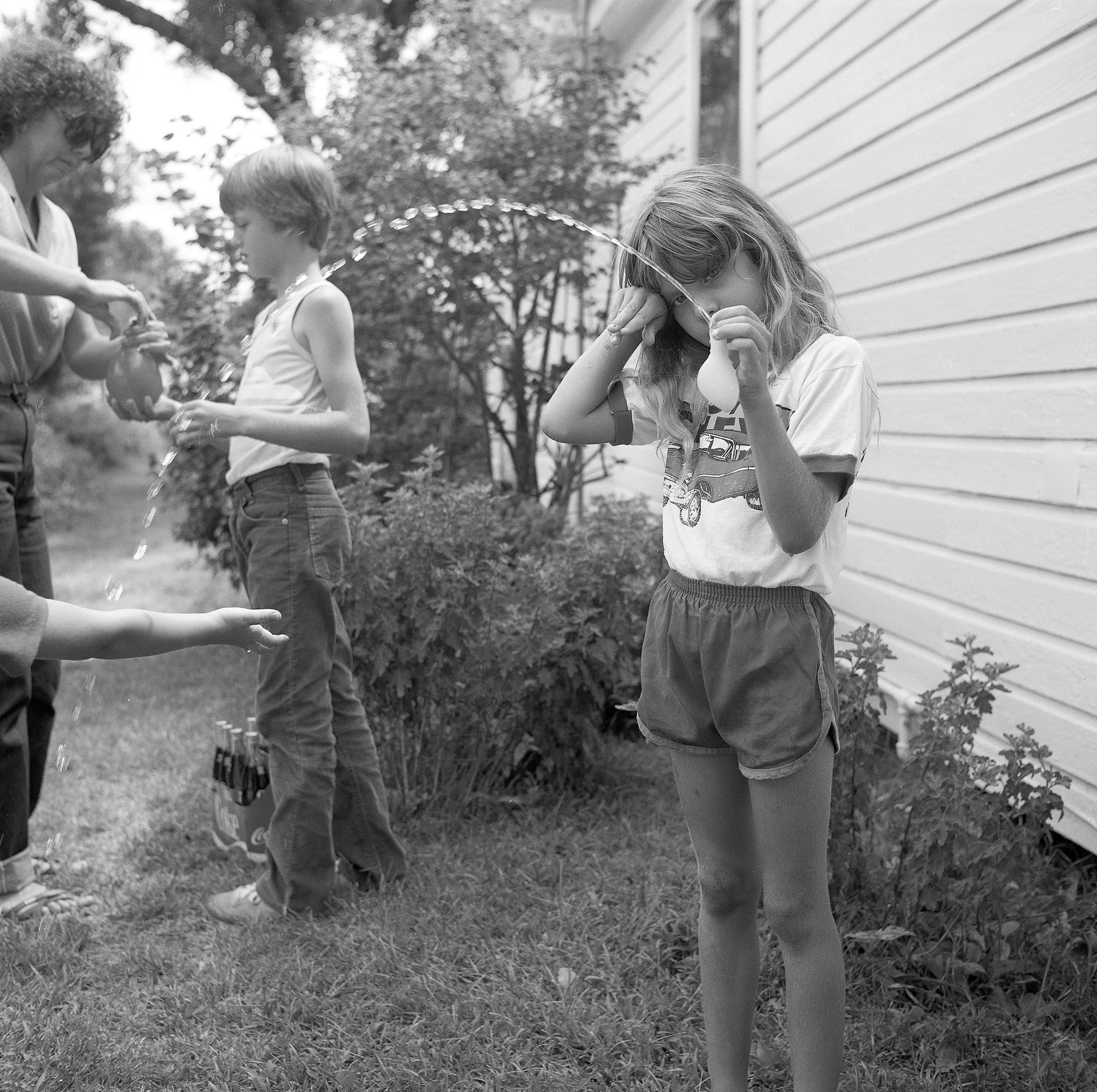
EMMET GOWIN "Family Reunion, Danville Virginia”, 1983. © Emmet Gowin, courtesy Pace Gallery

EMMET GOWIN "Luther, Chatham, Virginia" 1979 © Emmet Gowin, courtesy Pace Gallery

EMMET GOWIN "Nancy, Edith and Dwayne, Danville, Virginia" 1966 © Emmet Gowin, courtesy Pace Gallery