
By Jeffrey Whetstone, April 10, 2026
The complicated practice of representation in the form of portraiture is the subject of a surprising and powerful exhibition at the Hill Art Foundation in Manhattan. Forty photographic portraits from the photographer Robert Bergman are exhibited together with paintings and sculptures that span eight centuries of the practice of portraiture. The show is curated by writer David Levi Strauss, who faced the challenge of pairing old hand-wrought masterworks with machine-printed photographs. The confluence of modern photography and Renaissance painting in this exhibition not only works, but together they tackle big questions: who is granted the privilege of being represented? What is the relationship between the artist and the subject? How do humanistic and spiritual ideas like mercy manifest through the act of looking at portraiture?
All the works are borrowed from the expansive collection of J.Tomilson Hill, founder of the Hill Art Foundation. Bergman’s photographs were made between 1986 and 1995, and many of them were shown in concurrent exhibitions at MoMA PS1 and the National Gallery of Art in 2009. With a few exceptions here, most of the artworks that aren’t Bergman’s photographs are paintings from the Renaissance and Baroque period. The earliest painting in the exhibition is a fragment of a “Head of an Angel” by Duccio from the year 1280 that appears to be leaning in from a private alcove to see the show. Other highlights include “The Annunciation” from Luca di Tomme from 1360, a giant stained glass by Valentin Bousch depicting the creation and expulsion from Paradise from 1533, and “Portrait of a Gentleman” (who is most likely Velazquez) by Peter Paul Rubens in 1628. These works have the gravitas of objects that have survived the ruins of time yet still emanate radiant color and exacting form that for centuries have exemplified what mastery of a medium should look like. Entering the galleries is like walking into a Chelsea satellite of the European painting wing of the Metropolitan Museum of Art, which incidentally, lent a hand in designing this exhibition.
These great masterworks of the past do not take center stage, however. Robert Bergman’s work foregrounds the power of intimacy that is often lost in the historical aura of the old-fashioned art. Photographs like Bergman’s register all the markers of cultural immediacy and indexical truth. These photographs evoke the emotional weight of looking into the eyes of a stranger along with the kind of modern questions about representation, identity, and the extractive symbolism that have blessed and plagued the medium of photography since the first daguerreotype.
In theoretical terms, photographs that engage with the social-realist endeavor often camouflage an unbalanced relationship between photographer and subject. That imbalance is fundamental to modernism and the economic access to the technologies of representation. The critiques of power and class espoused by such work are built upon the power that the artist holds in representing the dispossessed, so the argument goes. The textures of poverty move the viewer into a kind of empty empathy: Susan Sontag argues in On Photography, “gazing on other people's reality with curiosity, with detachment, with professionalism, the ubiquitous photographer operates as if that activity transcends class interests, as if its perspective is universal.” This certainly seems an accurate way to describe Bergman’s images, but it is only a small part of the experience of witnessing his work.
I remain haunted by how deeply moved I was by these images of anonymous people with enigmatic expressions; the faces that draw you in like a spell, bathed in light and imbued with color. They are cemented in time but seem otherworldly – like saints yet to be deified. The narratives of their lives are written across the details of their skin, clothes, and expressions.
Toni Morrison wrote a story about her experience looking at a Robert Bergman portrait for the introduction of his 1998 book, “A Kind of Rapture”. In “The Fisherwoman”, Morrison imagines meeting a woman Bergman photographed. She went from being alarmed by a trespasser to romanticizing the stranger. She realizes that she made the woman a character in her own internal story, a type of ownership over the Other. “In the admonition of a prophet and the sly warning of an artist, strangers as well as the beloved are understood to tempt our gaze to slide away or to stake claims.”
As the story morphs into an essay, Morrison comes to reason that regarding the stranger in photographs like Bergman’s is to understand that she “was longing for and missing some aspect of myself, and that there are no strangers. There are only versions of ourselves, many of which we have not embraced, most of which we wish to protect ourselves from.”
Curator and art historian Joachim Pissarro said of Bergman’s subjects, “They aren’t subjects. They are almost authorial, or co-authorial” As authorial, theses strangers have a particular representational power that can make us reflect upon ourselves like Morrison does.
What makes a viewer, as Morrison suggests, reflect upon themselves in front of these Bergman portraits? Is it that these photographs in this exhibition are paired with religious art? Do the old paintings make us think about how time has played out between when they were created and Bergman’s now? Or is it something Bergman does artistically to achieve the notion that the subjects have authority over their image? In this show, it is all of these, and David Levi Strauss deserves credit for turning the precious white cube of the Hill Art gallery into a place of solemn contemplation on portraiture.
Formally, Bergman’s portraits are made from a very close perspective. The head and shoulder depiction is roughly life-sized, and the subjects’ faces all but fill the frames forcing attention onto the subjects’ expressions. Rarely is there any grounding information in the background that may offer a sense of location or any other identifying details. The faces, however, contain a lot of specific details and information that compel the viewer to read into the lives of the people depicted.
In one portrait from 1991 (none of the subjects of Bergman’s portraits are named, nor are the images titled) a man with closed eyes and a sun-burned face is depicted in front of a blood red background. His eyes are cinched shut, his mouth agape, his forehead knotted; like he was reliving an agonizing memory or reveling in ecstatic vision. It is a dramatic expression. He has blemishes on his forehead. It isn’t acne, or eczema; they are small, fresh wounds. Are they from a fall? Or from beating his head against a wall? Is he a drunk? Or in penitence? Or both?
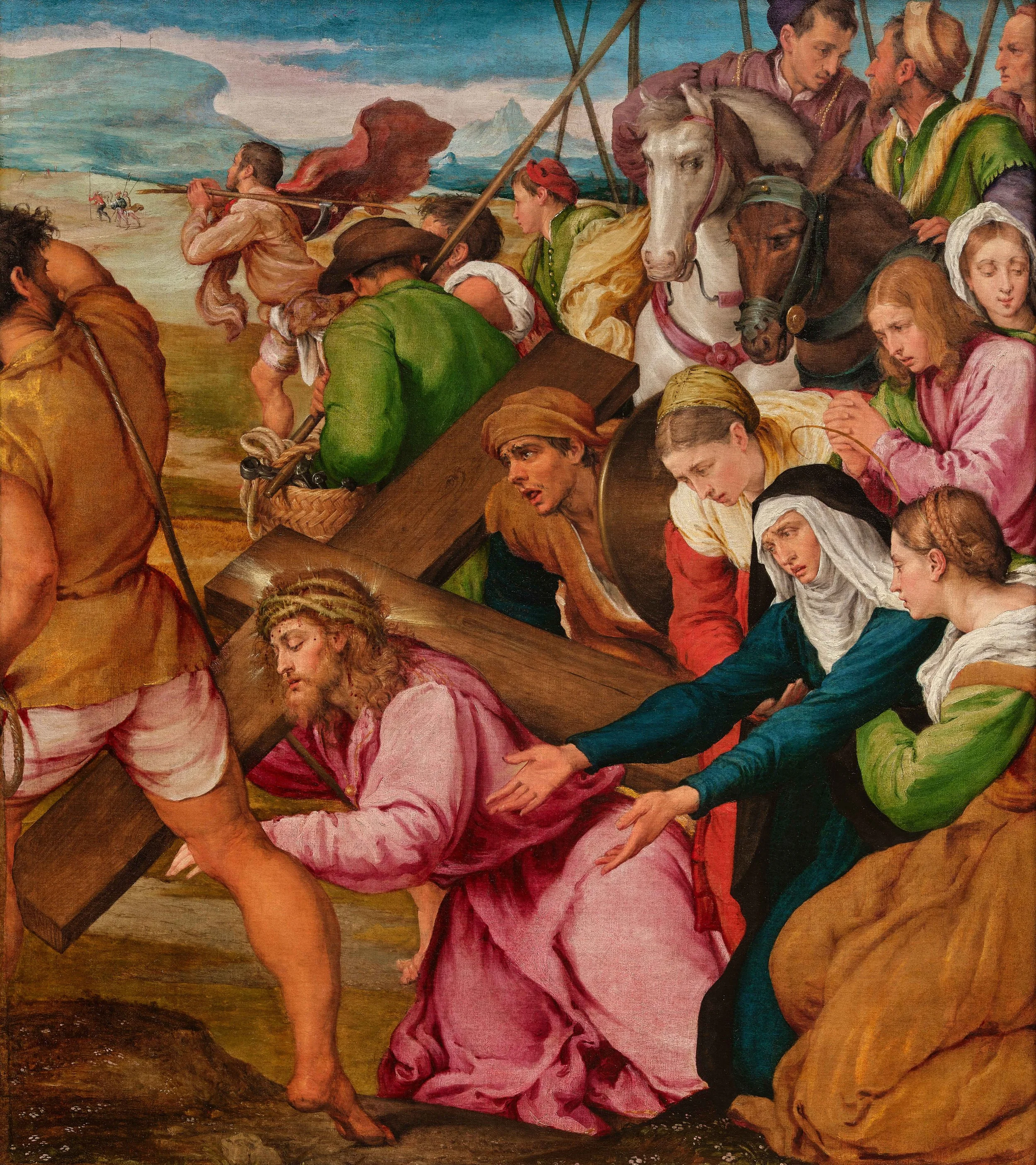
These head wounds aren’t so different than the tiny points of blood dripping beneath the crown of thorns on Christ’s forehead in Jacopo Bassano’s 1542 painting, “The Way to Calvary”, displayed nearby. Bassano depicts about a dozen faces in the crowd leading Christ toward the crucifixion. A Roman soldier occupies the very center of the picture. His face is flush, clinched, his mouth agape, something like agony is conjured through Bassano’s depiction of his face. The soldier “could be a Bergman subject,” Levi Strauss writes in the catalog that accompanies the exhibition, “wearing everything on his face…” These dramatic expressions in “The Way to Calvary” have context – the rocky landscape, the heavy cross, the three Marys. The New Testament gives us a dramatic universe in which these expressions are expected. We know who the characters are, where they are, and what they are doing.
Bergman’s portraits are anonymous and devoid of context, yet flush with specificities and fluid with the power of abstraction. The blurry backgrounds do a lot of the work in these pictures. Bergman fills the background with saturated color, hues that intelligently rhyme with details of color present on the body of the subject. In one image, a purple background complements the woman’s sickly bluish lips. That background hue helps us read the blue lips and seeds a narrative for the viewer. Background is rendered with such surety that the figures emerge as if they are a part of them, like prophecies emerging from dreams.
In the photographs, there are no mysterious shadows hiding the subjects. Their faces are graced with open soft light that make their expressions readily legible. Every detail is revealed. Everyone photographed has an internal story told on their faces. It is easy to be swept up, like Toni Morrison was, in the romanticization of prophetic strangers and sidewalk shamans, or just people going through existence.
The process by which these prints were made is a kind of modern antecedent to how the paintings were rendered centuries ago. These images are made from a professional inkjet printer that has been modified to allow for “multiple impressions with various isolation coats of conservator chemicals,” after which the prints were subjected to “hand-applied micro-crystal and waxes over the isolation coats."
Instead of pressing command-P and sending the output print to the framer, Bergan builds up a print in layers with light washes of ink, so that every color is controlled independently and constructed over time – much like methods of Renaissance painters, expect using ink instead of paint, and a machine instead of a hand. The method allows for color to be added sequentially, and the palette to be controlled and improvised. For instance, Bergman can lay another thin layer of red on the skin, and blue on the background, then build and alter those tones through multiple passes until he feels the work was complete.
The process is impossibly time consuming and requires a great deal of engineering and like a Renaissance painting workshop, relies on a team of innovators. The result isn’t consciously perceptible, except for a “wow” factor of how the prints seem to be richer than normal. The way the photographs look next to beautifully restored paintings without any deleterious effect makes Bergman’s obsessive attention to density, hue, and saturation evident.
The photographs fall short when the balance struck between photography and painting tilt erratically. When colors stretch beyond realism, the social-realist stance of the images gets infected by idealization of the subject – for instance, the blue in the eyes rendered too saturated for belief. In such cases, few but noticeable, the image becomes more of a spectacle of portraiture than a meditation on personhood.
Bergman portraits can be viewed as a political statement, aligning with social realism and class-conscious documentary approaches that have been a hallmark of the language of photography since the medium’s inception in the latter part of the industrial revolution. Many of these portraits were made in the rust belt of the late eighties and early nineties, ground zero for such efforts to examine the individual effect of American capitalism. But Bergman warns us against such readings revealing that in the collection, "there's a housewife, there are three artists, there are two actors, an affluent owner of a bar; there's the son of a millionaire and the granddaughter of a billionaire."
It is difficult, and indeed, diminishing, to the exhibition and to Bergman’s portraits to look beyond the subject of class and representation. Even though Bergman says, “I am not a social scientist, I am not a do-gooder, I am not a documentarian,” his presence on the street, finding strangers with the kind of wear on clothes and in their faces that articulate economic challenges, describing people not so differently than how Walker Evans photographed Annie Mae Burroughs in Hale County, Alabama for the Farm Security Administration in 1936, inflects the images with social and economic commentary regardless of his intentions.
In the context of this exhibition, heavily weighted toward Christian art, Bergman’s portraits remind us that the New Testament of Jesus’s teachings focuses on class, poverty and humanizing the disposed with undebatable directness: “Blessed are the Poor for they shall inherit the Kingdom of Heaven”. The Baroque paintings also represented in the exhibition: “Portrait of a Gentleman”, “Portrait of a Nobleman”, and “Portrait of a Young Man in a Red Cap” collectively pose the question around class —who is granted the privilege of representation in the centuries that predated the daguerreotype? It was those anointed by God, or those born into wealth. Bergman makes it clear that anyone deserves to be represented powerfully and articulately —a belief that is summed up by the late Pope Francis as referenced in the extensive wall text for the exhibition, “Art must not discard anything or anybody. It is like mercy.”
After spending time with all the portraits, I found myself thinking about my position in this exhibition. Toni Morrison writes that we tend to “back into our own mirrors” when contemplating portraits of the Other. And my own perspective: one of present privilege, researching this rare art for this review standing in a beautiful jewel box of a gallery regarding 600-year-old masterworks on new walls painted a radiant blue that only the Metropolitan Museum of Art could muster.
Behind the subtle and particular blue wall were panes of glass that offered a view down Tenth Avenue on a beautiful spring day; a fantastically expensive zip code that month by month is home to some of the most valuable contemporary art in the world. The highline overhead was full of flaneurs.
Glaring on ground level across 24th street is another radiant blue wall. The Tenth Avenue Carwash. Been there forever. Before the highline, before the galleries, when the neighborhood was all auto repair and warehouses. Its façade would make a good Bergman background. Lapiz lazuli. How has it survived? Perhaps by the same way that some of Bergman’s characters have, by persistence born out of belief.
Jeffrey Whetstone is a photographer, writer, and educator. He received a Guggenheim Fellowship in 2008 and is a professor in the Visual Arts Program at Princeton University.

Installation view: “The Lost Beauty of Humankind Robert Bergman's Portraits in the Hill Collection”. Hill Art Foundation, 2026 © Hill Art Foundation.

JOOS VAN CLEVE, “Portrait of a Nobleman with a Beard”, 1525–1530.
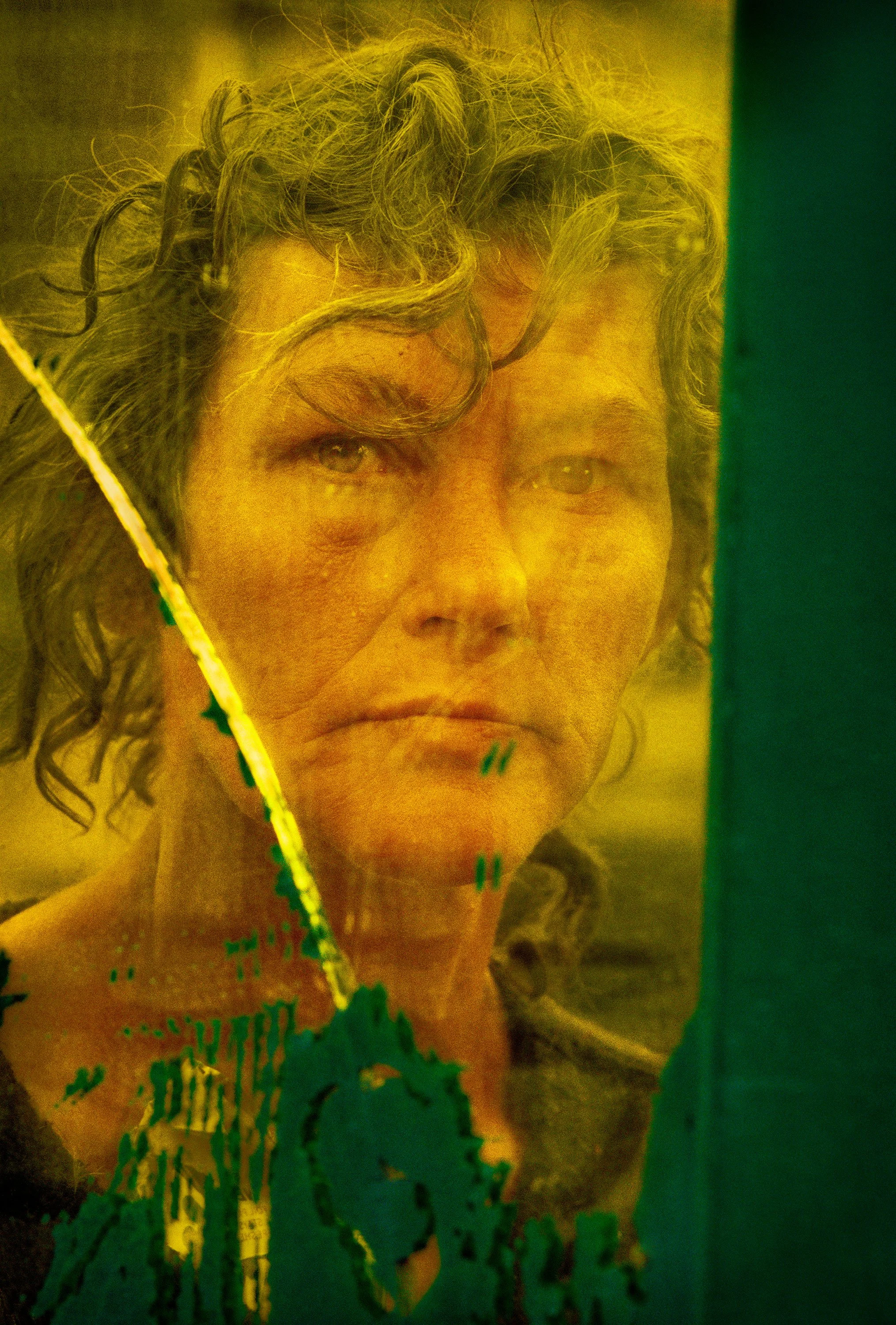
ROBERT BERGMAN "Untitled" 1989 © Robert Bergman.
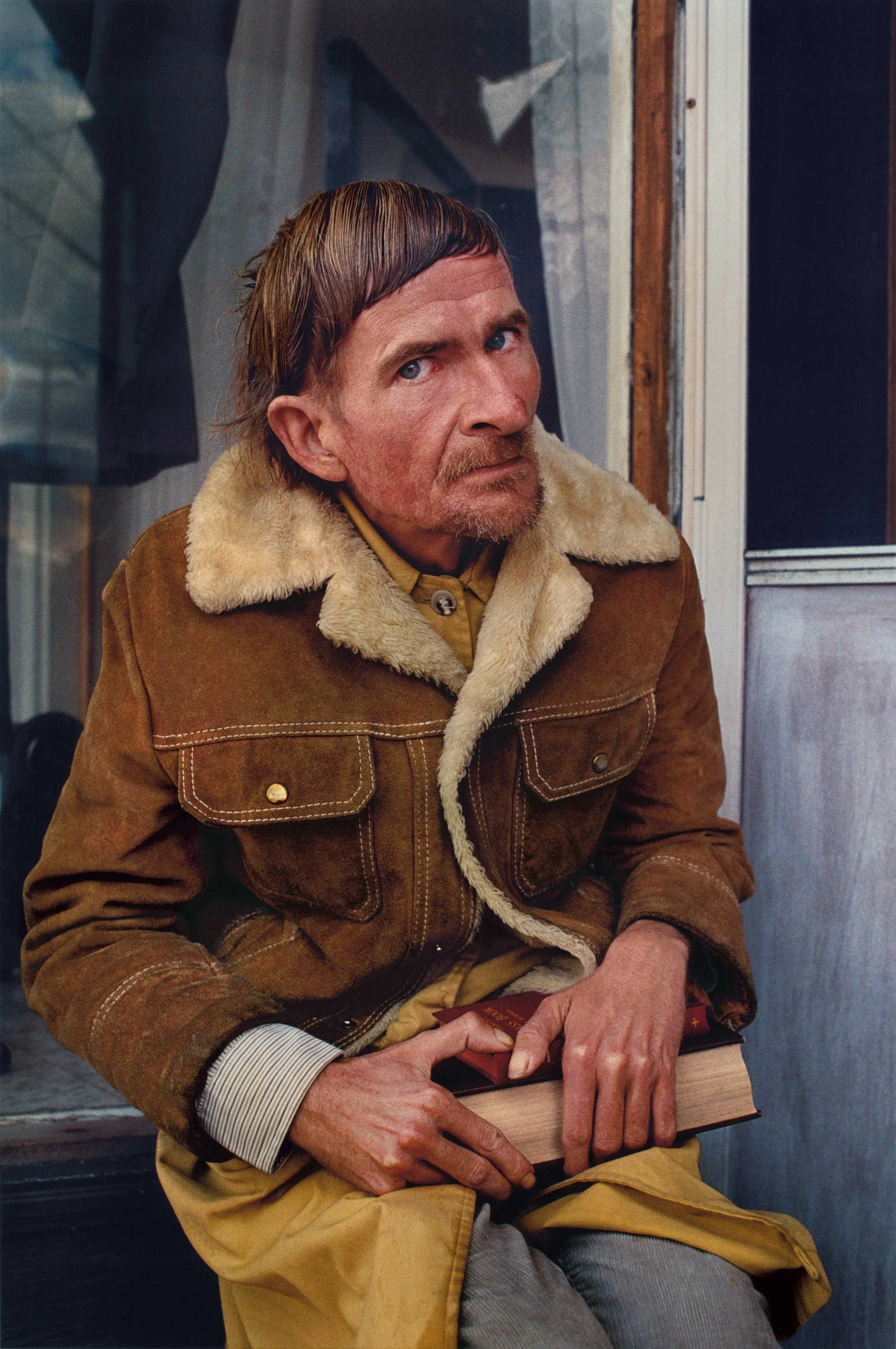
ROBERT BERGMAN "Untitled" 1989. © Robert Bergman.

WILLEM DE KOONING "Clamdigger" 1972. © 2026 The Willem de Kooning Foundation / Artists Rights Society (ARS), New York.