By Danielle Ezzo, “Blinking in and out of Existence: From First Living Woman to FLW” June 10, 2026
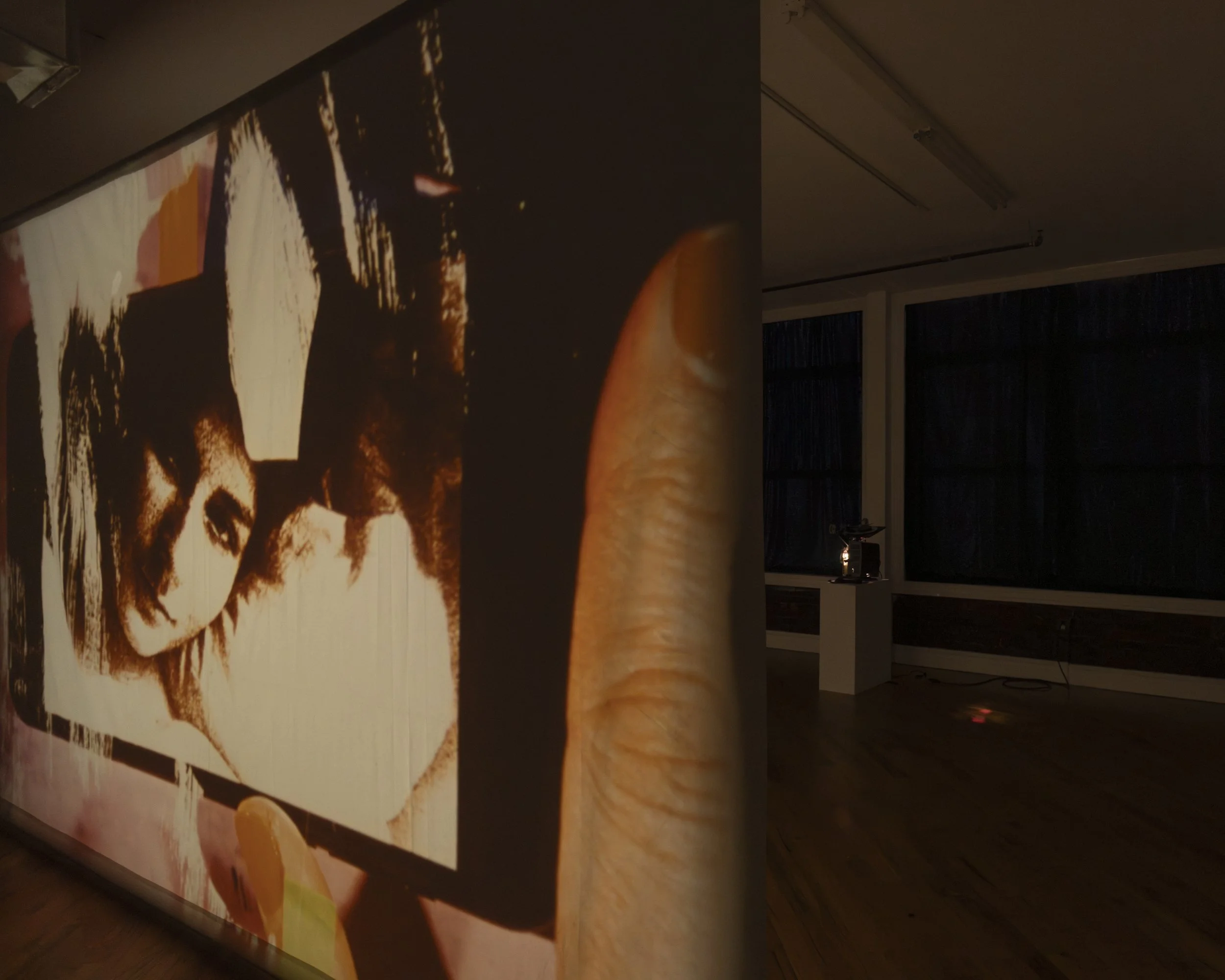
The elevator doors open, and I step into the darkened room of the David Peter Francis gallery. A single ceiling-height screen divides the room. I can’t see anything besides the illuminated scrim and the projector behind it. Is this all? I ask the gallerist, who sits just out of my view. Yeah, he says, gesturing for me to take the empty chair next to the projector.
Carrie Schneider’s FLW is one of three sibling works, including her installation at this year's Venice Biennale and the recent Independent Fair booth. Each references the same source material, an eight-second sequence pulled from Chris Marker’s 1962 film “La Jetée”. This is all I know for now. I’ve intentionally come to Schneider’s work blind. I watch what appears to be a stop-motion montage of analog film stills with a black-and-white portrait of a woman at its center. The frame around the portrait flickers through graphic compositions, emblematic of analog chemical processes. A set of fingers creep in from the lower edge of the frame, hold the portrait down. They dance in color along its edges momentarily until the screen goes black before looping once more.
It happens subtly at first—did the woman blink, or had I? Against my inclination, I keep my eyes open longer to confirm my suspicions. Then, again. Another blink. Perfectly timed to my own bodily rhythms. Only after the film takes three full cycles do I notice the woman’s face also drifts, chin slowly turning downward in slumber.
At the Venice Biennale, “First Living Woman” is a one-kilometer-long chromogenic photograph, the largest ever, stacked across three steel tiers to the ceiling of the Arsenale, each frame of Hélène Châtelain, the actress centered in each of the works, exposed onto a continuous roll of paper with a room-sized camera Schneider constructed herself. Here, though, in this Chinatown space, the photograph has been rephotographed onto Super16mm film.
In the original film, the moment is described as "an extraordinary epiphany” by Time Out in the 2014 review when Châtelain’s face animates because it’s the only sequence in the entirety of the film constructed almost exclusively of optically printed photographs playing out as a photomontage. Marker leads into it with dissolves between frames rather than the hard cuts that deceive the viewer’s eye and leave me wondering whether what I’m seeing is actually in motion or serialized still images.
Chromogenic paper, as what is presented at the Independent Fair and the Biennale, is the standard of the analog index. Light leaves its trace on scrolls of emulsion through optical projection, which reads as the photographic act in its most classical sense. But the light hitting Schneider's paper is the light of a screen showing a JPEG sequence whose relationship to Châtelain's 1961 face is already mediated by codec, by compression, and the distribution networks that put pirated stills within proximity of any artist's phone. The photographic index is doing two things at once. It is a material record, but also a cultural one.
This is the premise the installation presses on, and it’s sharper than the prevailing critical line on Schneider's work, which tends to celebrate her as a worker of material elasticity and execution at a colossal scale. Chris Marker's photo-roman already troubled this binary by making cinema out of stills, and by treating the still as the ground of cinematic time rather than its absence. Schneider takes Marker's trouble and adds recursion. The 16mm projection in the gallery is, technically, film of a photograph of a film of a phone of a film.
It bears mentioning that Hèléne Châtelain was 26 when she made “La Jetée,” and it remained her only role of note as an actress. Her work as a filmmaker, translator, and writer is worth lingering on, too, because it clarifies why Schneider settled on this footage in particular. Châtelain spent decades on the other side of the camera: as a collaborator of radical playwright Armand Gatti, her documentaries on Soviet dissidents, translations from Russian, and, most pointedly, her work on the 1975 prison film “Les Prisons Aussi”, made for Michel Foucault's Groupe d'Information sur les Prisons. That she is the face Schneider chose to resurrect, an actress whose own creative life was largely spent giving image to the effaced, is notable.
Koyo Kouoh, the Swiss-Cameroonian curator who was the first African woman invited to lead the Venice Biennale, died suddenly last May, aged 58, and her team carried out her project posthumously. The exhibition is, as Wallpaper noted, "perhaps unavoidably, steeped in mourning." Schneider is among the 81 artists who withdrew from the Biennale competition in solidarity with the jury Kouoh had selected, following protests over the inclusion of Russia and Israel. This happened in the weeks immediately before FLW opened. Given Châtelain's lifelong political documentary work and the landscape Schneider is now operating in, FLW reads as an extension of that politics: a commentary not only on the divide between analog and digital, but on a sociopolitical one. Even the title of this installation, FLW, is shorthand for “First Living Woman”, pointing to various forms of collapse over time.
Danielle Ezzo is an interdisciplinary artist and writer. She is the author of “If Not Here, The Where?” published by Silent Face Projects in 2023, and is on the faculty of ICP.
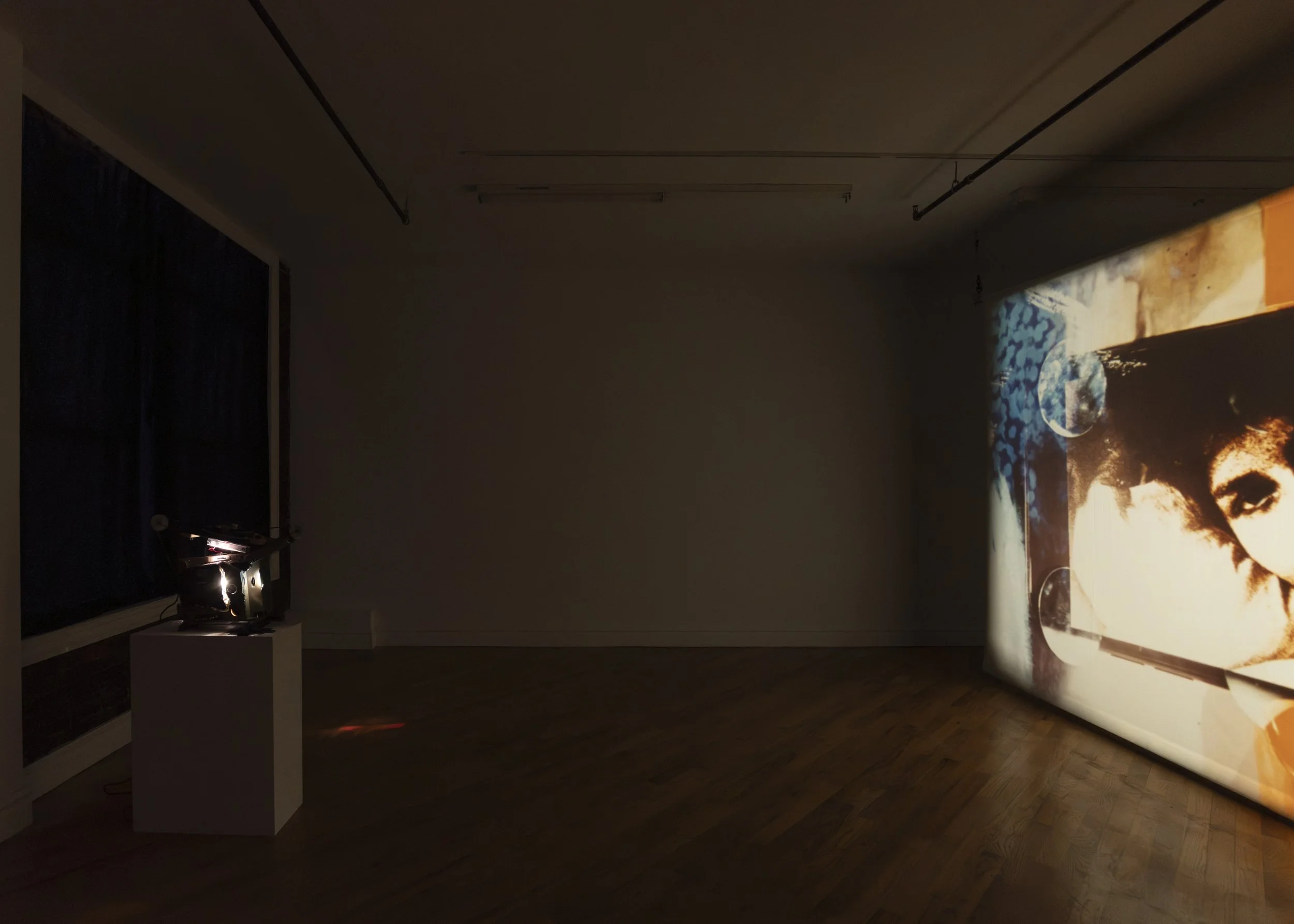
Carrie Schneider “First living Woman” 2026
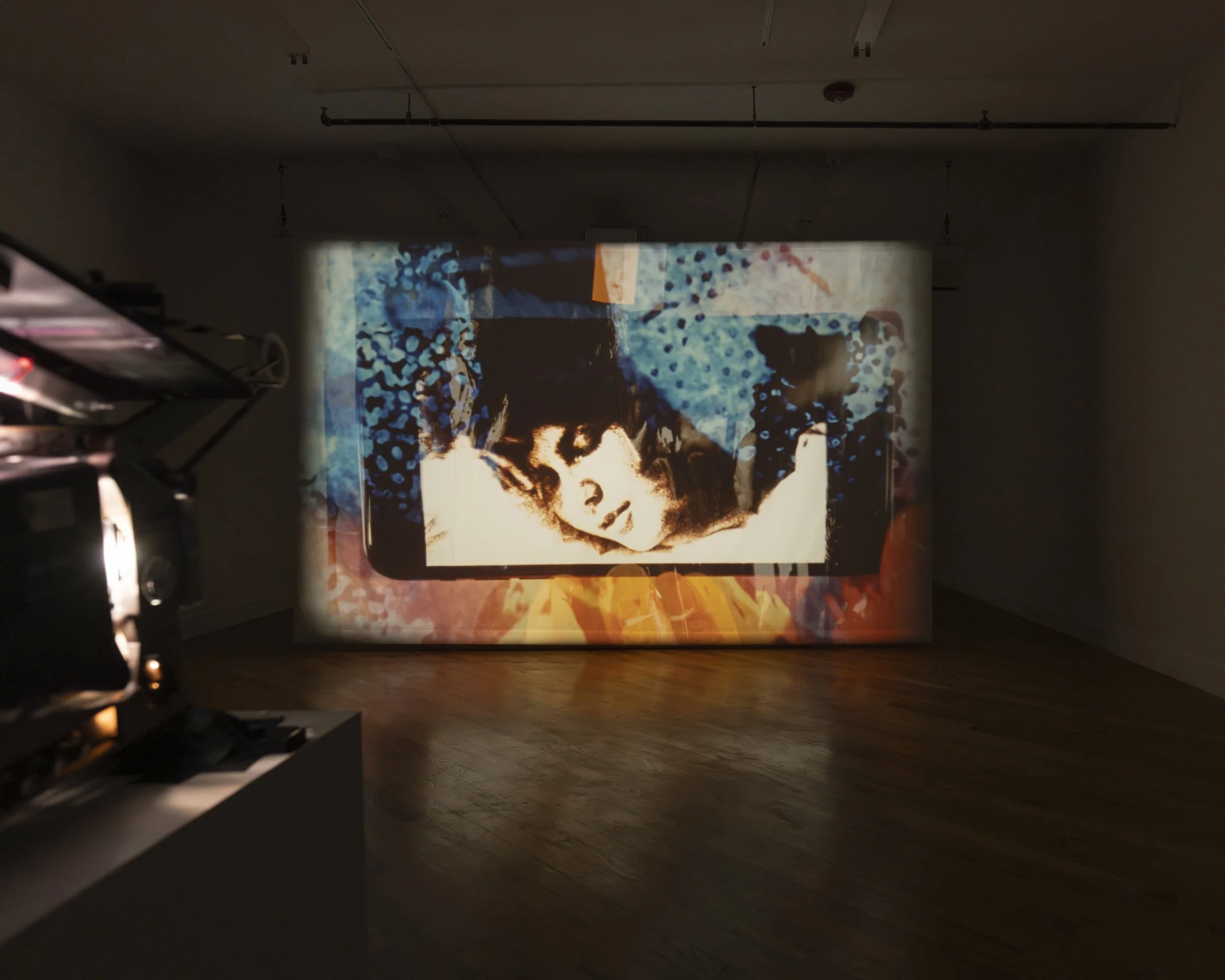
Carrie Schneider “First living Woman” 2026
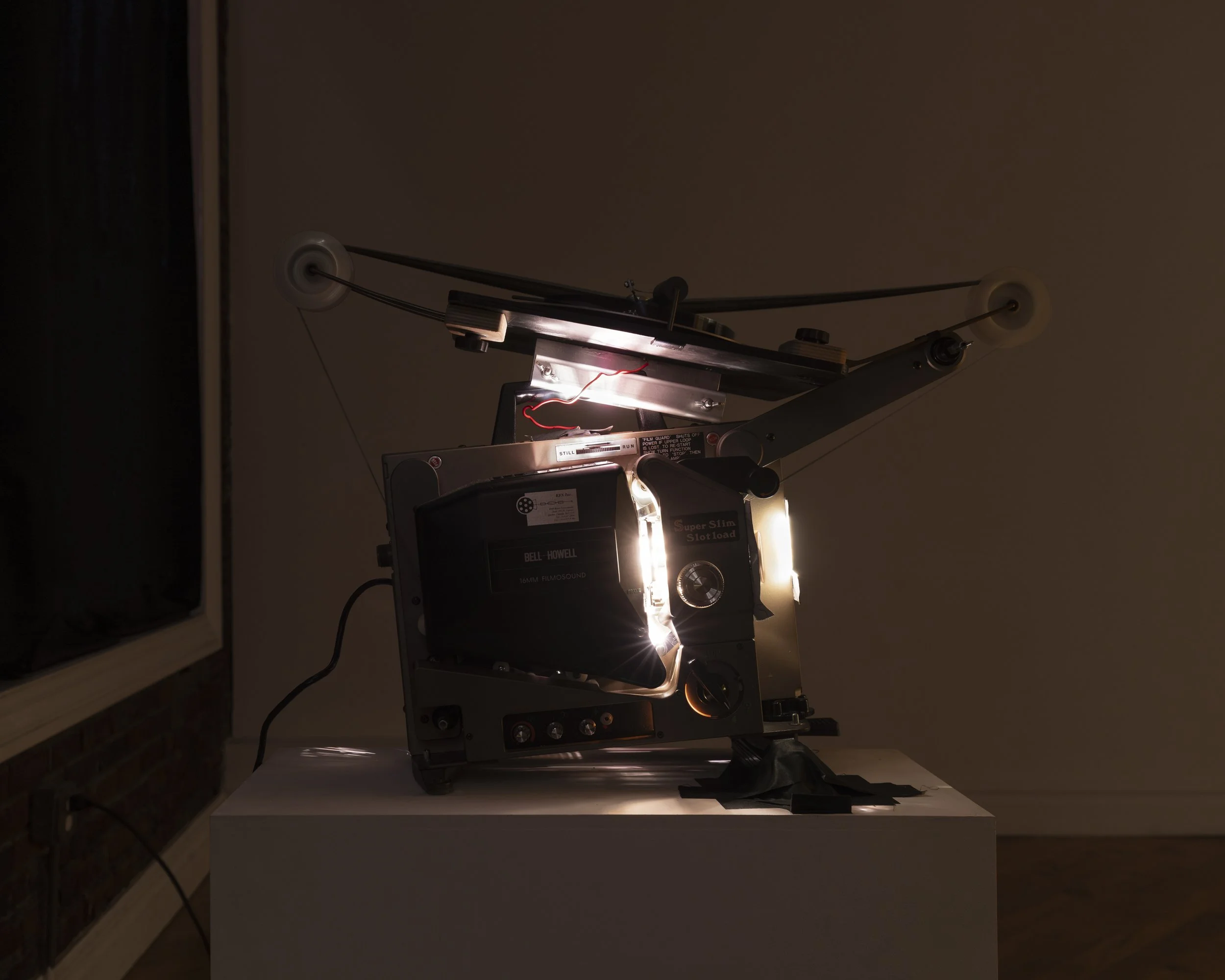
Carrie Schneider “First living Woman” 2026