
By Marcus Civin, June 10, 2026
Sophie Rivera passed away in 2021 at the age of eighty-two, but "Double Exposures," now at El Museo del Barrio-the artist's first museum survey- is still something of a homecoming. Over a fifteen-year span from 1979 to 1994, the museum exhibited the Nuyorican photographer eight times, including a solo show in 1986. The new survey is overfilled and sometimes uneven but largely revelatory. Curated by Susanna Temkin, Interim Chief Curator at the museum, it includes nearly 200 photographs-mostly black-and-white prints from the 70s and 80s made in New York City. The title of the exhibition can be read as a reference to her intersectional identity as a woman of Puerto Rican descent. As well, the most recent works in the exhibition, the series "Two/Two" (1995), are double exposures in which children on a playground look fragmented or magnified. In "Shoulder to Shoulder" (1995), one work from the series, a boy lying at the end of a tunnel has two heads and four arms. Through the exhibition, Rivera herself comes into view as if she were simultaneously two artists: one a portraitist, photojournalist, and street photographer, the other exploring abstract, intimate, and conceptual terrain, as all of these modes were part of the photographic discourse of the time. “Double Exposures” resonates with Hiram Maristany's documentation of the Puerto Rican Civil Rights group, the Young Lords, Ming Smith's blurred photographs, and Eleanor Antin's “Carving: A Traditional Sculpture” (1972), her chronicle of weight loss through daily nude portraits.
Rivera excels at the deceptively simple photograph. She transformed subway cars and a restaurant near her Uptown Manhattan home into impromptu portrait studios. In "Untitled", from her "Latino Portraits Series" (1978-79), a woman centered in frame and dressed for the office sits tall and alert, hands resting lightly in her lap, head cocked slightly to one side, lips pressed firmly together. She seems like someone who's open but knows boundaries. In the series, Rivera treats men, children, and other women she recruited on the street similarly. She darkens the background so that light focuses on the sitter and splashes off their shoulders. Their portraits are crisp (tense, even), restrained, and dignified but not grand. In her lifetime, Rivera would tell a tale about photographing the sitters in her apartment studio rather than a restaurant, as if to establish, by shifting the location, a closer tie between her and the people she photographed. In 1989, the result of a commission, six large-scale versions of these photographs were installed at the 161st Street-Yankee Stadium subway station. A more adventurous retrospective would have re-engaged this work in the public sphere outside the museum. In a statement about the project, Rivera said, "I'm excited about the possibilities of the general public coming out of the subway and seeing portraits of people like themselves and being able to look at them from their own personal perspective."
A few works in the show are less compelling than others. Some of the on-the-spot photography is underwhelming and could have been left out. A lackluster series of classroom images for Liberation News Service in 1977 is the result of a freelance job, an assignment that didn't yield much fruit as slumped students' expressions shift from disengaged to briefly focused, then skeptical. Likewise, the political documentary photographs are muddled and lack significant human drama. Rivera seems at times more interested in recording the protest signs than in the people holding them. Her best photographs in the series show children displaying a concern and seriousness beyond their years. "Workers' Needs, Not Bankers' Profits" (1976) catches two determined elementary-school-aged students at a protest, their mouths wide open, mid-chant. The composition is loose, but the image still registers intensity. "Men at Work," a more disciplined and playful series from the mid-70s, presents warm portraits and scenes of a team of bridge painters dappled equally in sunlight and paint splatter. An untitled photograph (ca.1970s-1980s) shows a storm of graffiti tags and two holes in a train station window. Possibly bulletholes, they could hint at the sensationalist vision of New York as a war zone popularized in films of the era, such as "Fort Apache, The Bronx" (1981) and "Carlito's Way' (1993), both rife with racist representations of Latine and Puerto Rican people. Or they may simply be holes, a stone piercing the glass. In any case, through the window, people can be made out, walking through the parking lot undisturbed.
The biggest surprise-and most productive complication-of this retrospective is tucked away at the end: two complementary groups of photographs, "Bowl Study" and, in color, "Rouge et Noir" (both 1976-1978), Rivera's serial record of her toilet bowl after use. These works ask the viewer to overcome any aversion and consider the bowl's elegant egg shape as seen through the toilet seat, how blood stains a tampon and drifts in water, and the density and irregular shapes of shit.
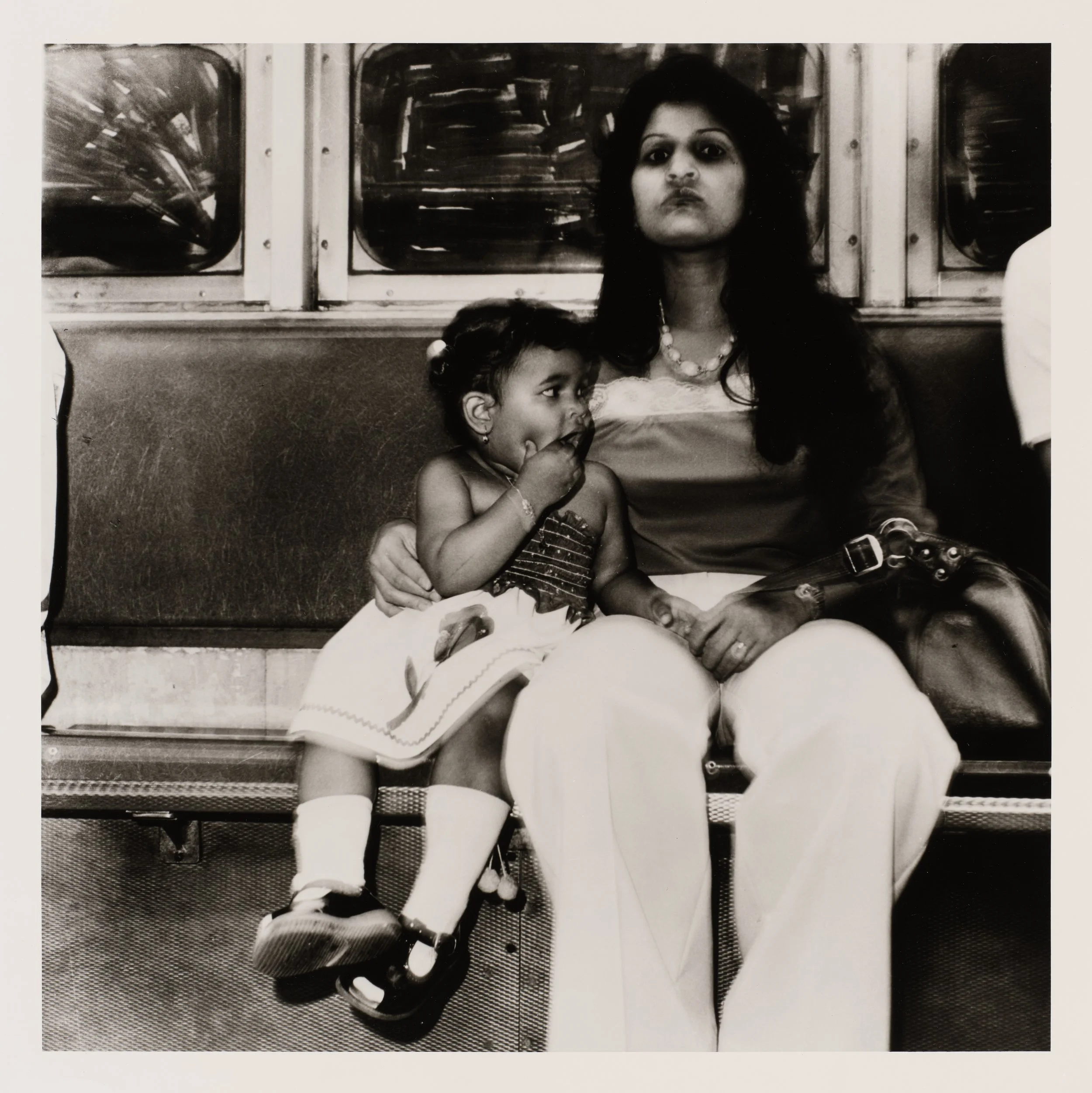
In 1989, Rivera wrote to the critic Lucy Lippard, who was preparing her book, "Mixed Blessings: New Art in a Multicultural America," published the next year. She described her pictures of people of color on the subway—sitting alone or accompanying a child—as records of those "who are unnoticed and underrepresented in our consciousness unless a crime occurs." Empathetically, Lippard read Rivera's "Mother and Child in Subway" (1982) as poignant, the mother standing in for any mother, necessarily vigilant in the fast-paced city. Yet, set beside the visceral work, cultural misrepresentation emerges as a biological problem. If someone is ignored, everything they do and need is treated as invisible. In this light, Rivera's photographs, "Blizzard" (1982), in which snow obscures a figure in front of a fence, and three similar untitled prints (ca.1970s-1980s), where snow obscures elevated subway tracks, become about looking not at what's coming down, but searching despite it for what has not been completely covered over, discerning its contours. The task, these works suggest, is to see-or see through -any storm.
Marcus Civin is a writer who lives in Brooklyn. He has written recently for ArtReview, BOMB, Boston Art Review, and Frieze, among other publications.
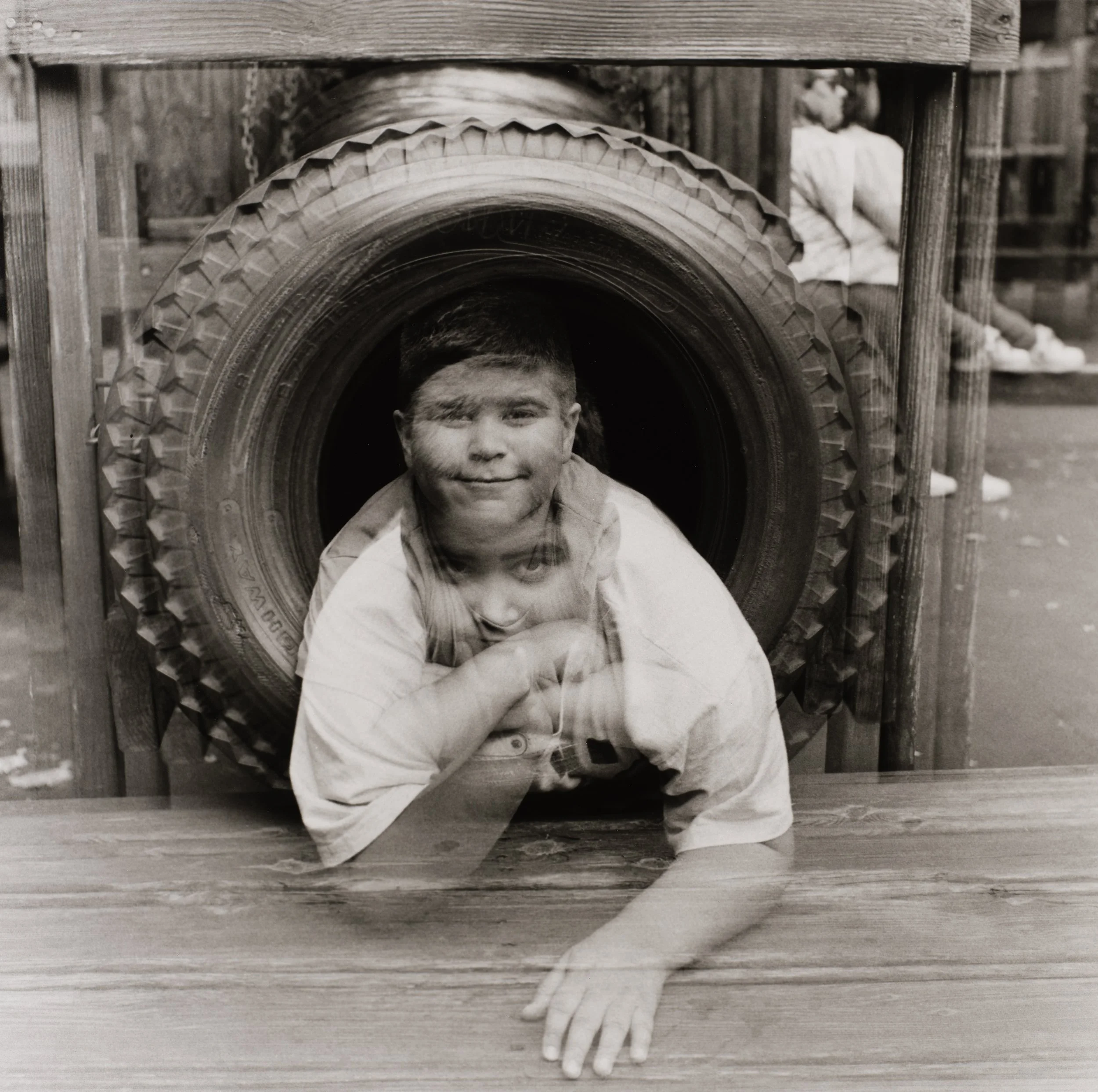
SOPHIE RIVERA "Shoulder to Shoulder (from the series Two/Two)" 1995. Estate of Martin Hurwitz.

SOPHIE RIVERA "Untitled (from the Latino Portrait series)" 1978-79. Estate of Martin Hurwitz.
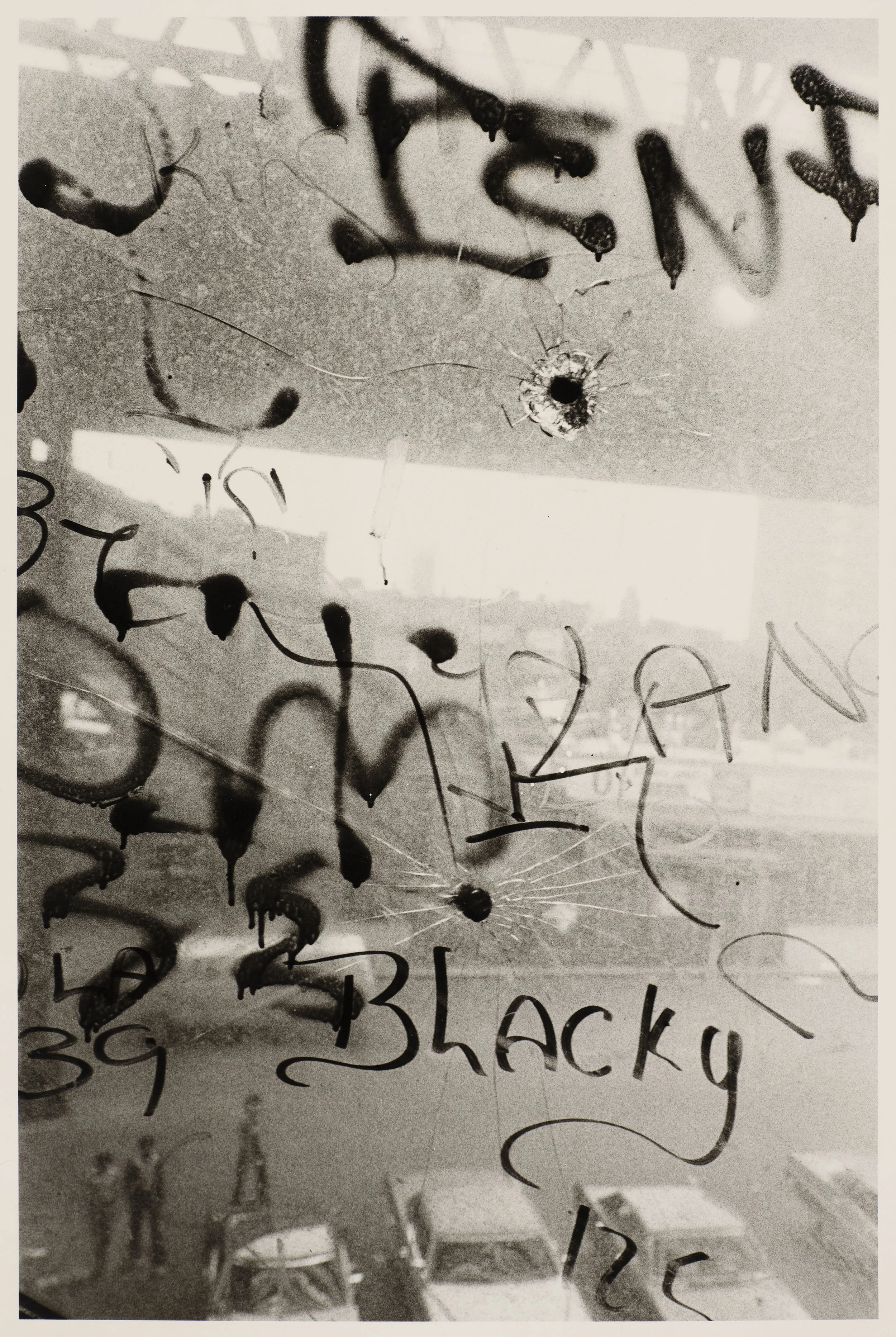
SOPHIE RIVERA "Untitled" 1970s-80s. Estate of Martin Hurwitz.

SOPHIE RIVERA Installation photo of. "Double Exposures" at the Museo del Barrio.