
By Erin F. O’Leary, October 10, 2025
I’m suspicious of institutions that produce exhibitions neatly timed to coincide with the increasingly corporatized Pride Month. So, ascending the Getty’s beige modernist staircase, its travertine risers temporarily colored to form a rainbow, the words of artist and writer Elisabeth Nicula were already catching between my ears: “It bothers me that there is so little usable infrastructure beneath artists and so much baroque architecture built on top of us.” The rainbow stairs were part of the PR campaign surrounding “Queer Lens”, an exhibition that was indeed an attempt to build. But what emerged was less a meaningful historical excavation and more a palatable museological corrective—one whose important efforts were undermined by its reductive framing of both queer life and photography in this moment, as well as by the promotional activities that supported the exhibition.
“Queer Lens”, held through September 28, amounted to a massive undertaking by co-curators Paul Martineau and Ryan Linkof, who sought to construct a narrative of photography that honored and accounted for queer photographers and subjects from the medium’s inception. The exhibition positioned that affect as reciprocal, framing visibility via the camera as integral to shaping the “current understanding of queer identity.” The show was loosely structured according to a timeline (1732–2021) published in the catalog that weaves photographic and queer history, emphasizing media, critical moments of resistance, and legislation. (The first widely adopted method of photographic reproduction is invented thirty years before Congress prohibits the USPS from distributing “obscene” materials, and so on.) Inconceivably, the present decade is represented by just three entries: The U.S. Supreme Court decision prohibiting workplace discrimination based on sexual orientation and gender identity, the Biden executive order allowing trans people to serve openly in the military, and Pete Buttigieg’s confirmation as the Secretary of Transportation.
The mainstream media coverage of the exhibition has been a bit delusional, too. The L.A. Times, for instance, called “Queer Lens” the “provocative photography show only the Getty would be brave enough to stage,” in reference to the museums that have recently chosen to comply with far-right authoritarian demands to whitewash their programming rather than risk their federal funding. But the Getty has more money than God, and anyway, it doesn’t rely on government grants. Untouchable institutions, concerned largely with upholding the status quo, seldom exhibit bravery. I find no bravery in the timeline’s sanitization of the present. I find no bravery in the fact that my first engagement with the show via its press release involved a paragraph-long clarification that the word “queer” has been popularly reclaimed; nor in the fact that my final encounter came in the form of a free takeaway poster that provided rudimentary definitions for words like “lesbian” and “androgynous.” Like, if the Getty believes their visitors don’t know what a lesbian is, I don’t know what to tell them.
Still, there was a lot to love in the pictures. “Queer Lens” unfolded across nine galleries, where more than 270 photographic works were organized by decade, beginning in the early19th century with images depicting homosocial relationships and concluding with a selection of photographs made between 2015 and 2025. The exhibition, which skewed heavily toward portraiture (all but two-ish images included figures), featured studio and environmental portraits, figure studies, and documentary images. Various photo booth prints, cartes-de-visites, and postcards were presented in glass vitrines, gesturing to the photograph as a thing meant to be carried, handled, exchanged. In gorgeous albumen and silver gelatin prints by Baron Guglielmo von Plüschow, Ruth Bernhard, Reynaldo Rivera, Man Ray, Bruce of Los Angeles, Horst P. Horst, and others, nude figures are depicted with supple, dimensional sheen. The many fantastical or formal depictions find occasional contrast in works like Therese Frare’s aching, now-famous photograph of activist David Kirby dying from AIDS complications in a hospice bed, the most explicit image in the show. “Queer Lens”included many photographs I have loved and which have impacted me completely, and that in many cases, I’d only seen in reproduction. I stood for several minutes before Claude Cahun’s collaged “I.O.U. (Self-Pride)” (1929–30) which I’d always understood as defiant, but was more delicate than I’d imagined; the chance to be with David Wojnarowicz’s “Untitled (Face in Dirt)” (ca.1990) at scale was one of the more moving art encounters I can remember.
The final gallery, titled “The Future is Queer” included striking works by Guanyu Xu, Robert Andy Coombs, John Edmonds, and Amina Cruz, among others. But in this collection of current images, the curatorial approach narrowed—contracted, even. While the broader exhibition included photographic collages, works comprising both image and text, solarized prints, a photograph reproduced on a hand fan, and even a pair of cut-paper silhouettes framed by tendrils of human hair, the present was predominantly represented by “straight” images: unaltered, in-focus, rectangular, two-dimensional pictures. I found this especially surprising in light of Jordan Bear’s catalog essay, which positions early 20th century Pictorialism as a “hereditary line of queer photography”, as it rejected the rigid, purist boundaries of mainstream modernism. So, where were the artworks that challenge what is now institutionally popular, that reach beyond the subscribed edges of the medium?
In Los Angeles alone, there are many queer, figural photographers whose work approaches photography as a leaky, hybrid medium: Peter Tomka makes his textural, high-contrast silver gelatin prints by projecting images through a glory hole; Mia Weiner transforms figural photographs into hand-woven tapestries; Rory Hamovit constructs colorful nightlife scenes from googly-eyed cut-paper figures; Cassils enacts brilliant, physically-demanding performances illuminated only by the camera’s flash. Others, including Rakeem Cunningham, and Guadalupe Rosales, make collages, photo-sculptures, and utilize other alternative and multimedia processes. (Some of the exhibited artists, including Cruz, also work in more experimental modes, but those were not shown.) I read the absence of such works as an implication that “Queer Lens” envisions queer photography’s present and future as enclosed within the vocabulary of what has historically been called “straight” photography, which is to say, that which does not stretch photography’s current institutional mode. So much of the richly diverse landscape of queer photography is lost in this approach, in the desire to make a neat, narrativized shape; in the attempt to talk about queer photography’s futures without also including those who are formally queering the medium.
When I read the final gallery’s wall text, which referred to queer communities as “previously marginalized”, and the accompanying timeline, which ignores the accelerated dangers they have faced in recent years (along with many forms of resistance and care that have endured or emerged in response) and concludes instead with white men and political play, I can think only of the vast, dehumanizing oppression of the state, how our liberative struggles are bound up in one another. Such historicizing rhetoric is leaky, too. It seeps beyond the museum’s walls, where it has real material consequences. So in that final gallery, I think again of Nicula, who has already said it so well: “I propose that we stop playing along. I am imagining a type of degrowth, a disassembly of dominant structures, a refusal.” Institutions demand legibility, but queer photography is vibrational, and notions of futurity require radical confrontation with the conditions of the present. Without it, they continue to build on top of us all.
Erin F. O’Leary is a writer, editor, and photographer based in Los Angeles. Her texts on photography and image culture have appeared in Momus, Carla, and Photograph, among other publications. She is currently an MFA candidate in Image Text at Cornell University.
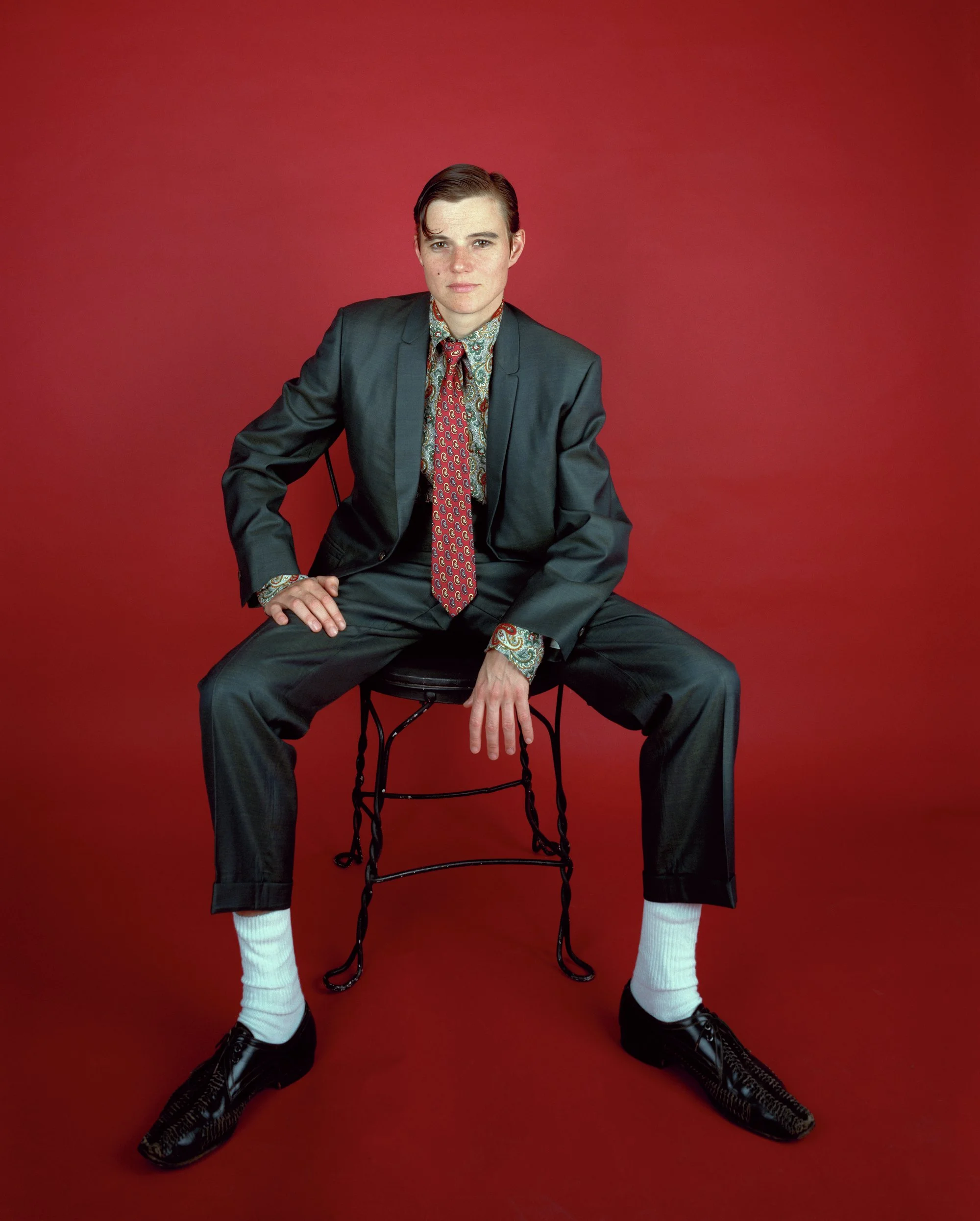
CATHERINE OPIE " Angela Scheirl (now A. Hans Scheirl)”, 1993.
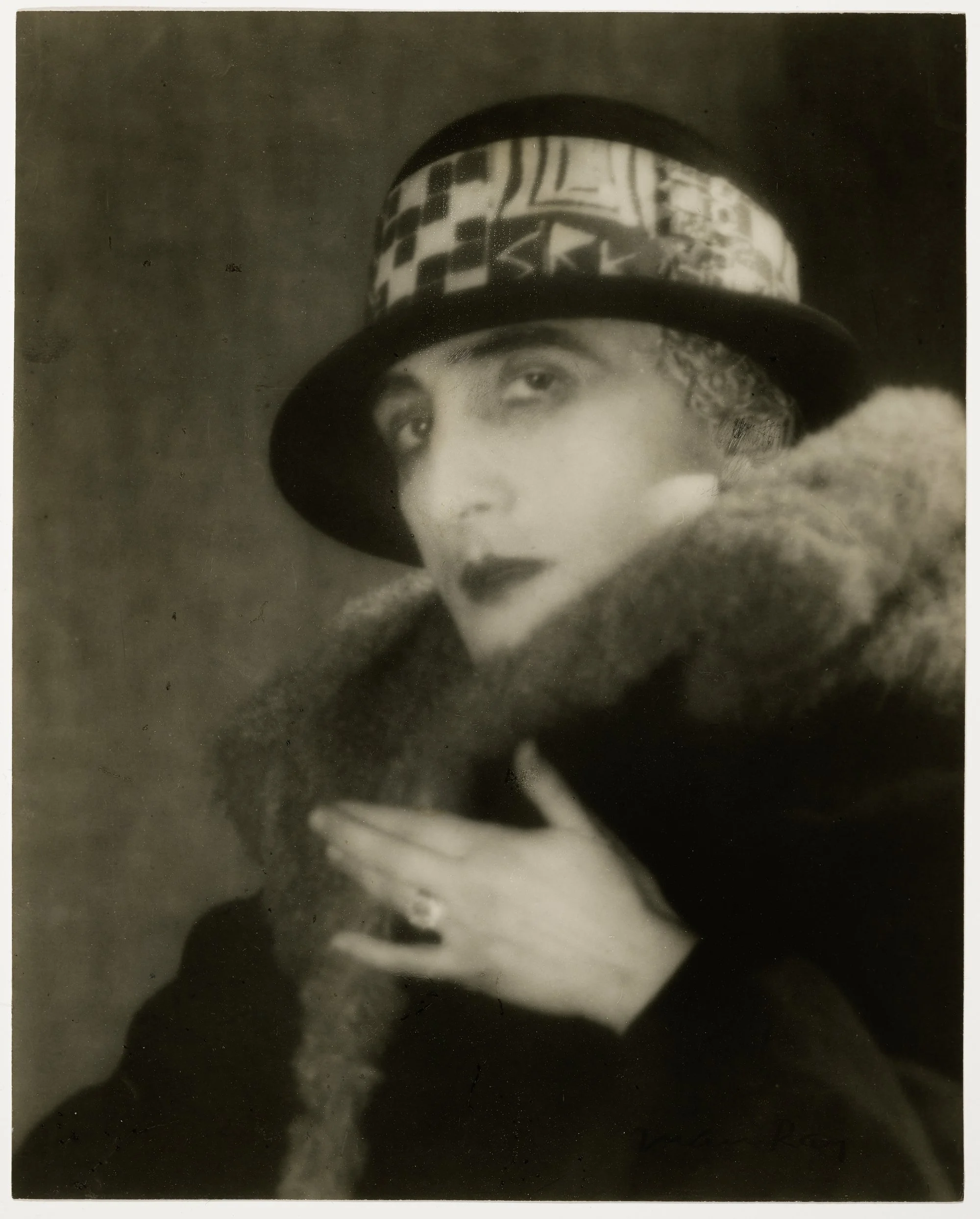
MAN RAY "Rrose Sélavy (Marcel Duchamp)", 1923.
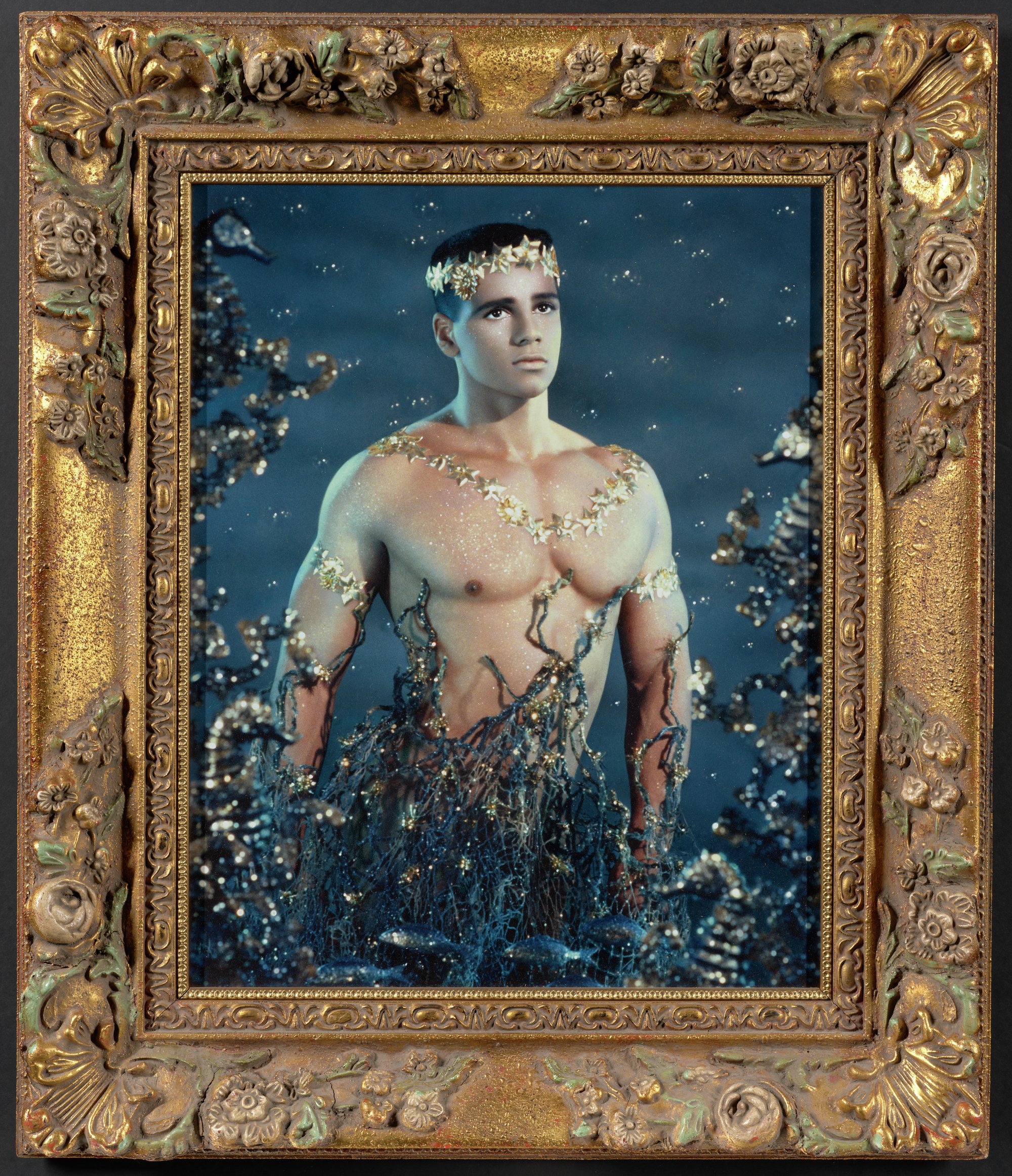
PIERRE ET GILLES "Neptune (Karim Boualam)", 1988.
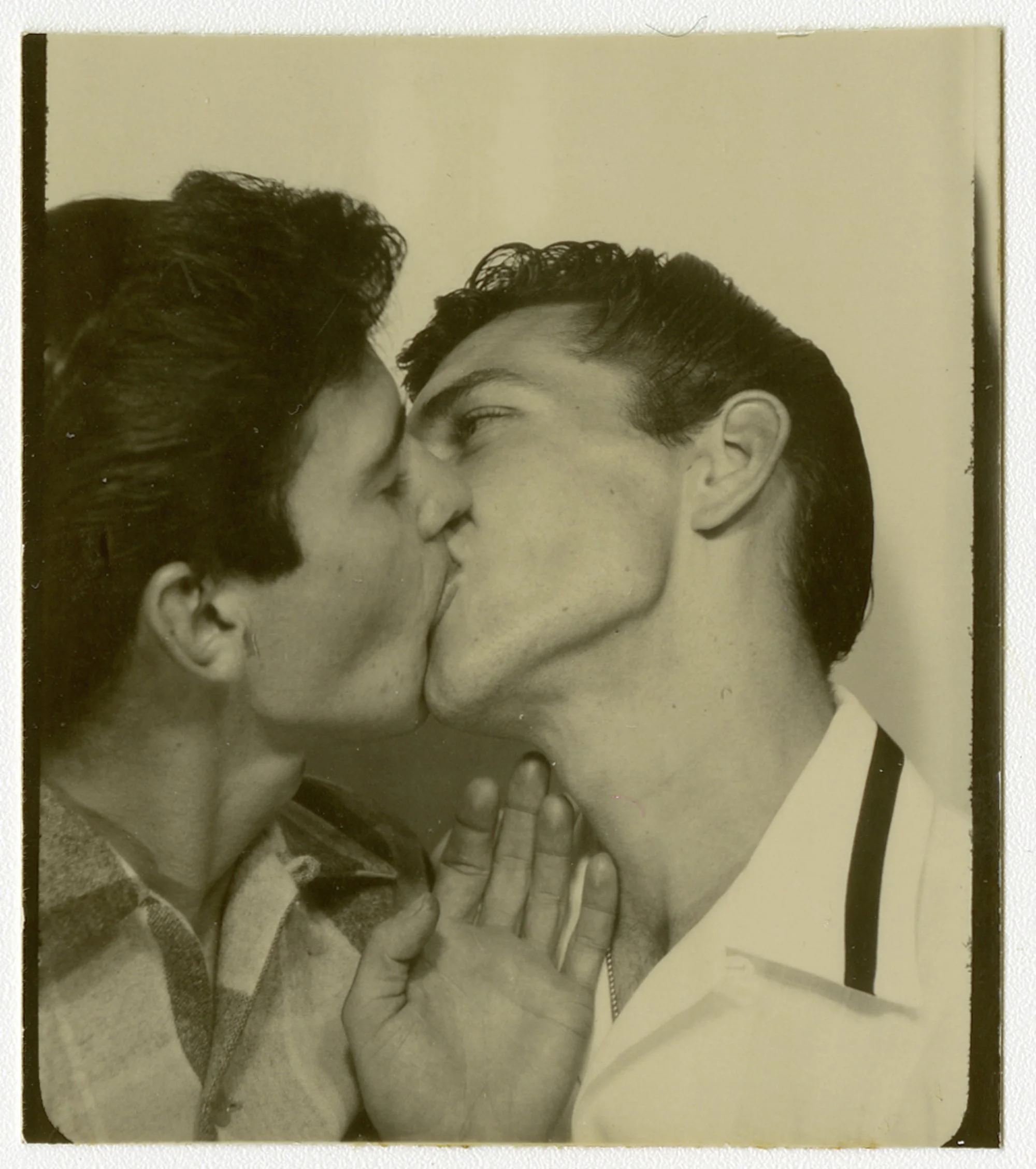
UNIDENTIFIED "Two Young Men Kissing in Photo Booth" 1953.