
By Rica Cerbarano, December 10, 2025
Approaching Luc Delahaye through the lens of his past as a photojournalist is misleading. Doing so may lead to frustration, confusion, or even a sense of betrayal; perhaps that is why his exhibition “The Echo of the World”, on view at the Jeu de Paume until 4 January 2026, was among the most hotly debated events during Paris Photo in November. Some viewers loved everything, from the curatorial vision to the installation, while others rejected the boldness with which the artist seems to have abandoned photojournalism to probe the broader, less constrained possibilities of photography as an artistic medium.
There are many possible ways to engage with Delahaye’s work, but perhaps only one is truly productive. It is, not coincidently, the one suggested by the exhibition’s curator, Quentin Bajac. One of the wall texts states that his practice “is closer to that of writing”: a mode of writing through images, aimed at producing “thinking photographs”, photos that articulate a complex inner logic.
As someone who writes for a living—and does not photograph—this, to me, is the interpretive key to Delahaye’s body of artworks he has produced since 2001, the year he broke with photojournalism and declared himself an artist. I understand precisely what it means to write with images because the process echoes the very logic of writing: its slow rhythms, its hesitant phases, its continual cycles of construction and revision. Writing helps me understand the world and decipher my own thoughts; through writing something is created that did not previously exist, something that draws from the real, from its urgency and its disruptions. Writing means assembling fragments that often have nothing to do with one another, allowing their unexpected convergence to generate revealing short circuits — those subtle tonalities I may chase for a very long time before finally encountering them. Writing has always been a way of staging both the world and one’s interiority.
Delahaye works with images in exactly this manner. His photographs — particularly the composite ones — take shape over time, incorporating elements from unrelated events that, in his mind, find an adoptive place. This is what happens, for instance, in two monumental works conceived in 2012, “Trading Floor” and “Soldats de l'Armée Syrienne, Alep” exhibited here in the same room. Although the subjects could not be more different, Delahaye places them in an allegorical dialogue: stylized gestures, choreographed postures, and at times exaggerated expressions make them among the least “realistic” images in his entire oeuvre, introducing a grotesque or even surreal tone. Yet beyond this grotesque register lies another gesture: Delahaye constructs the faces of some Syrian soldiers using portraits of London traders, thereby drawing an oblique parallel between two contemporary “battlefields,” the financial and the military.
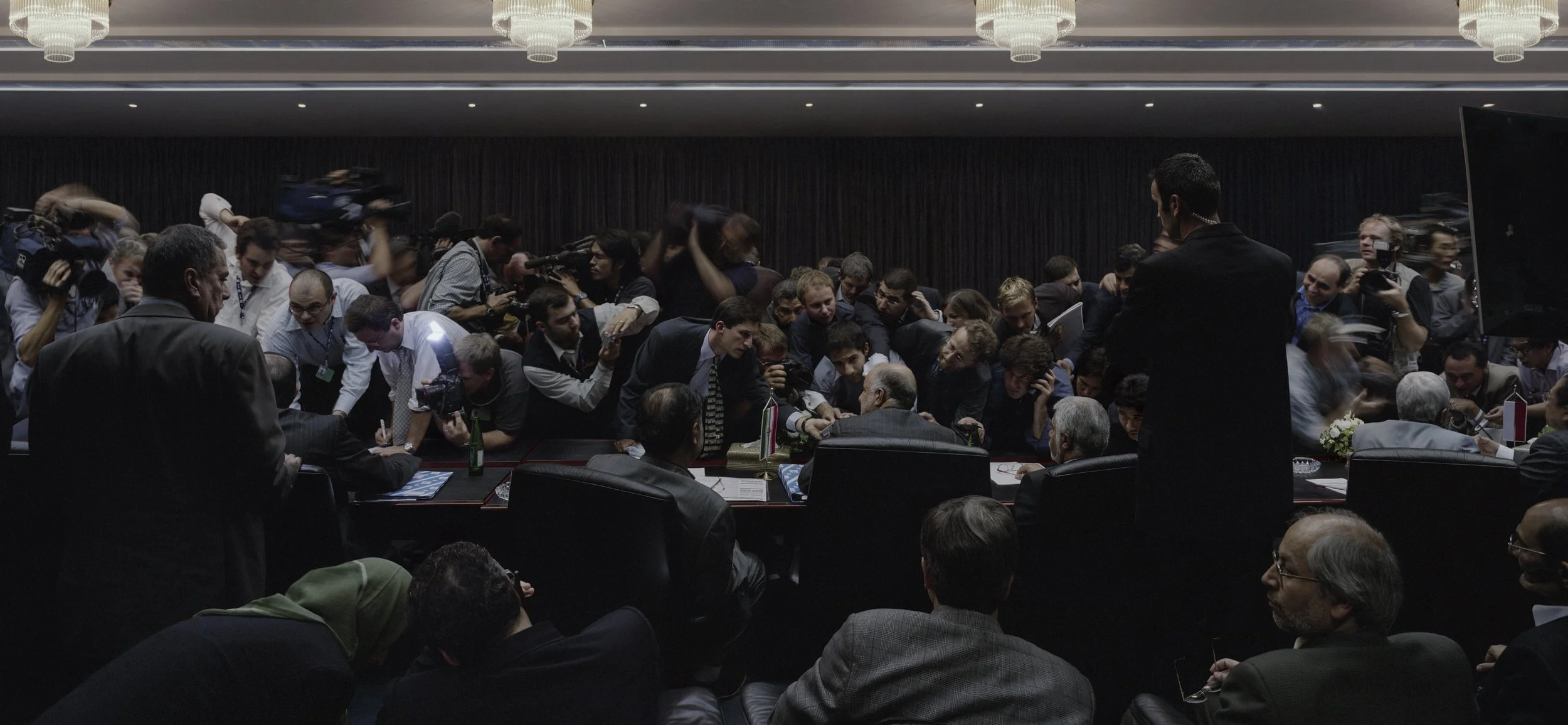
This may appear to be a purely formal exercise, but it is instead the construction of an image that reveals, in its details, a shared narrative structure. Delahaye sketches a portrait of the twenty-first century: its conflicts, its resistances, its centers of power. A geopolitical mapping of the real, conveyed through images that allow us to hear the world’s noise. From Iraq to Ukraine, from Haiti to Libya, from OPEC summits to COP conferences, Delahaye moves through the places where the world fractures and the places where—at least ideally—it attempts to regulate itself.
In this first French retrospective since 2005, it becomes unmistakably clear that Delahaye’s work no longer belongs to the field of photojournalism; yet this does not mean it has drifted away from the real. His photographs always originate in an encounter—immediate or deferred—with what is happening. His working space, however, is no longer the street: it is the studio, a place of solitude and construction, in which the image is mulled over, built, layered. The process through which the real is transformed becomes slower, more intricate. Yet the moment of capture remains essential, and each work is dated according to the day of its initial shooting.
What interests Delahaye is not the individual story of the person photographed, but rather their symbolic significance within contemporary society. His method—reflective, constructed, and deliberately staged—is ultimately a way of conveying the complexity that runs through everything we experience.
Rica Cerbarano is a curator, writer, editor and project coordinator specializing in photography. She writes regularly for Il Giornale dell’Arte and has also contributed to Vogue Italia, Camera Austria, FOAM, among others.

LUC DELAHAYE "Ambush" 2006. © Courtesy Luc Delahaye et Galerie Nathalie Obadia, Paris/Bruxelles
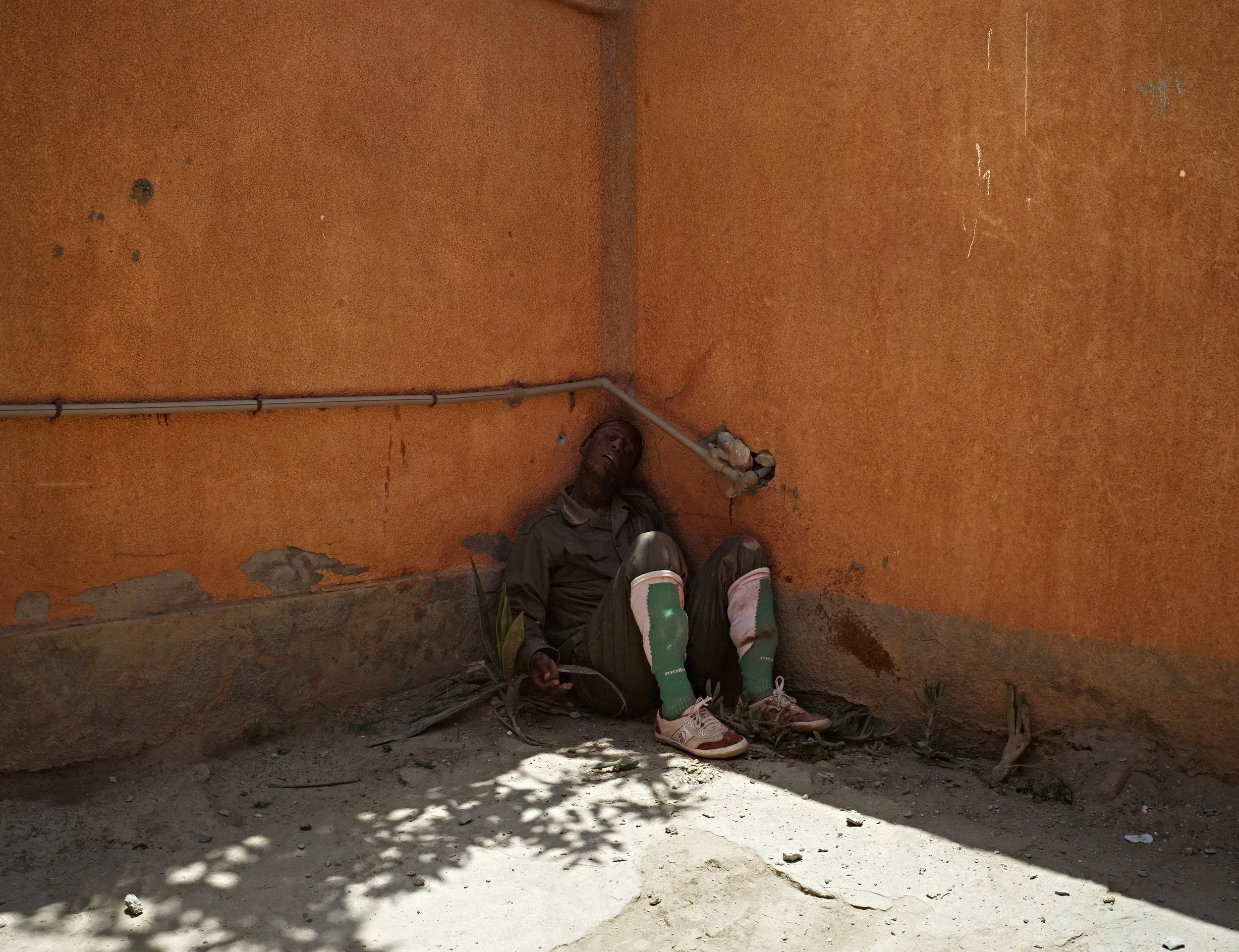
LUC DELAHAYE "Death of a Mercenary" 2011. © Courtesy Luc Delahaye et Galerie Nathalie Obadia, Paris/Bruxelles

LUC DELAHAYE "Soldats de l'Armée Syrienne, Alep, Novembre 2012" 2012. © Courtesy Luc Delahaye et Galerie Nathalie Obadia, Paris/Bruxelles
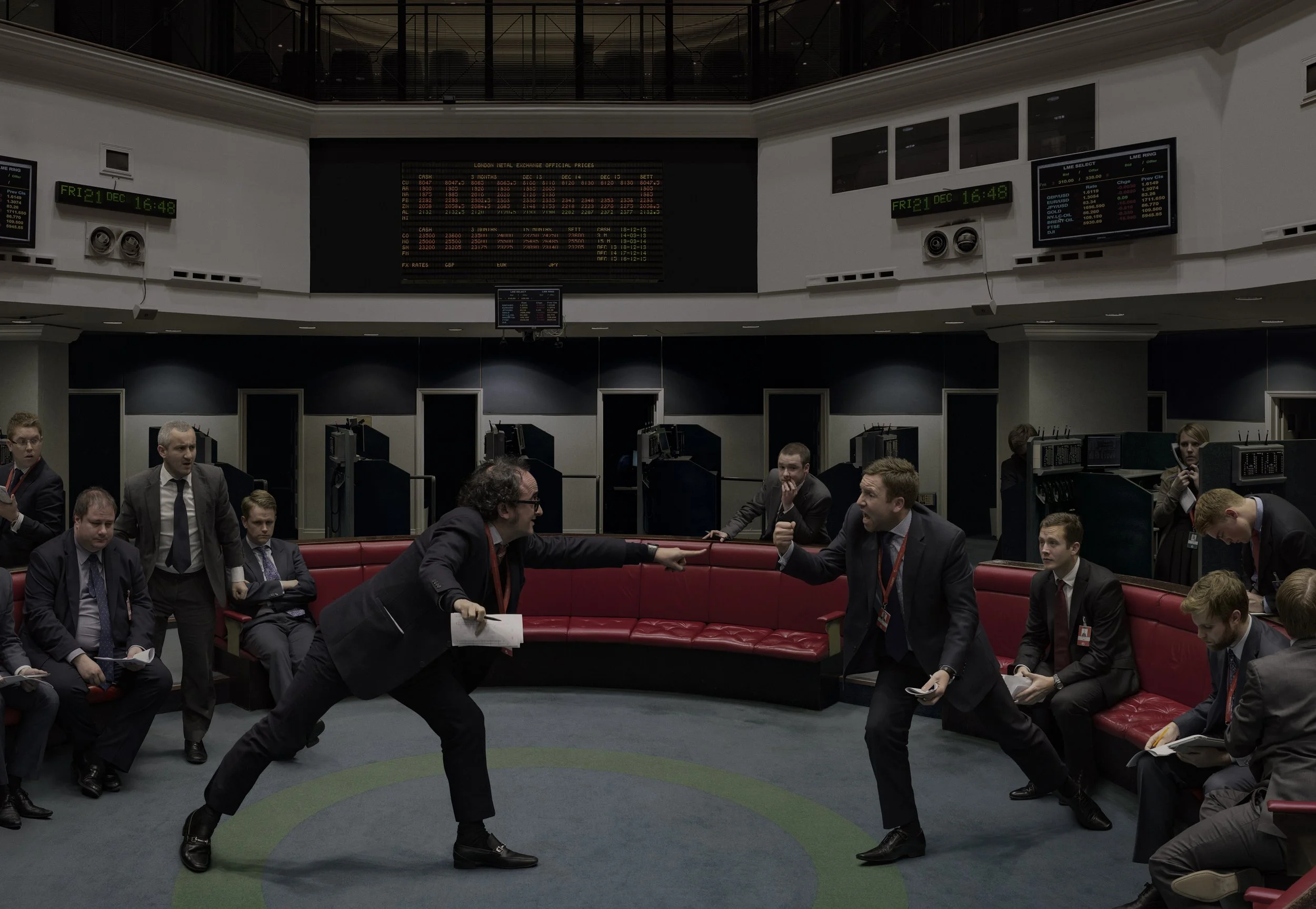
LUC DELAHAYE "Trading Floor" 2013. © Courtesy Luc Delahaye et Galerie Nathalie Obadia, Paris/Bruxelles

LUC DELAHAYE "Un Feu" 2021. © Courtesy Luc Delahaye et Galerie Nathalie Obadia, Paris/Bruxelles