By Christian Jones October 10, 2026
Today it seems like there is more news than there has ever been before—and there probably is. But not all of it is news so much as information clothed in the language of spectacle and this advertisement-driven approach to media is now the dominant mode. Instead of the printing press a hyper-flat online architecture—infinite scroll, clickbait, shortform content—has effectually splintered culture into streams of soundbites and competing sources, where content as serious as global politics or as vapid as tabloids has begun to look indistinguishable. These new problems only further exacerbate the age-old journalistic challenges of subjectivity, authorial credibility, absences or stereotypes. Alarm bells have been rung about the erosion of critical media literacy in American society, and yet our slow slide only continues. Both national and regional journalism cling fast to their waning readership, remodeling themselves to fit a new era of cultural relevance. An ethic of seeing for this fast-paced, short-form engagement has not been updated.
Curator Susan Bright takes the precarity of the dying print medium to task with the group exhibit “Between the Bylines,” on view at Boston University’s Faye G., Jo, and James Stone Gallery. A byline—defined as a line noting the author of a magazine or newspaper article between the title of an article and its text—has also become a colloquial moniker for any kind of published article. The exhibition title’s nice alliterative ring abstractly suggests the unseen forces that shape and render an article: the numerous waves of editors, the assumptions and values of the zeitgeist. It could also refer to that fragile substance upon which the bylines are printed, that semi-transparent membrane between one story and the next: paper.
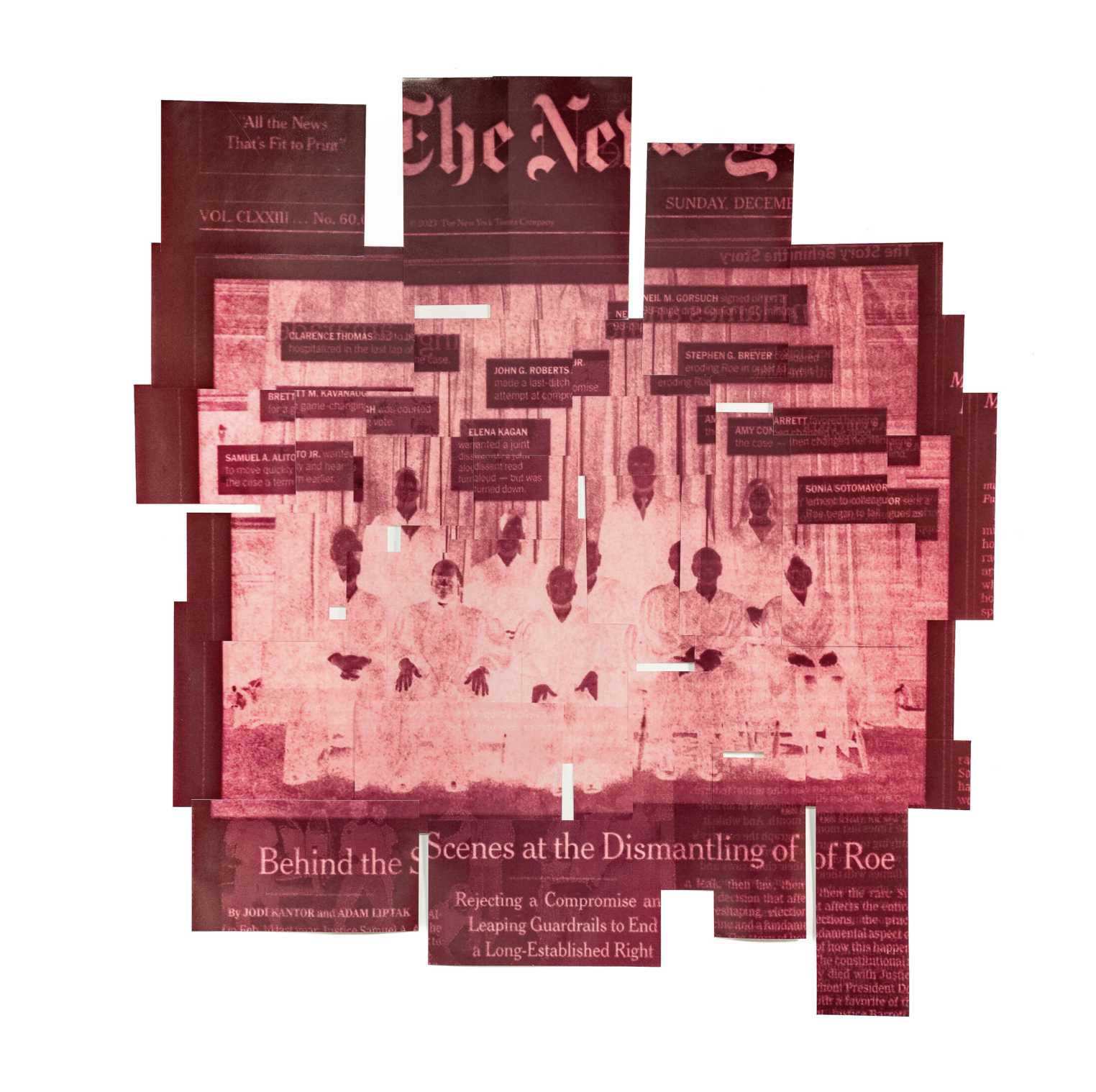
Works along the entrance of the exhibit feel vaguely connected by how they address the rhetorical and imagistic content of newspapers. Donna Ruff’s 2024 piece, “The Overturn of Roe (Purple)”, a bright fuchsia photogram that reassembles a spliced and color-inverted photo of the December 17, 2023 cover of The New York Times, features an investigative report into the dismantling of Roe v. Wade. The faces of the nine Supreme Court Justices are all obscured in darkness by Ruff’s rendering, and their cloaks have become an infernal whitish color, evoking the robed malice of the Klan. Close by hangs Alexandra Bell’s 2020 moving triptych, “A Teenager with Promise (from Counternarratives)” (2020), which features three versions of a The New York Times cover story about the police killing of Michael Brown Jr. The artist plays editor in the first version, marking up a printed copy of the article in red pen and highlighter to signal charged language and questionable authorial choices; the second version is a sort of blackout poem that redacts the story down to two brute lines about the profiling and killing; the third version is a reimagined printing of the cover story humanistically retitled “A Teenager With Promise” that features no text, only a large portrait of Brown Jr. at his high school graduation.
Deeper into the exhibit are works that explore the materiality of the newspaper medium. Five of Anne Eastman’s sculptures hang in the center of the exhibit, each one presenting newspaper scraps encased in layers of glass and mirror to disorienting effect. Snippets of photo and text, since reordered or removed from their original contexts, refract and reflect nonsensically. The curatorial arrangement of the whole exhibition follows a similar structure—pieces in proximity are connected loosely by theme or material concern, but otherwise feel more like a web of associations or a fragmented narrative with recursive motifs. It is fitting given today’s fractured media landscape, which cannot be captured by an uninterrupted nor linear narrative.
Many artists lean into an elegiac tone about print media. Three prints from Laura Letinsky’s digital photography series “Who Loves the Sun”, started in 2022 and ongoing, feature still-life tableaus of overgrown garlic bulbs, half-eaten food scraps, broken cups, and other kitchen-table detritus sitting atop or beside a crumpled newspaper. The high contrast, fluorescent look of the photographs gives them a look of faded hyperreality, as if the color pigments have been bleached by too much light exposure. Two of Jennifer Bolande’s sculptures capture something inert and cumbersome about the newspaper form. “Ghost Column 2 and 4” (2017), are two resin sculptures cast from stacked newspapers like plinths stacked on top of each other to form a column; “Image Tomb (with Coliseum)” (2017) is a stack of newspapers hollowed out in the middle. In both works, the newspaper stacks resemble Grecian columns—the pillars of democracy they once functioned as—but their content being obscured or removed leaves only an empty monument.
Some of the works offer only superficial correctives to the limited representations of the past, signaling to absence without transformative alternatives. In Odette England’s “Cropping Us In” (2022), the artist collages snapshots of rural women atop original press photographs of male farmers from the 1940s–80s. England’s collages engage a double entendre of the word “cropping,” both as in re-populating and re-framing the narrative in the original photographs. But because the photographs lack any context or identifying information, the gesture remains symbolic: attempting to overlay the women into a narrative that has long escaped them without contesting it. Who are these women? What are their names? What of the land did they know? We see them without really knowing them.
Selections from Laura Fields’ “Front Pages with Pictures of Women and Flowers” (2025) feel similarly bereft of context because each panel is a painted reproduction of what were originally photographs from The New York Times. Fields removed certain details from the original photos, painting background sections beige so that patterned flower motifs appeared more prominent. The flowers blended with the various emotional tones of the women in each painting, whether tragic, resilient, or uncertain. But besides the wall text descriptions for each associated headline, the paintings feel abstracted from their original context—especially given that some paintings are photorealistic and others bear clunkily painted human forms.
While there is nothing wrong with simply representing the contours of absence and responding to it, the power of those works feels paltry against others in the exhibit that propose entirely new modes of perception. Take Toni Pepe’s 2026 piece “Cradles (missing, found, held, & released)” for one, in which the artist organized hundreds of archival prints drawn from the Women and Gender Issues Collection at the Boston Public Library, placing them in curled bundles into four wooden supports. Each piece of archival material appears mummified, wrapped in a thin semi-translucent paper sheath Pepe made from abaca, flax, and linen. The rhetorical contents of these cradles are simultaneously safeguarded and hidden from view, complicating the ethical question of how we construct narratives of remembrance and who they protect or harm. When paired with “Envelope (held)”, a piece framed next to it, the support cradles, which are where information and archives are “held,” become safe holders as in a process of care or memorialization, a means of gathering and protecting fragmented histories.
Then there is Lorie Novak’s “Remembering Possibilities” (2022-2026), an anchor work and adjacent video installation created for the exhibition. The video is one long meditation on the ethics of looking and photographs of people holding photographs. Superimposed upon collages of headlines and cover stories, are the artists’ eyes, which bear witness to 8-and-a-half minutes of news content featuring photos of photos. There are protesters holding up pictures of missing loved ones or martyrs. As the images play, Novak, vocalizes how the original photos have been stripped of their primary context and operate as stand-ins for evidence of life, testimonials of existence. These photographs of absence become a kind of presence, a tangible placeholder for loss that is communicated clearly even in our hyper flat digital landscape. Novak’s musing becomes an ethic for the show, and a way of seeing we are asked to participate in.
Each of the artists has developed a tactile infrastructure for critical media literacy. Their strategies involve various verbs: annotating, redacting, recasting, hollowing out, cropping, inverting, composing, archiving, holding, memorializing, reflecting, isolating, compiling, juxtaposing, recontextualizing, scratching, superimposing, reimagining, and, of course, witnessing.
Christian Jones was a 2026 writing fellow at the Boston Art Review, where he is now a contributing writer and editor. He was also formerly Co-Editor-in-Chief of milk crate. He will receive a graduate degree in Publishing and Writing from Emerson College in 2027.
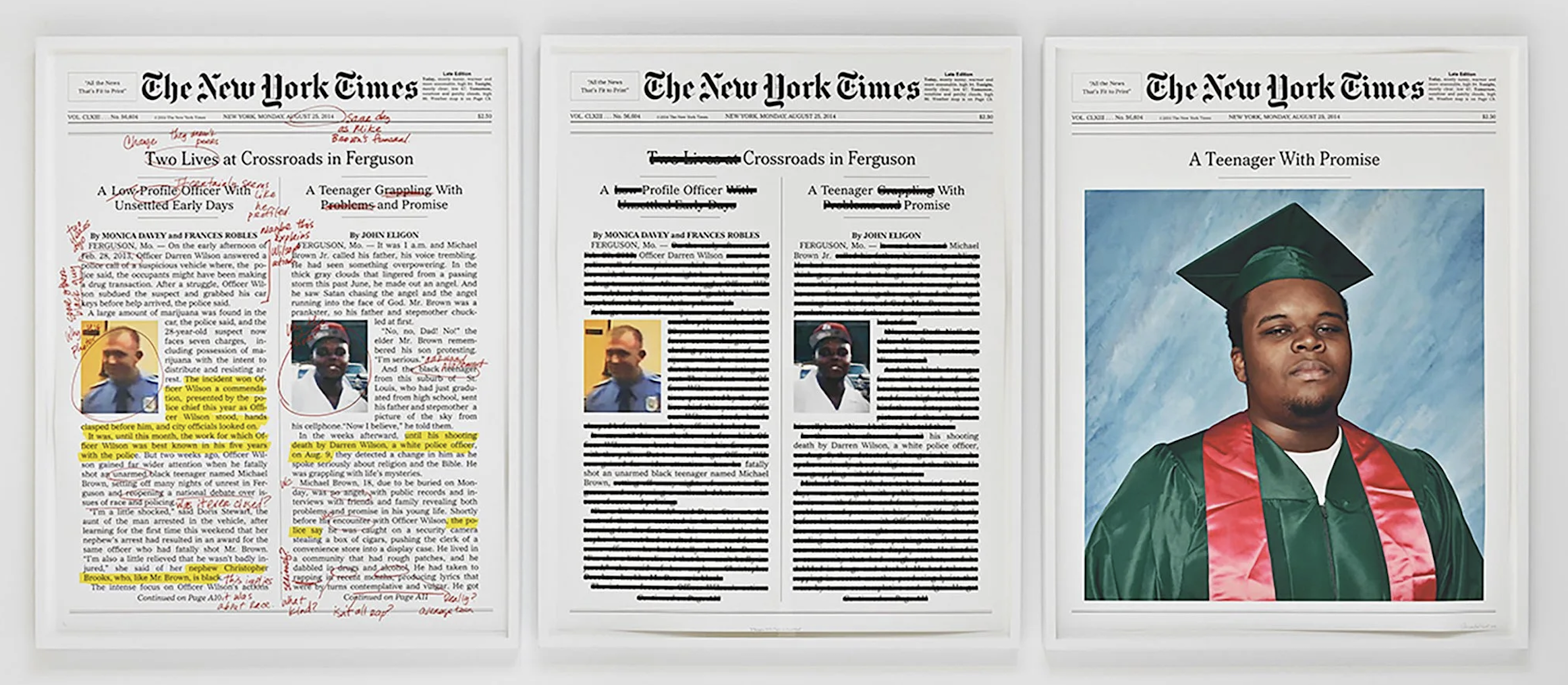
ALEX BELL "A Teenager with Promise (from Counternarrative)" 2017.
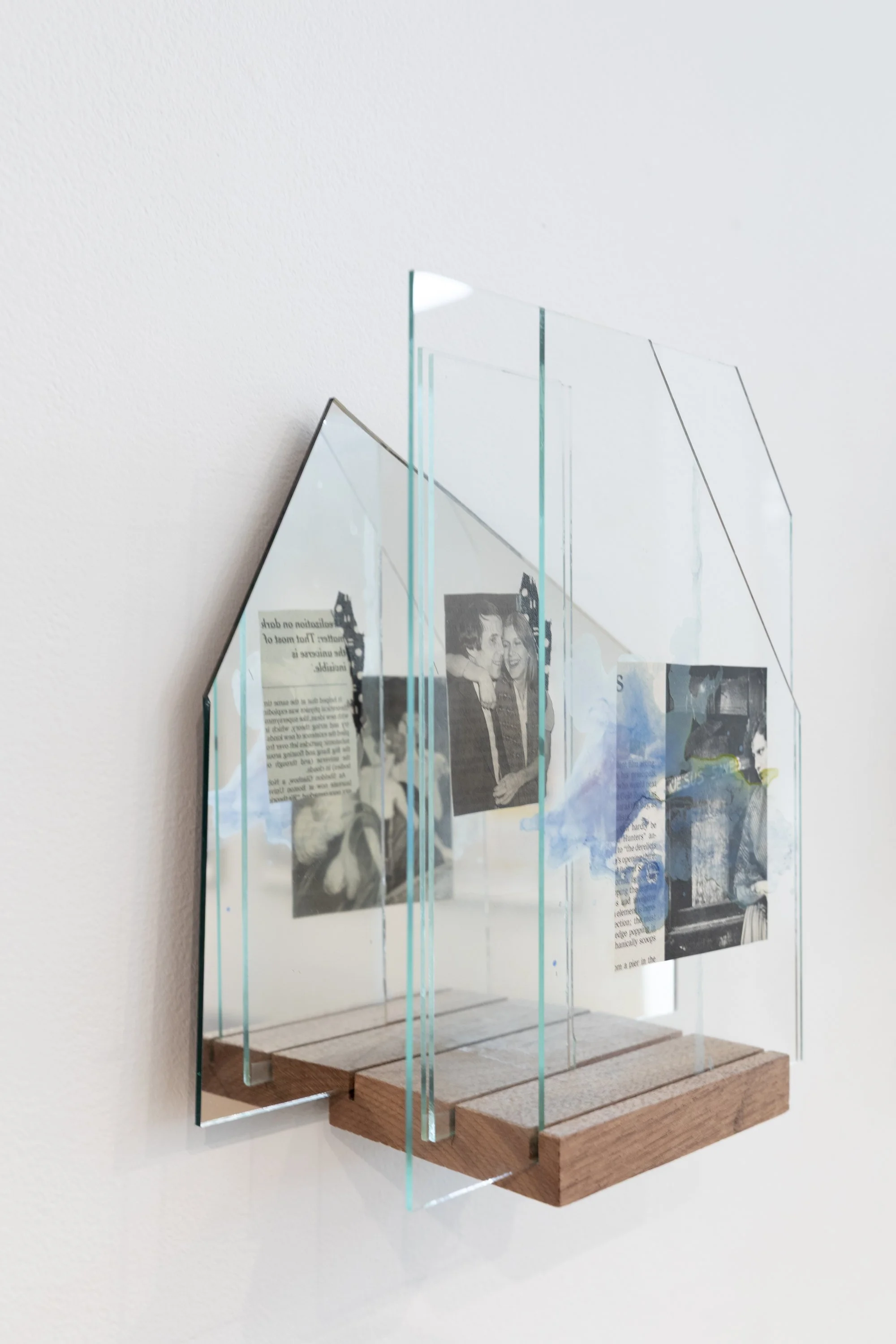
ANNE EASTMAN "Four Woman" 2020.
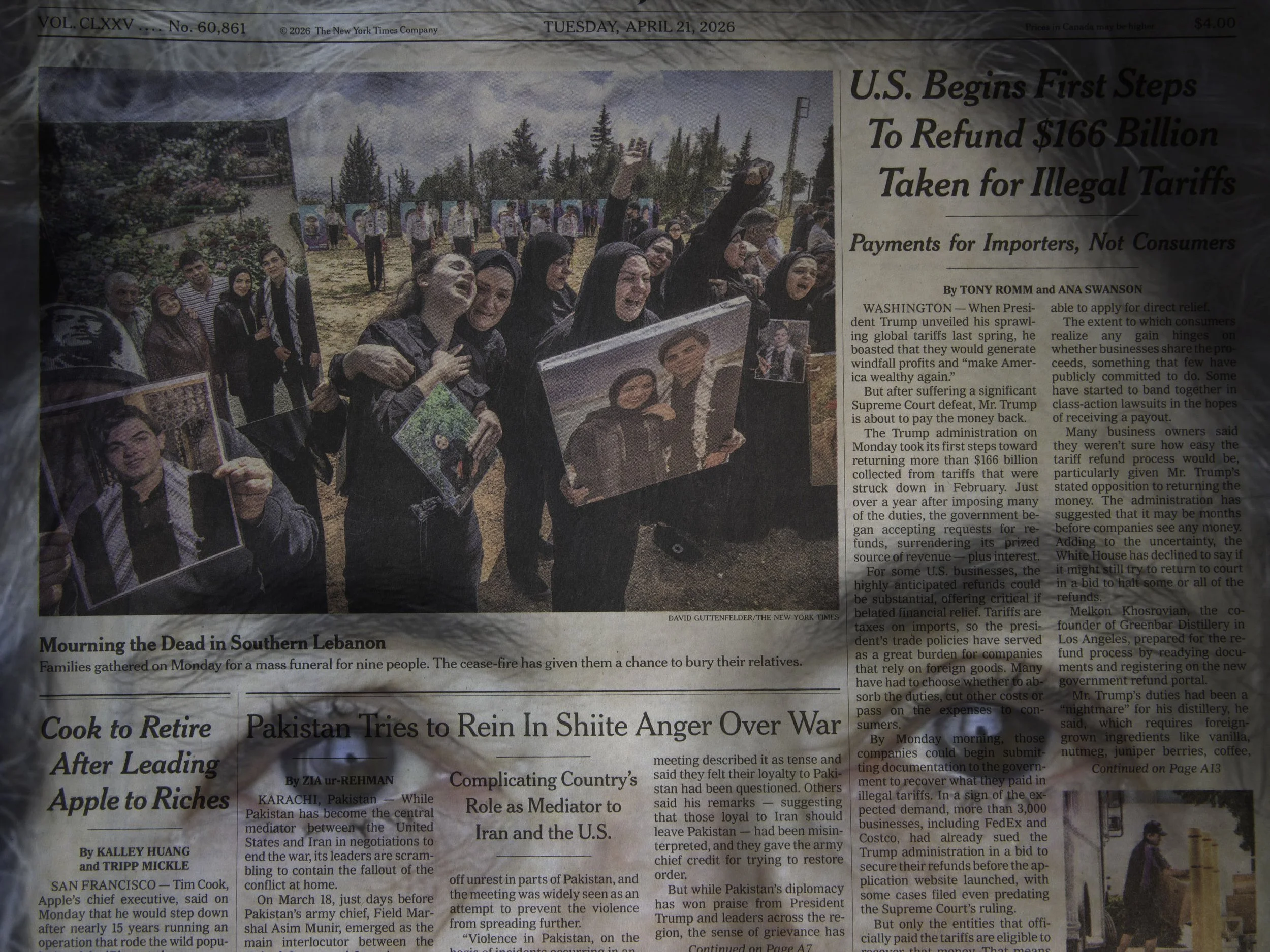
LORIE NOVAK "Remembering Possilbillities" 2026.
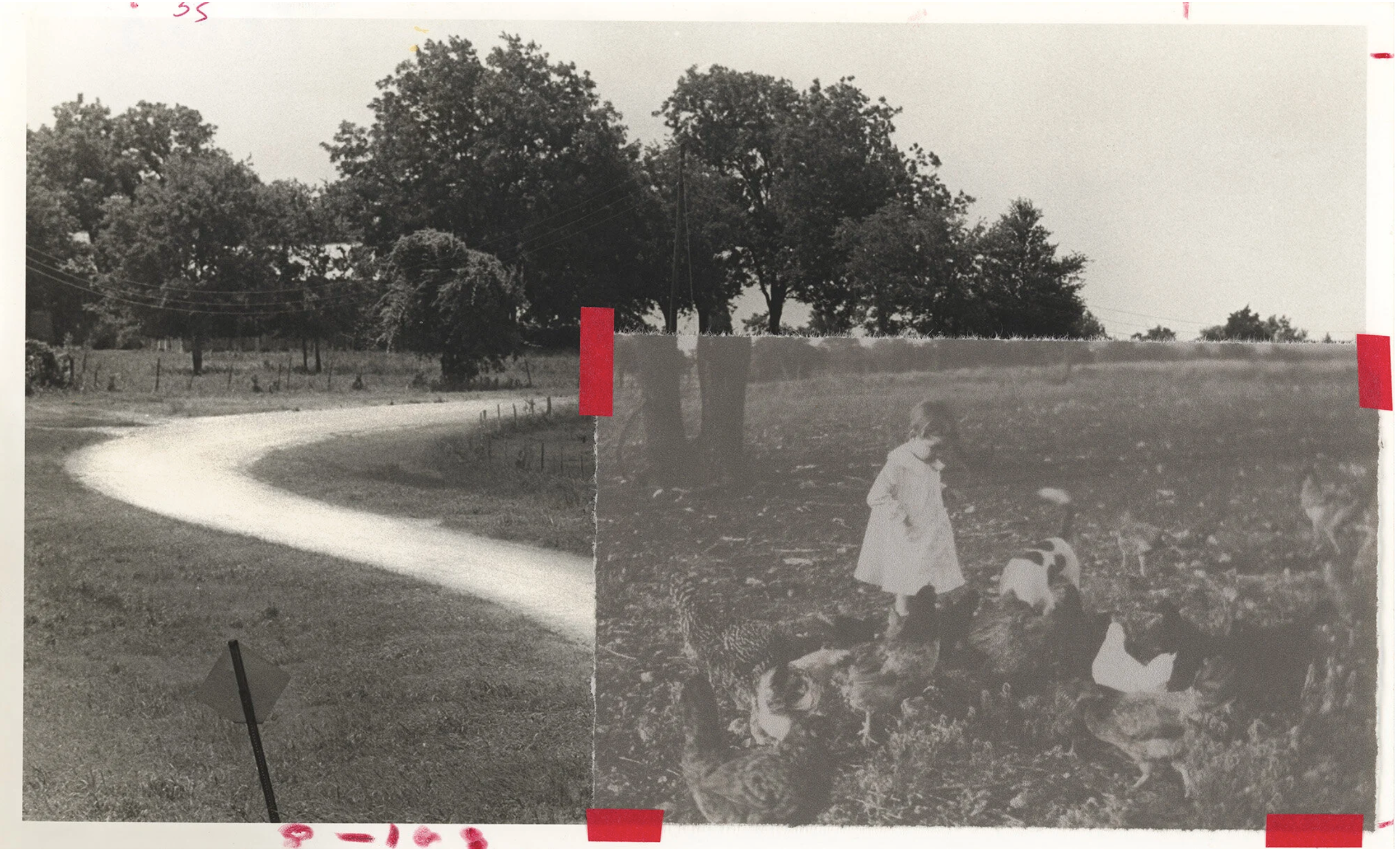
ODETTE ENGLAND "Cropping Us In", 2022.

TONI PEPE "Cradles (missing, found, held & release)" and 'Envelope (held)", 2026.