
By Jessica Shearer, October 10, 2026
In Joseph Janney Steinmetz’s 1958 black-and-white photograph Untitled (Tupperware Party), fourteen women—all between their mid-twenties and mid-forties—are assembled in a Sarasota sunroom. They are seated in a semicircle around arguably the most elegant of their number, a bobbed blonde with a wasp waist who could easily pass for June Cleaver, and she is demonstrating the use of one of the plastic containers (by this I mean she is taking off the lid, or perhaps putting it on—what else could possibly be demonstrated?) Regardless of the lack of evident intricacy, her audience is rapt. Their lipstick is perfect, their skirts hit below the knee, their posture is enviable, and they are thrilled with the transformational potential of these food storage containers.
Steinmetz took countless images like this one for magazines like Life, Time, and the Saturday Evening Post throughout America’s midcentury, creating, along with his commercial photographer compatriots, the nation’s post-war personality: A prosperous but not profligate nuclear family comprised of a stalwart father, a disciplined child, and a mother whose only appropriate means of obtaining an income involved selling underwhelming home goods to her friends. This persona, is on view at the Harvard Art Museum in “The Way We Never Were: The American Professional Photographers Collection,” along with a subtle undercurrent of critique found in the accompanying wall texts. While not immediately apparent in the images themselves, curators Audrey Sands and Madison Brown clearly hope viewers will interrogate these carefully crafted depictions of the American Dream, offering language that calls the authenticity of such a narrative into question.
Pulled from an extensive archive compiled in the 1970’s by curator and scholar Barbara P. Norfleet—the first woman to earn a PHD in sociology at Harvard—the exhibition organizes the photographs into five distinct sections, each denoted by a candy-coated wall color. Untitled (Tupperware Party) can be found in the first section: Postwar Booms(baby pink). Snaking around the cropped corners and floating walls of one of the Museum’s university research galleries follows Inventing Suburbia (light yellow), A Nation of Conformity (blue), The Work of the Professional Photographer (peach) and Rites and Rupture (seafoam green). All of the photos on view, with the exception of an enlarged 20 x 24-inch Polaroid print portrait of Norfleet, are quite small, matted in ubiquitous black frames and hung in clusters, salon style.
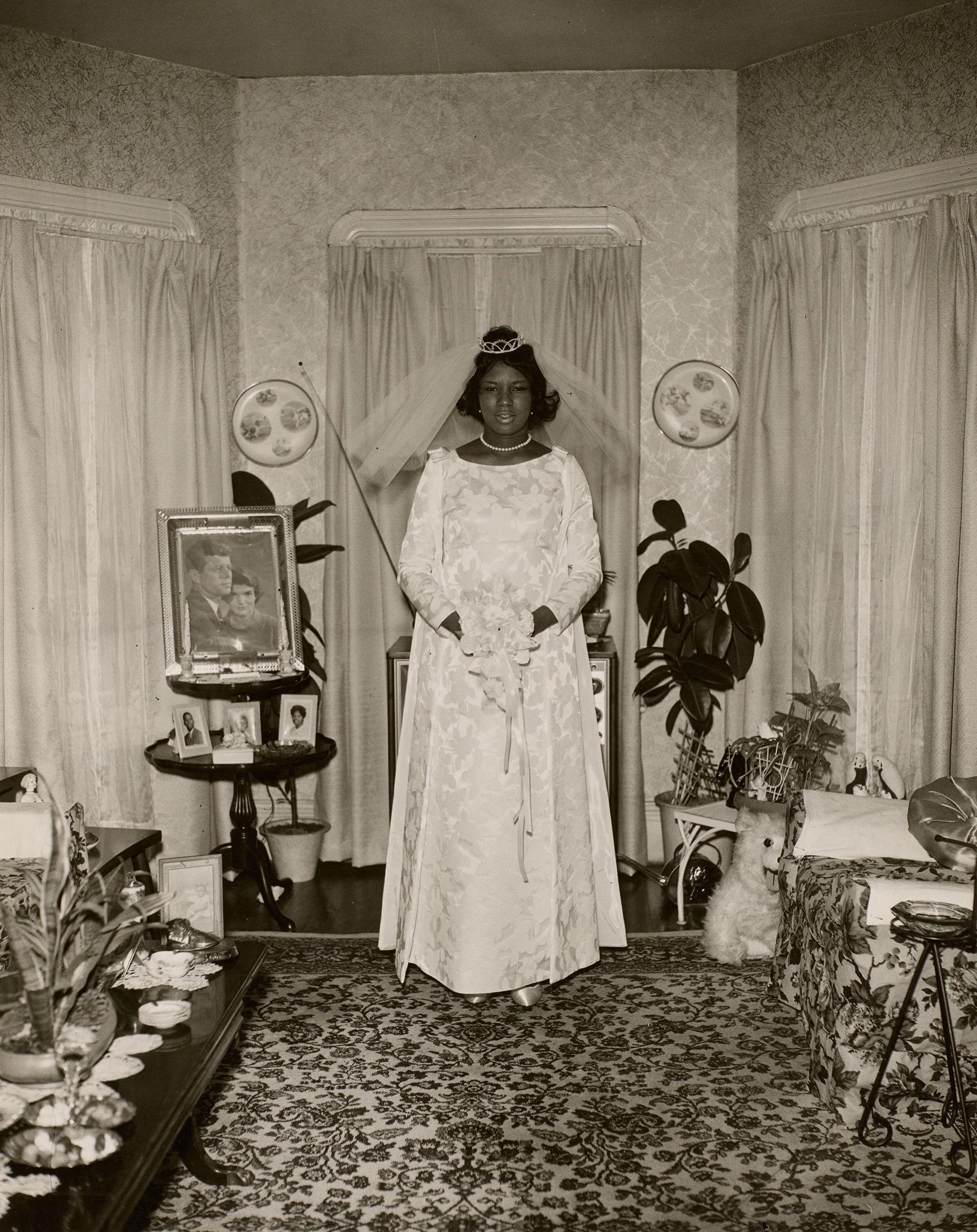
The thematic titles and associated wall text raise an eyebrow at the homogeneous identity constructed by the commercial photographers of the day, but the images themselves don’t reveal any glitch in the simulacrum. Even the final section—Rites and Rupture—with wall text that points to an increased sense of racial reckoning stemming from the Civil Rights Movement and burgeoning dissent courtesy of the Vietnam war, doesn’t actually signal any movement toward a more expansive depiction of society, unless of course you count the inclusion of Clement McLarty’s photograph of a Black bride in her living room, which I don’t.
Rather than visit the exhibition to get a sense (as the title suggests) of what we (Americans) are not, it is perhaps more beneficial to appreciate these photographs for what they are. Take McLarty’s aforementioned Untitled (Bride in living room). Compositionally, the image is a vernacular marvel: the bride’s short veil mirroring the curve of the three curtained windows behind her; the subtle patterning of her damask gown thrumming against the prints of the wallpaper, the carpet, the armchair, the lone woman herself upright and serene between two identical houseplants, two identical wall-mounted plates, her own impending partnership echoed in the large, framed portrait of power couple du jourJohn and Jackie Kennedy.
McLarty’s image was taken in Massachusetts, Steinmetz’s in Florida, and indeed many of the contiguous 48 states are found in the exhibition; if commercial photographers were truly unleashed in a concerted propaganda effort, the powers that be covered their bases. Orion Barger snapped sock hops In South Dakota, Lucian and Mary Brown caught a girl with her favorite Elvis record in Minnesota, Jack Gould captured men mowing their lawns in Missouri, and Francis J Sullivan photographed a cheery line of young dancers in New Hampshire.
Many of the images on view are, as the title suggests, stilted—or even eerie—in their desire to reflect a healthy and wholesome populace. Robert Burian’s formal portrait of a cheerful bride holding aloft a new coffee maker is laughable today, and Deusing Studio’s seated schoolchildren are like something out of a Kubrick film. Still, amidst all the coy nostalgia and staged Tupperware parties, some images, like McLarty’s bride, break through. This photograph, much like Samuel Cooper’s Untitled (Bar mitzvah) offers up a slice of life that feels recognizable today. In Cooper’s image, a crowd—all inky black suits and stark white yarmulkas—gathers around the celebrant. The face of the boy-now-man is smushed between the kisses of his parents, abashed and happy at the same time. It’s a rendering that acknowledges the complexity of what we are, then, now and onward, amidst what we are not and never were.
Jessica Shearer is an art-writer and critic and is the Editorial Director at the Boston Art Review.
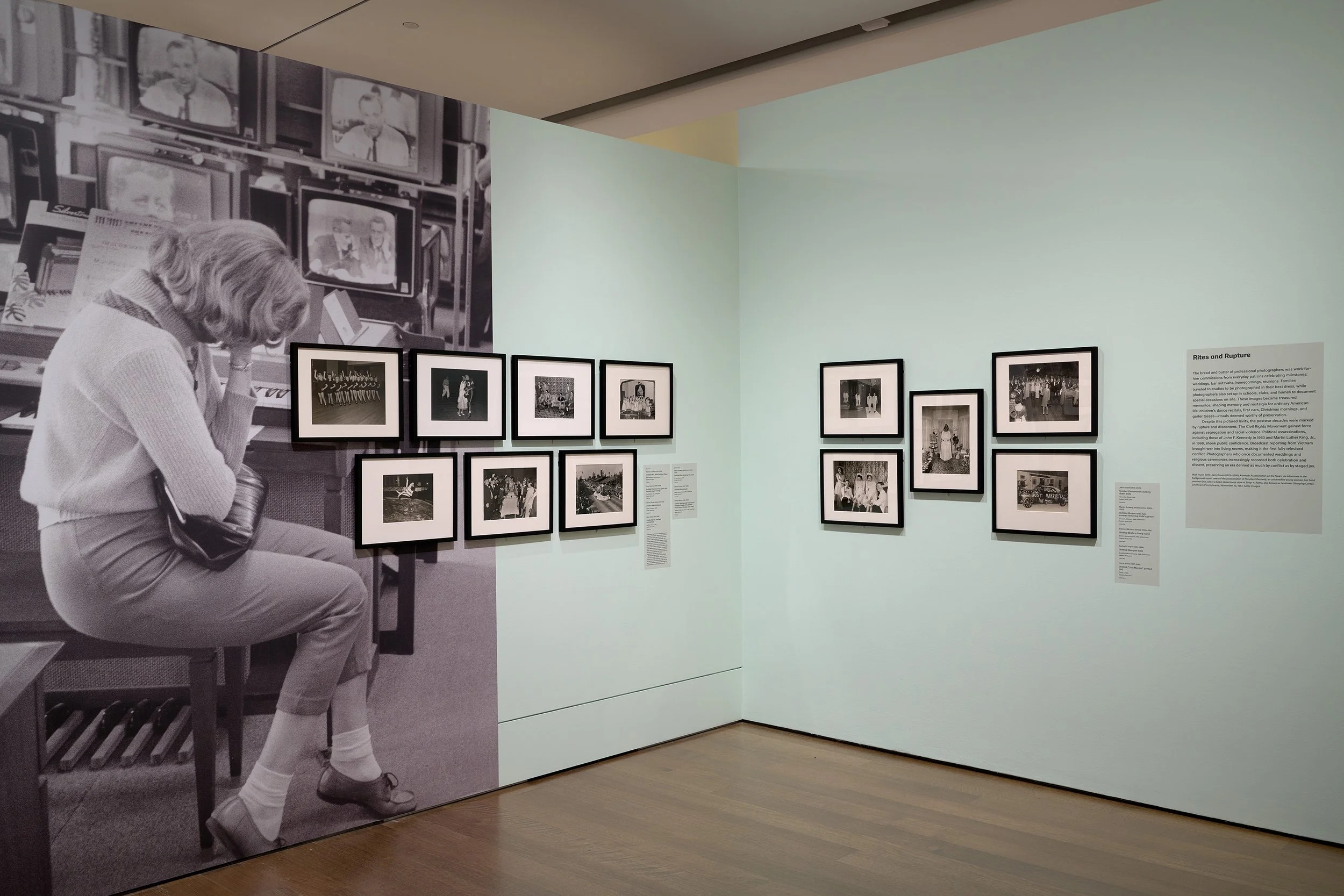
INSTALLATION VIEW “THE WAY WE NEVER WERE'“ Harvard Art Museums/Fogg Museum, Transfer from the Carpenter Center for the Visual Arts, American Professional Photographers Collection
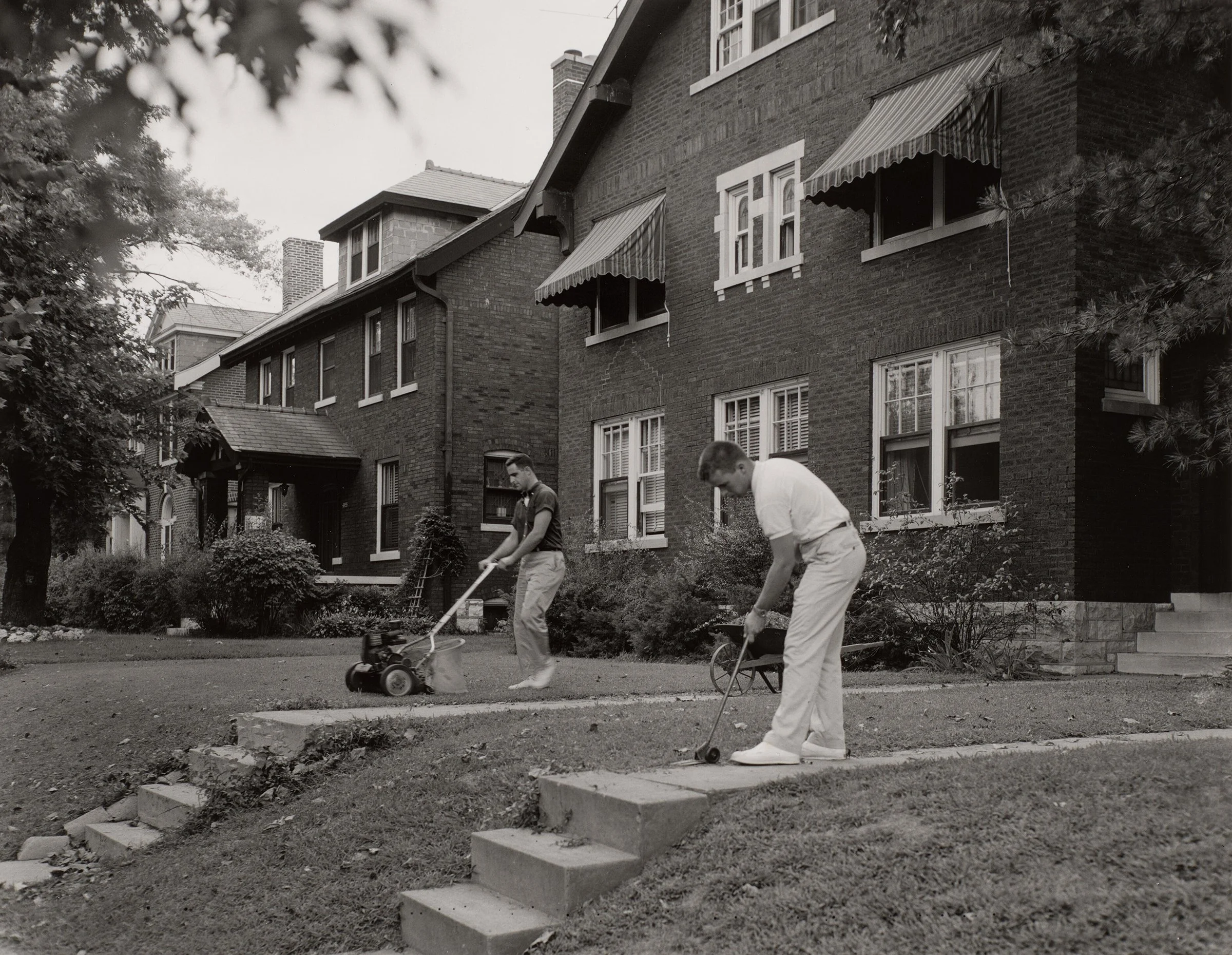
JACK GOULD "UNTITLED (MEN GROOMING FRONT LAWNS)" 1950. Harvard Art Museums/Fogg Museum, Transfer from the Carpenter Center for the Visual Arts, American Professional Photographers Collection
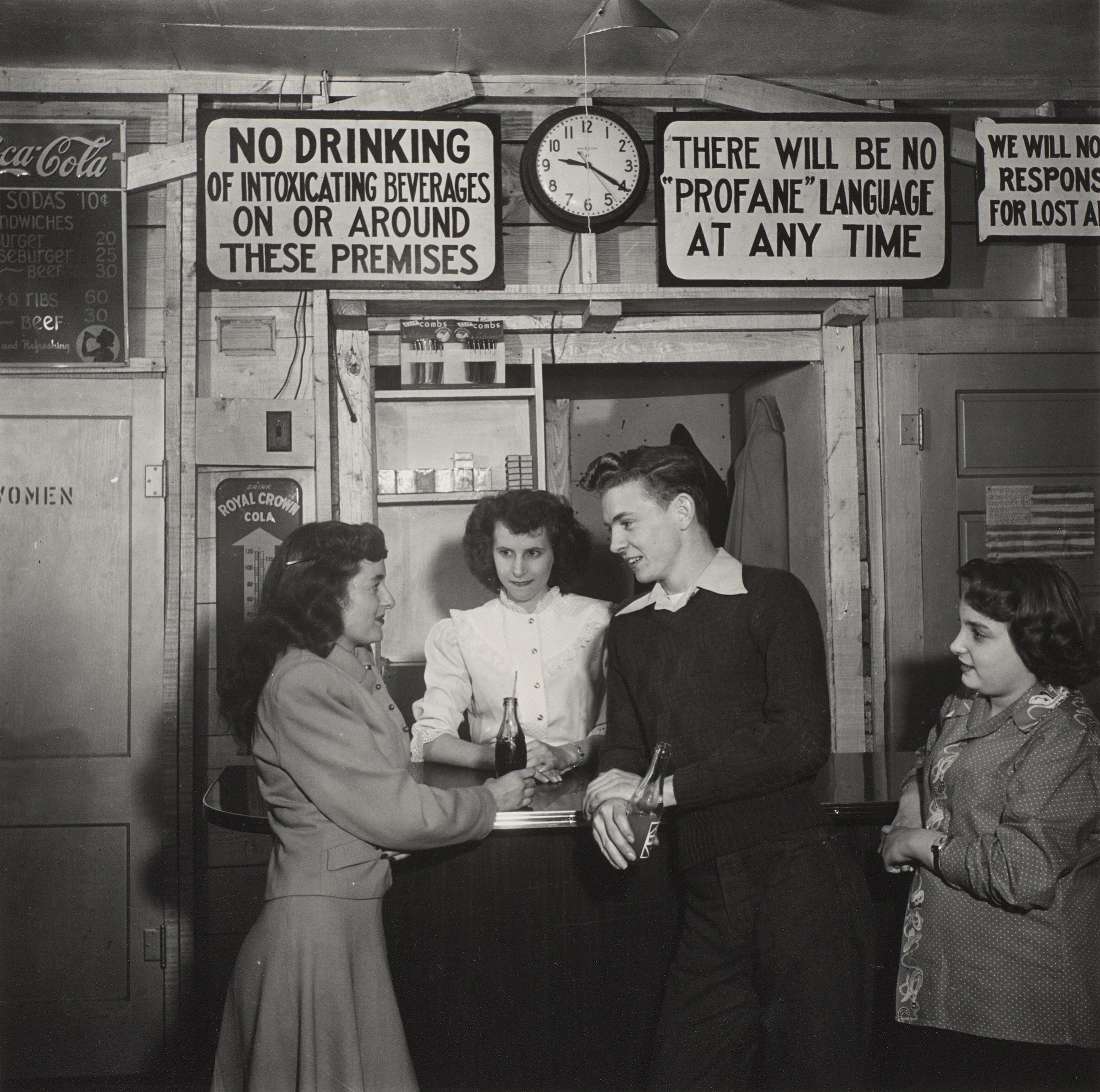
JACK GOULD "UNTITLED (TEENAGERS AT SODA FOUNTAIN)" 1950. Harvard Art Museums/Fogg Museum, Transfer from the Carpenter Center for the Visual Arts, American Professional Photographers Collection

JOSEPH JANNEY STEINMETZ "Untitled (family picnic on beach, Longboat Key, Florida)" 1958. Harvard Art Museums/Fogg Museum, Transfer from the Carpenter Center for the Visual Arts, American Professional Photographers Collection
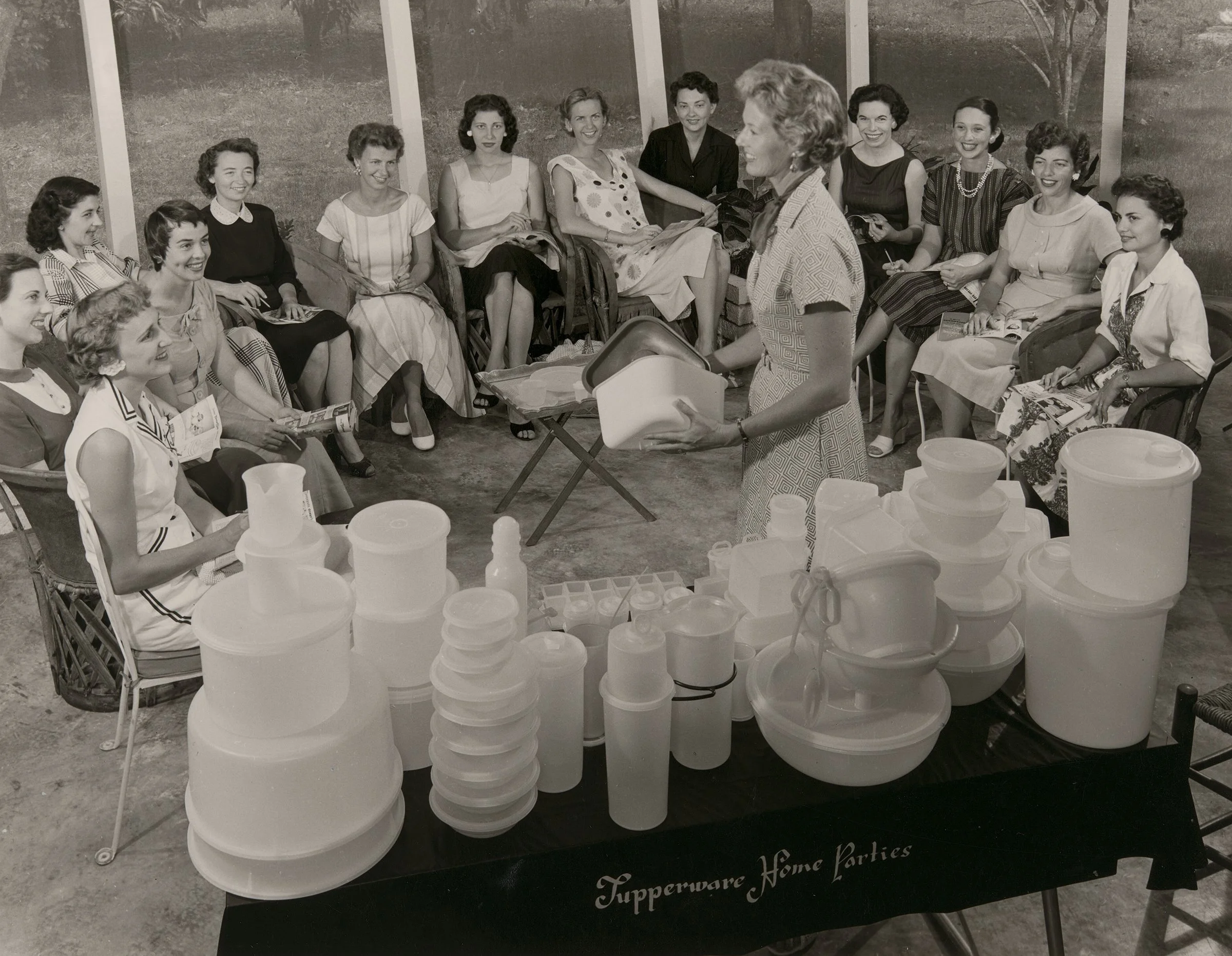
JOSEPH JANNEY STEINMETZ "UNTITLED (Tupperware Party, Sarasota, Florida) 1958. Harvard Art Museums/Fogg Museum, Transfer from the Carpenter Center for the Visual Arts, American Professional Photographers Collection