
By Marcus Civin, October 10, 2026
Caleb Stein has a documentarian’s drive but stirs a poetic sensibility. Selections from his black-and-white digital photo series “Down by the Hudson,” also a book (Palo Gallery Press, 2026), were recently on view at this intimate East Village space. In the dreamy photograph “Andrea’s Hand and Light Ray” (2023), an ethereal forearm, wrist, and claw-like hand appear luminous against a darkness that holds what seems a solar system’s worth of lavish micro-bursts. Perhaps underwater or blurry at night, Andrea’s limb evokes a loose tree branch in the wind. Across the gallery, the roots in Stein’s “Roots and a Fisherman’s String” (2023) grow out of or into the water. They look animal: a gray pile of shriveled orifices and wary octopus eyes. The fisherman’s string, lost and caught in the gnarled tree, appears to imitate its host, embracing disorder as a white, wiry tangle. In “Statue in Water” (2020), right at the front of the gallery, a figure from neck to knees is clothed but partially submerged, fabric clinging to skin. Before the shutter snapped, this may have been only a boy, but in Stein’s intense water, he becomes heroic, a great sailor, resurfacing here unexpectedly from another place and time.
Of course the water and the beach are favorite sites for artists: here, a reliably available array of half-nude models, both costumed and exposed; here, a clear boundary between one set of conditions (land) and another (stream). Nowhere else can someone dip, freestyle, and drown, in danger of becoming so quickly covered, consumed, and cut off. As a student at Vassar College about a decade ago, Stein found his part of the Hudson, Wappinger Creek. Neighboring the town of Poughkeepsie, the creek is ninety minutes from Manhattan. Now based in Brooklyn, Stein keeps returning. He’ll often spend the afternoon with someone he’s photographing, getting to know them in the process. Cows graze by the road, and a drive-in movie theater is around the way. Looking at these pictures, you might imagine hearing the slosh and sighs of a couple slipping into the water, then their modest splashes as they become relaxed and buoyant. In front of these pictures, you can feel the slippery rocks, the bark on the trees, and the mud under your feet. At times, it seems Stein is in the water with his camera; he pushes the water so dark that it sometimes conceals.
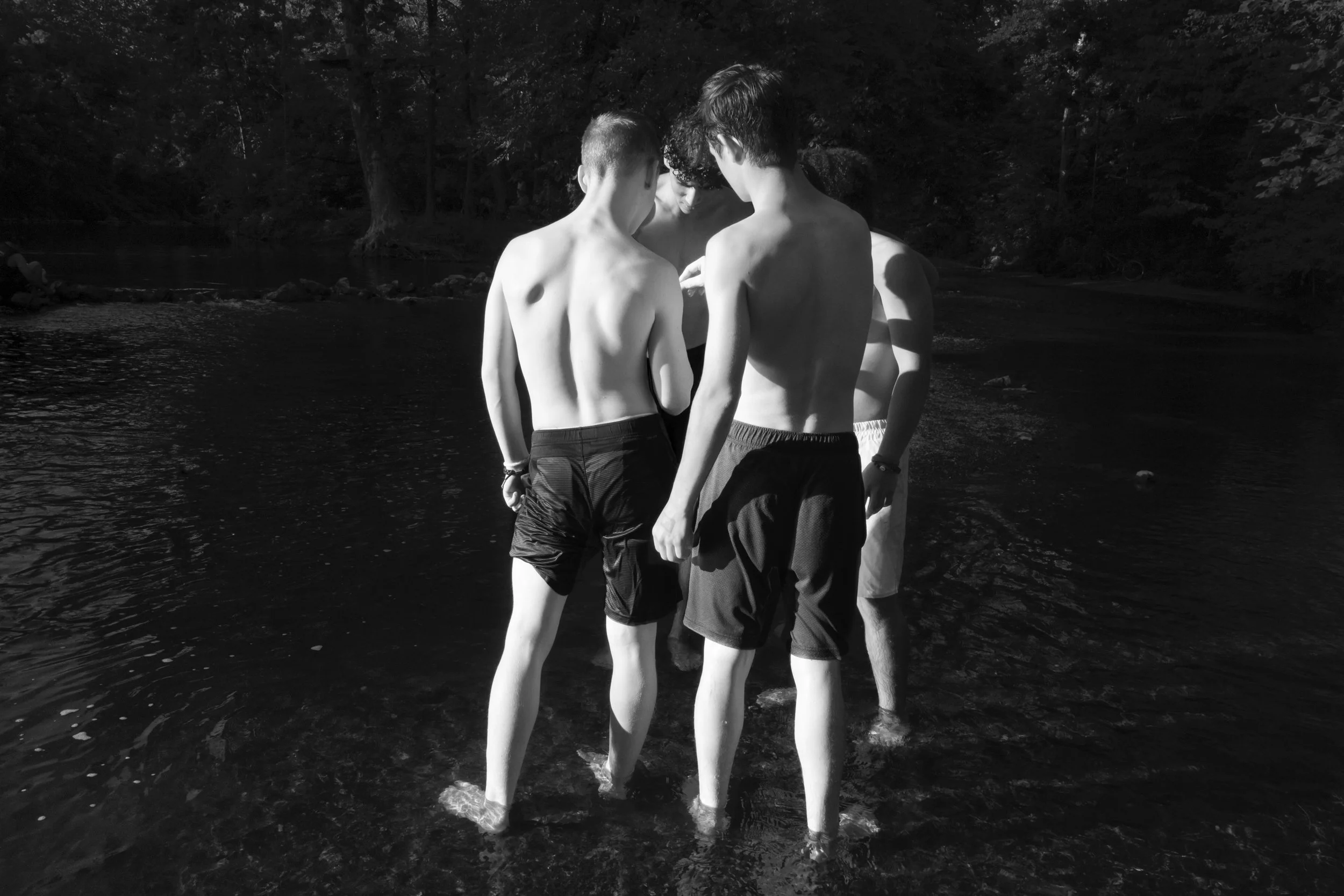
Stein knows his art history. Put “Boy with Roots Tattoo, with Roots” (2025) next to a heavy hitter like Paul Cézanne’s “The Bather” (1885). Compare “Matthew, Jackson, and Oden Floating” (2018) to Georges Seurat’s “Bathers at Asnières” (1884). The newer compositions are similar, rough mirrors of their forebears. “Anthony, Adam, Nick” (2020) plays a Thomas Eakins game. In “The Swimming Hole” (1885) Eakins positioned a group of male figures around a stone wall. As if they are different iterations of one person in a choreographed sequence, one lounges, one stretches, one stands, one dives, one swims. Likewise, the figures in “Anthony, Adam, Nick” cluster as a group, but also suggest a sequence, one person revolving in a circle.
Perhaps inheriting the grand tradition of the sublime through the Hudson River School and its vast, largely unpeopled painted landscapes, Stein respects the creek’s strong pull. His figures lose themselves in it. At least this grouping might too easily make nature romantic and restorative by default, rural America mysteriously pure, its landscape only a stage. Some complication of this narrative would be welcome if the artist continues to make photographs at Wappinger Creek. For now, though, the photographs are well worth swimming with.
Marcus Civin is a writer who lives in Brooklyn. He has written recently for ArtReview, BOMB, and Boston Art Review, among other publications.
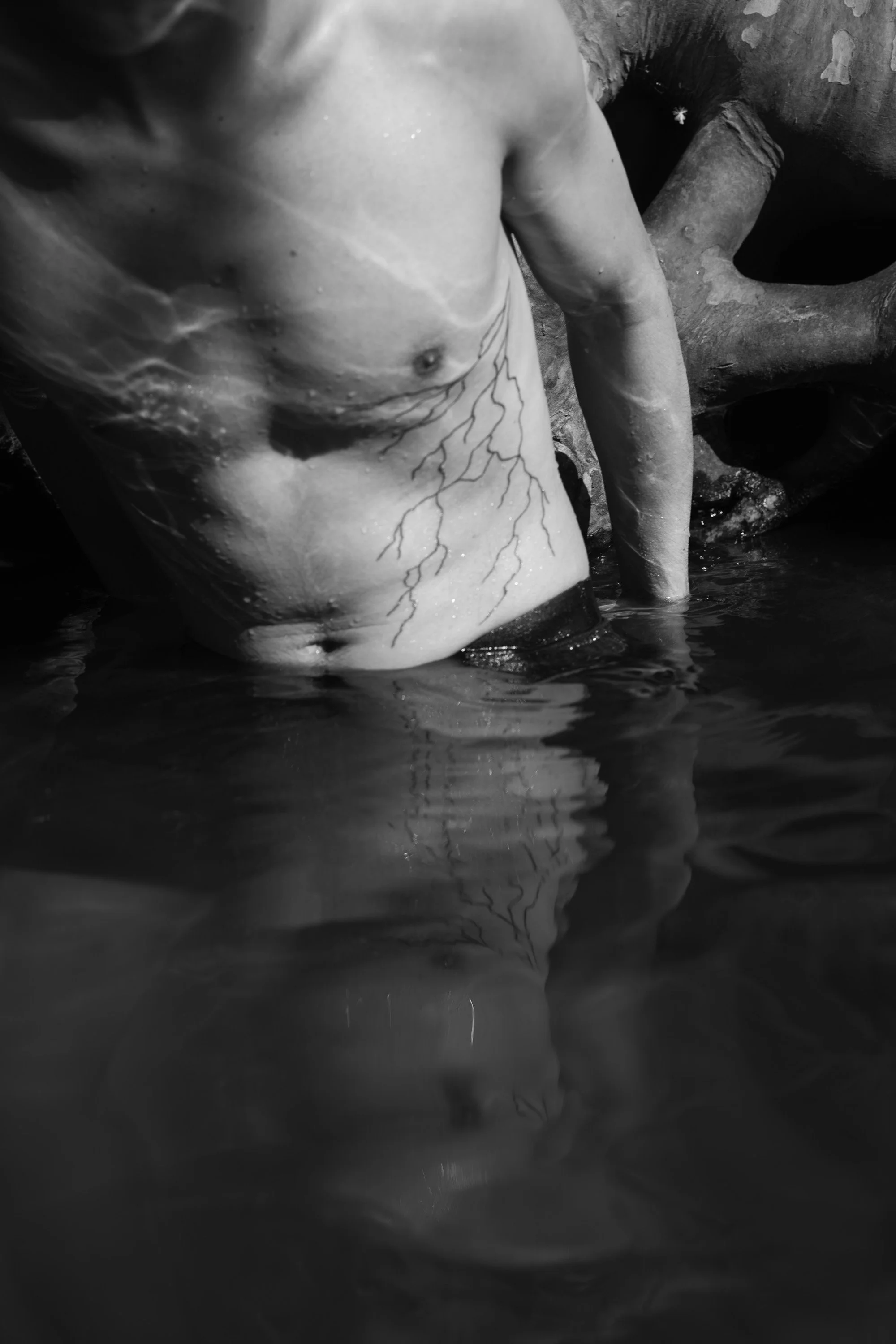
CALEB STEIN "Boy with Roots Tattoo, with Roots" 2025.
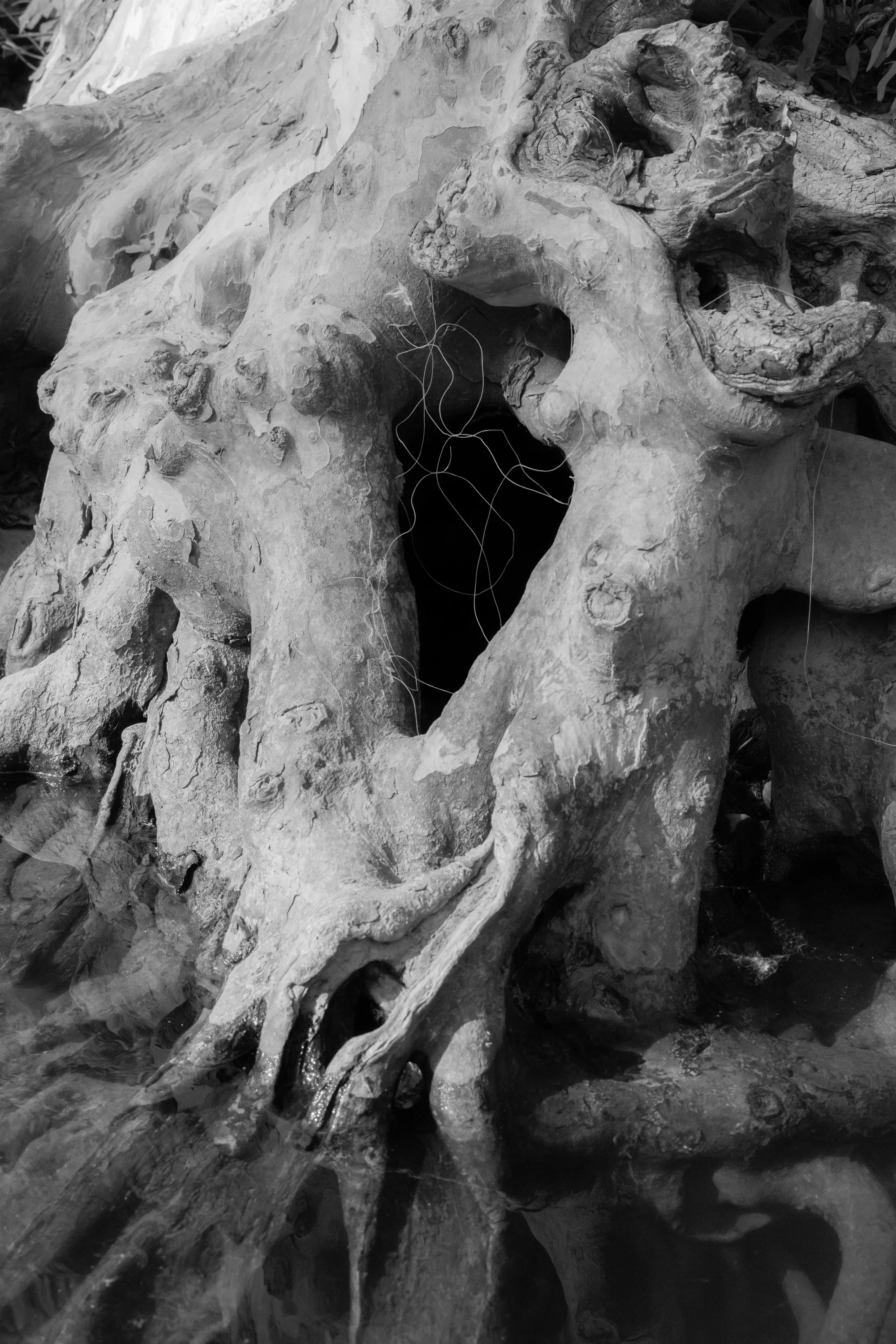
CALEB STEIN "Roots and Fisherman’s String" 2024.
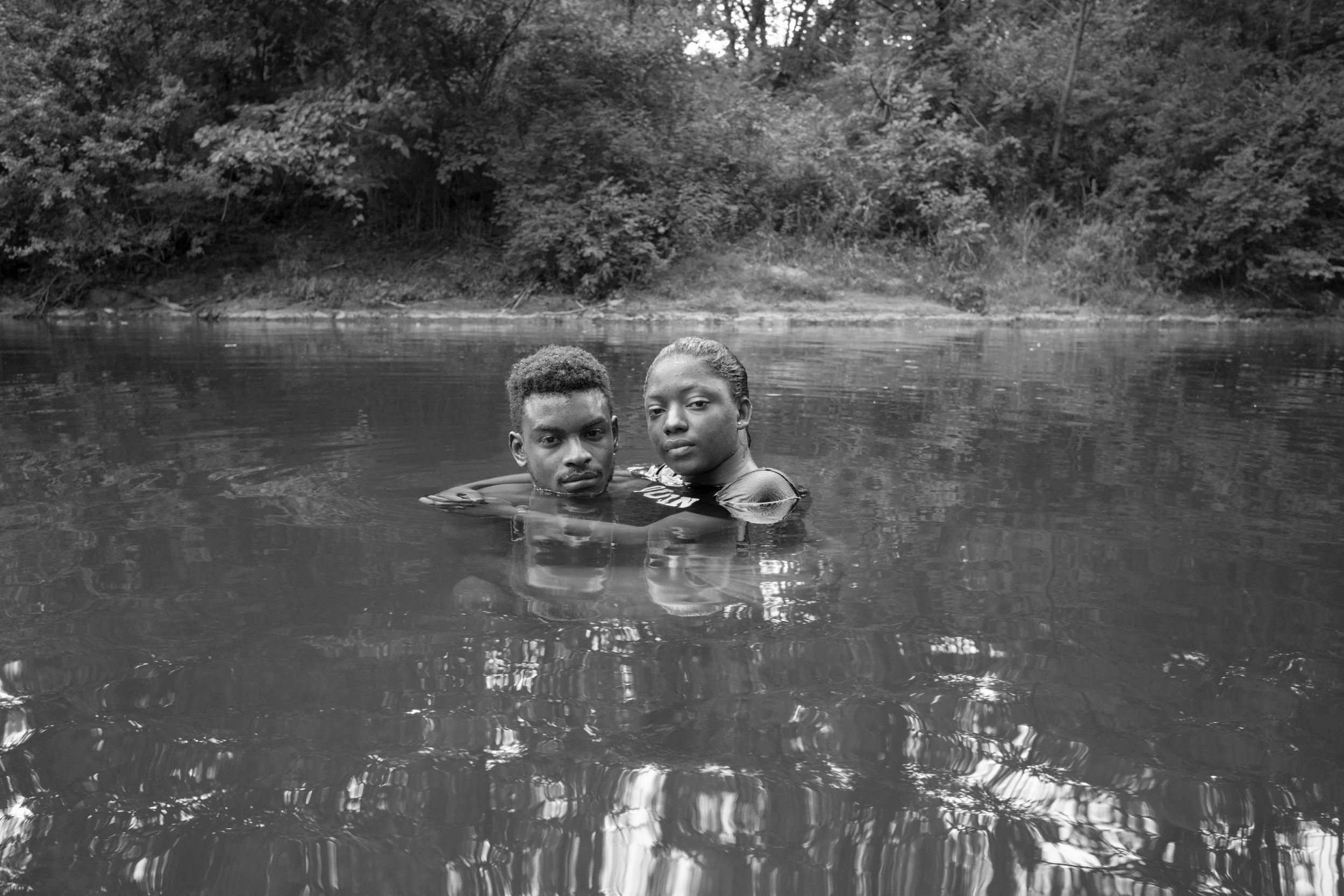
CALEB STEIN "Sanjay & Sherika" 2020.
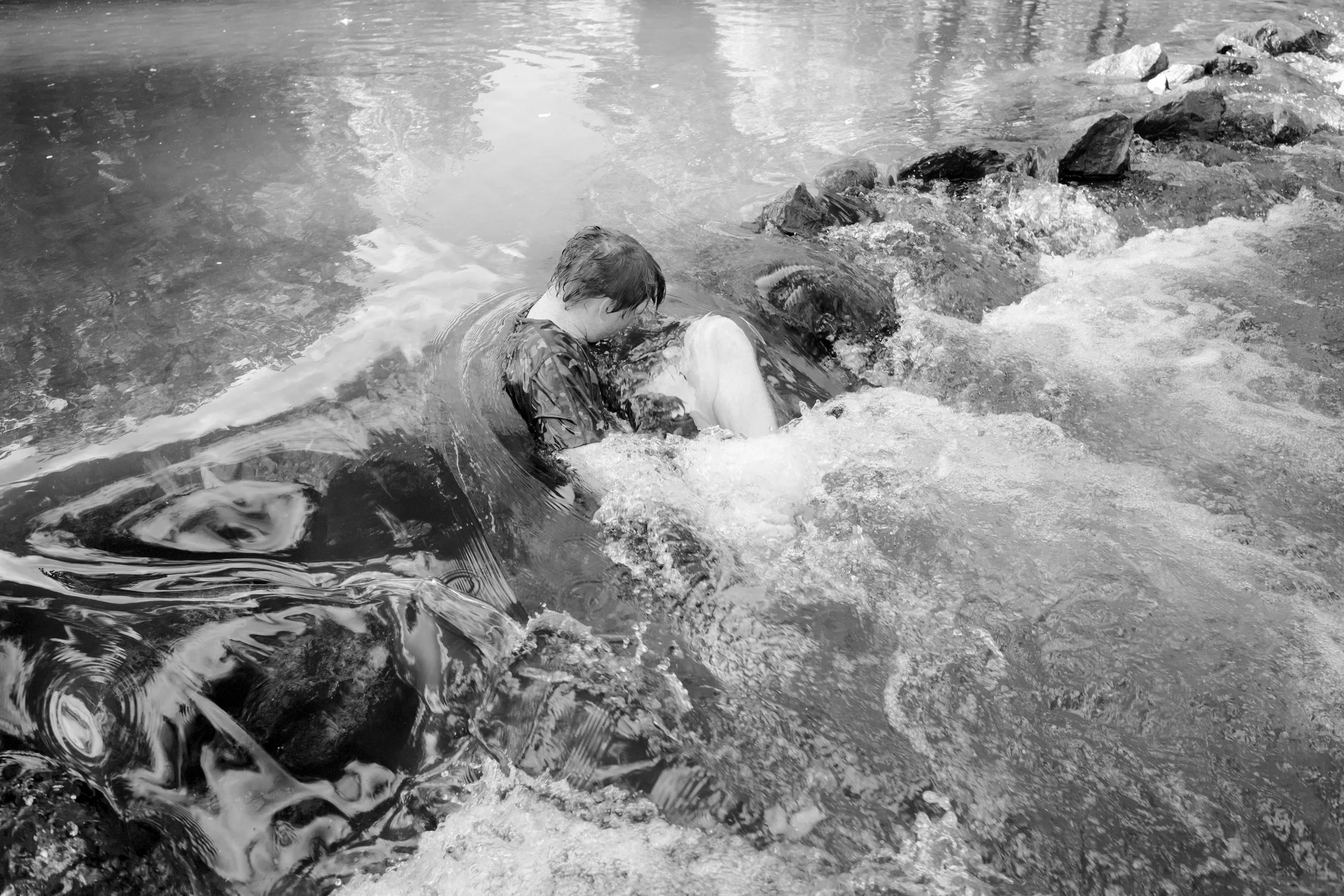
CALEB STEIN "Shamus in Embryo Pose" 2022.
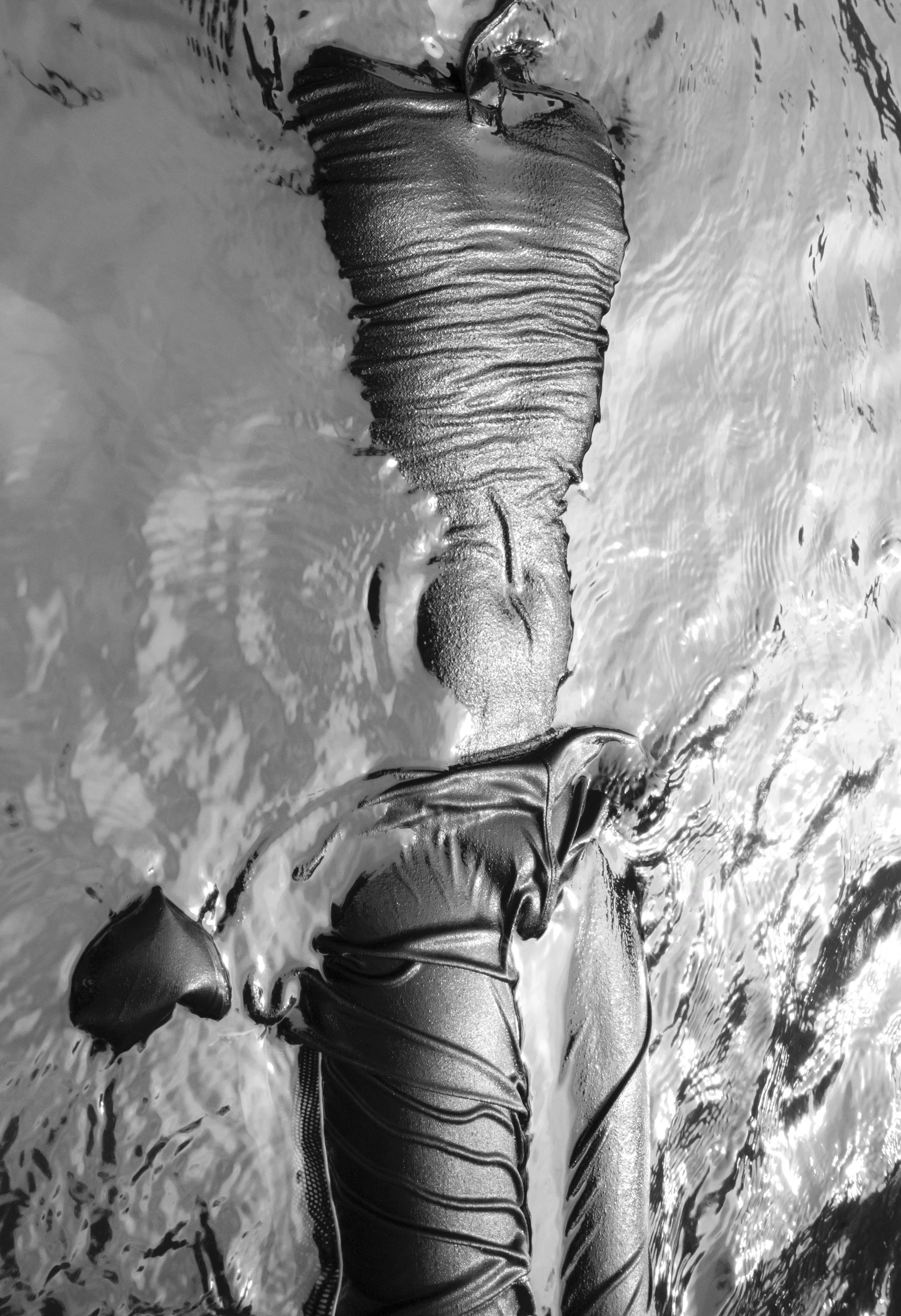
CALEB STEIN "Statue in Water" 2020.