
By Jan Staller, November 10, 2026
Photography has long been distinguished from painting and sculpture by its dependence on something existing in front of the camera. While the other plastic arts begin with the artist's intention to make an object, photography typically produces an image of something that already exists. There are exceptions, however: photographers who make the very objects they choose to photograph. The exhibition of Abelardo Morell at Houk Gallery, the gallery's first to show paintings alongside photography, raises the question of what happens when these two forms of image-making are brought together.
There is a lineage of photographers who have made or altered things specifically for their photographs. By the mid-1970s, Robert Cumming and John Divola were photographing their own constructions or interventions. Their photographs were not simply depictions of things as found; they were images of things constructed to be seen as finished photographs. Divola entered the photographers' theme park of ruined buildings and, instead of simply recording the decay he found there, applied a vandal's mischief, battering and spray-painting the interiors of abandoned military facilities to make images of confounding space and volume. Cumming stated in a1975 interview with Michal Auping that he approached photography as a sculptor, “nailing and hammering and building the photographs from the beginning rather than photographing things the way they are.” For at least 50 years, Zeke Berman has been arranging objects on a drawing table to photograph and, more recently, to make motion-picture studies. His resulting works are the only way to see the images he has imagined.
These artists are forebears of Morell's work: photographs of things gathered and manipulated for the picture, not simply to show how they appear but to transform them through the act of photographing. Throughout his career, Morell has manipulated objects before taking the picture, producing not a likeness but a vision that did not exist until he made it. His images are abstractions, and in that respect they are appropriate company for the paintings in this exhibition.
The photographs here offer an experience similar to that of looking at paintings. We may gaze at a painting for a time, filling our field of vision with the entire canvas. If the painting is representational, we quickly perceive a scene, figure, or still life rendered in pictorial space, much as we do in most photographs. With nonrepresentational painting, some concentration may be necessary to perceive painterly space: an illusion of depth despite the actual flatness of the surface.
Morell's photographs invite a similar kind of looking. The smaller works encourage the viewer to move closer and examine details rather than contemplate the entire field. The 30 × 60-inch proportions of “Paper Cut Outs #3” (2026) make it possible to take in the whole image, while its intricacies draw the eye closer. Following the rhythms of its jumbled shapes and colors, the viewer scans this way and that. The experience resembles examining a painting for the texture of its paint and the minute details of color and shape.
At close range, the shadows cast by the paper pieces become evident, as does a perplexing feature: some of the paper colors and layers seem to melt together, losing the crisp edges and shadows visible elsewhere. This effect involves making two or sometimes three exposures, moving objects within the frame between exposures. Objects that remain static appear normal, while those that move blend across the exposures. The resulting image makes the photographic process itself part of the spatial puzzle.
“Paper Cut Outs #1” (2026) is a third the size of #3, but its larger, jaunty shapes create a faceted field.
The Color Paper Abstractions are the standouts of the show. The illusion of space seems to jump out from the wall. These compositions consist of towers of stacked colored paper of indeterminate scale, arranged within the frame so that, under Morell's backlighting, the objects seem to dematerialize, becoming a spatial puzzle. Foreground and background oscillate. In “Color Paper Abstraction #12” (2026) the center of the image momentarily suggests an inverted pyramid, but a third stack of paper in the back of the photograph fights its way to the front, making an actual concavity appear convex. In a medium naturally inclined toward faithful description, these spatial reversals are a rare delight.
“Yellow Circle on Wood” (2025) is the outlier in the show. Its reductive composition offers much to contemplate. Five identically sized square slices of wood, with pronounced end grain, are assembled into a cube and overpainted with a yellow circle. The blue-painted top piece establishes a sense of volume. The assembly rests on a wood-grained surface, visible only as the thinnest margins around the cube. Yet rather than receding behind it, the wood-grained surface appears to come forward while the cube flattens out, reversing the spatial relationship. The curving lines of the wood grain are hypnotically arranged, and small black checks seem to dance across the yellow orb.
Placing Morell's photography alongside painting is a worthy consideration. These are all blue-chip paintings, and hanging photographs alongside them should impart some of that street cred to the photographs. I'm just not sure that the particular paintings in this exhibition are all that relevant to the photographs. With the exception of “Rectangle #2 Colored Tape and Paint” the photographs are spatially absorbing in a way that most of the paintings are not.
Looking at Kenneth Noland's “Orange and Blue” (1966) I found that it remained completely flat, no matter how long I looked. The same was true of Gene Davis's “Untitled” (1965). Larry Poons's “Untitled” (2016) and Jules Olitski's work, in contrast, were abstract maelstroms, offering a more absorbing experience of pictorial space. Gazing at the entire canvas or moving in to examine daubs, swirls, and whorls, one can become immersed in the illusions that emanate from painting.
These paintings, as a group, do not relate convincingly to Morell's photographs. Comparable work comes to mind in Al Held's paintings and in the spatial constructions of Cubism.
By chance, I went to Perrotin later that day and saw paintings by Young-il Ahn. Some of them seemed more appropriate companions to Morell's work, as might the work of many other abstract painters. The idea of bringing photography and painting into dialogue is sound. The success of the pairing, however, depends on the particular works chosen.
Jan Staller is a photographer whose most recent work is collected in “Manhattan Project” (Simon and Schuster) in 2025, his third monograph. His critical writing appears in The Brooklyn Rail.

ABELARDO MORELL "Colored Paper Abstraction #2", 2025. Courtesy of Abelardo Morell and Edwynn Houk Gallery.
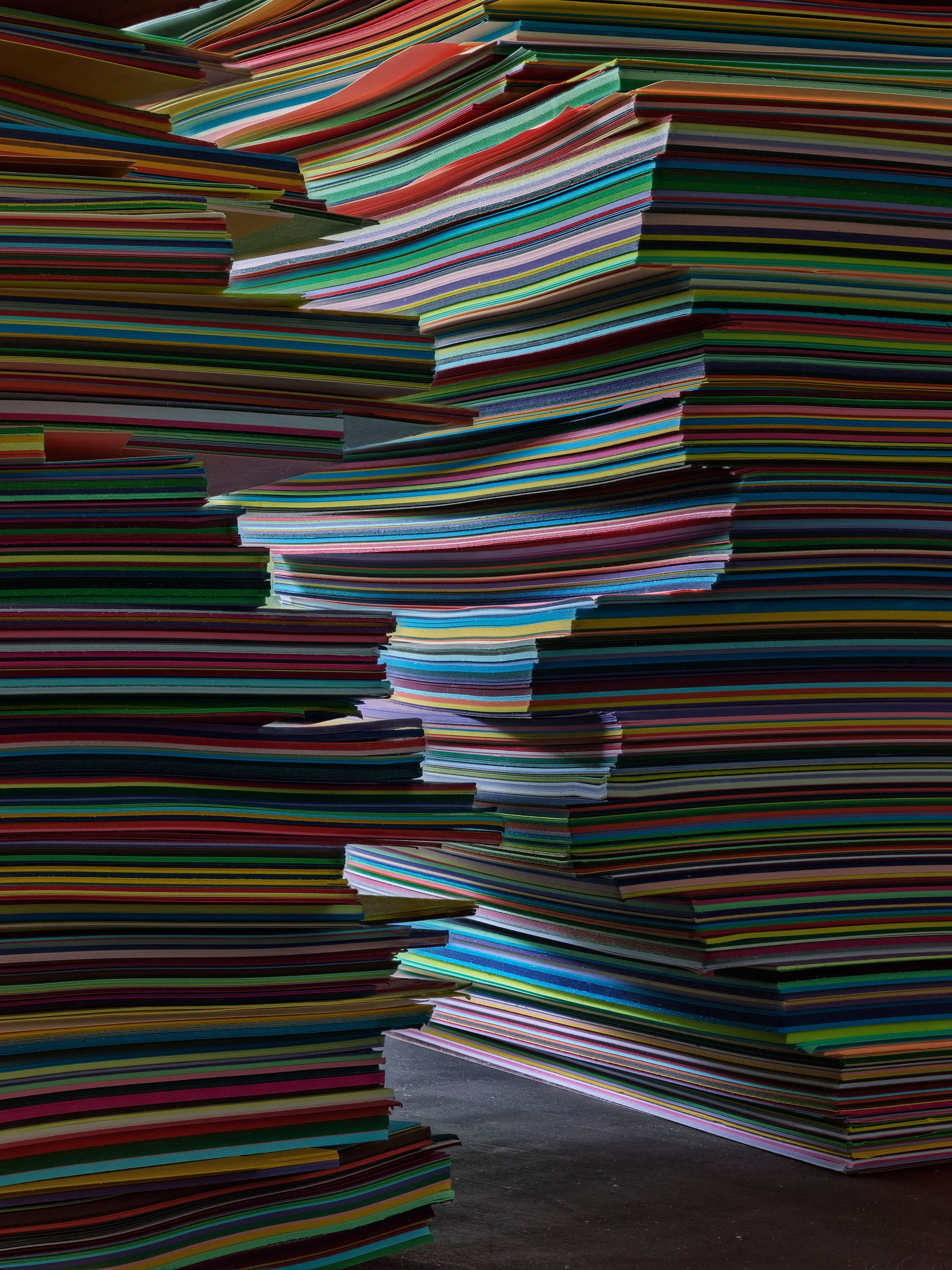
ABELARDO MORELL "Colored Paper Abstraction #4", 2025. Courtesy of Abelardo Morell and Edwynn Houk Gallery.

ABELARDO MORELL "Paper Cut Outs #3", 2026. Courtesy of Abelardo Morell and Edwynn Houk Gallery.

ABELARDO MORELL "Yellow Circle on Wood", 2025. Courtesy of Abelardo Morell and Edwynn Houk Gallery.