By Colin Beattie, November 10, 2026
How would you smuggle a dead octopus into an airplane bathroom? Would you hide it under your shirt, cold tentacles close to the skin? It’s a question I found myself asking at “GAG”, an exhibition currently on view at the George Eastman Museum in Rochester. Rigorously curated by Phil Taylor, the show is a collection of wild, mordant images that take turns slapping the audience – sometimes on the knee and sometimes right in the face.
The octopus in question occupies several photographs by Josephine Pryde. Clinging to the edge of the airplane lavatory sink, the poor creature looks like it’s been flung with great force. Describing these scenes in “GAG”’s exhibition catalog, the critic Tina Post says:
[It’s] some kind of violence… It’s not just a looming danger. There’s something that has happened, or has begun to happen… I don’t know quite yet how to name it.
When I first read those words, I thought they might just as easily be describing life. In these times, the dangers are no longer looming - they’ve really begun to happen. Sometimes I have a new feeling, an intoxicating kind of worry. I felt it when I watched rioters storm the US Capitol. I feel it every time I see a sunrise filtered through forest fire smoke. I feel it when I see ICE agents loitering by the doors of an airport, hands tucked in their Kevlar. More than ever, our lives are being shaped by some kind of violence. Bedraggled and bewildered, perhaps the octopus is… us.
“GAG” is packed with images that dangle awkwardly between hilarity and horror. A self-portrait by Tommy Kha balances a paper version of his face on the bare element of an electric stove. Nothing’s on fire yet but stick around. In two monumental prints, Arnold J. Kemp plays rough with a rubber Flintstone mask, filling Fred’s eyes with fingers and thumbs. The images are beautiful, but unnerving as well. Kha and Kemp are fucking around with the camera’s ability to make a mask seem like someone real. In his curatorial statement, Taylor says this game is “a glitch in the seamless production of subjectivity.” A series of new self-portraits by Whitney Hubbs develops that concept. In one image she’s Laura Palmer, then Judy Garland, then Janet Leigh, and then… a ghost in the shower? Hubbs’ costumes remind me of the procession of mugs who clamor for attention on my social media feeds, but her kohl-rimmed stare punctures the scene every time. It’s a pastiche of the self-branding we all do as we navigate the internet’s economy of attention. Look at me. Validate me. Like and subscribe.
We negotiate with the camera for our own worth, and it replies by flooding the market with value. “GAG” features plenty of work from the margins of commercial photography, that exploits the currents of myth and psyche that seethe under the gloss of most editorials. Phil Taylor’s delightful term for this genre is “prop cart and garment rack runoff.” In Talia Chetrit’s “Untitled (Family #1)” the flash pops for a cute baby, but the heteronormativity of the scene is disrupted by Dad’s bondage harness. I’m a father who has never yet worn a harness, but everything about this image resonated with my experience as a parent. Martine Gutierrez appropriated the tack-sharp lenses and lush resolution of fashion work to create her self-portrait as the Virgin of Guadalupe. The icon’s traditional mandorla is replaced by a bristling array of zip-ties cinched over her bare breasts. Nearby, Tobjørn Rødland’s “Mid Iron” shows us a model calmly swallowing a golf club. They might seem like crude ideas, but I was captivated by the fineness of the details. The beads of moisture on Gutierrez’s body precisely reference Our Lady’s oft-painted tears. Uncanny grace in the eyes of Rødland’s model give the scene a sacred quality; I thought of a Minoan priestess holding snakes, or the fervor of self-flagellation. This tension between the raw and the exquisite, there are echoes of the transfiguration at the core of humankind’s oldest pictures.
In 2015, Pope.L created a series of collages known as “Servants” pasting his own face onto 19th century photographs of white children and their Black caretakers. In these cutups, Pope.L is a time traveling, shapeshifting trickster, scrambling the social hierarchy of each scene. Sometimes he’s baby Pope.L, cradled in the arms of a man half his age. Elsewhere his face completely fills the frame or is inverted into his negative image. Here he’s a table, there he’s a bed for the child to sit on. Looking at these collages, I remembered something Kara Walker said recently about her approach to cutting up a decommissioned Confederate statue:
This was basically mine now, my found object…to be played with and contended with and wrestled with as an artist.
Pope.L and Walker both treat historical artifacts of subjugation with irreverence. It’s a transgressive stance by artists who refuse to provide the viewer with any easy conclusions. The rephotographed collages in “Servants” meticulously preserve each ragged cut and smear of paint left by Pope.L in his studio. They are indexical traces that trap the viewer in the mess of his creative process, withholding any way to escape.
While the main exhibition is dedicated to work from the 21st Century, Phil Taylor has also curated a show-within-a-show that pursues the exhibition’s theme deeper into the Eastman’s permanent collection. Taylor calls this a “genealogy of gag,” tracing examples by the likes of Man Ray, Laszlo Moholy-Nagy, Ed Ruscha and John Baldessari. There was also a sharp selection of relevant work by artists associated with Rochester’s Visual Studies Workshop like Bea Nettles, John Pfahl, Keith Smith, and Marion Faller. It’s important to state that these works share more than a superficial fascination with humor. As critic Heather Diack points out in GAG’s catalog:
With Dada and Surrealism, or Neo-Dada to Conceptual art, we’re also looking at moments where questions of “What is a rational way to be in the face of intense social upheaval?” come to the fore. And art and artists are trying to negotiate all kinds of really complicated power dynamics, which are often also being mediatized.
This review is being written during the dizzying cycle of another American election. This time it ended (for me) with catharsis instead of alienation, but these are still convulsive times. In the quickening vortex of protest, power and mediatization, the camera just keeps egging us on: Do another viral stump speech. Do another pratfall.
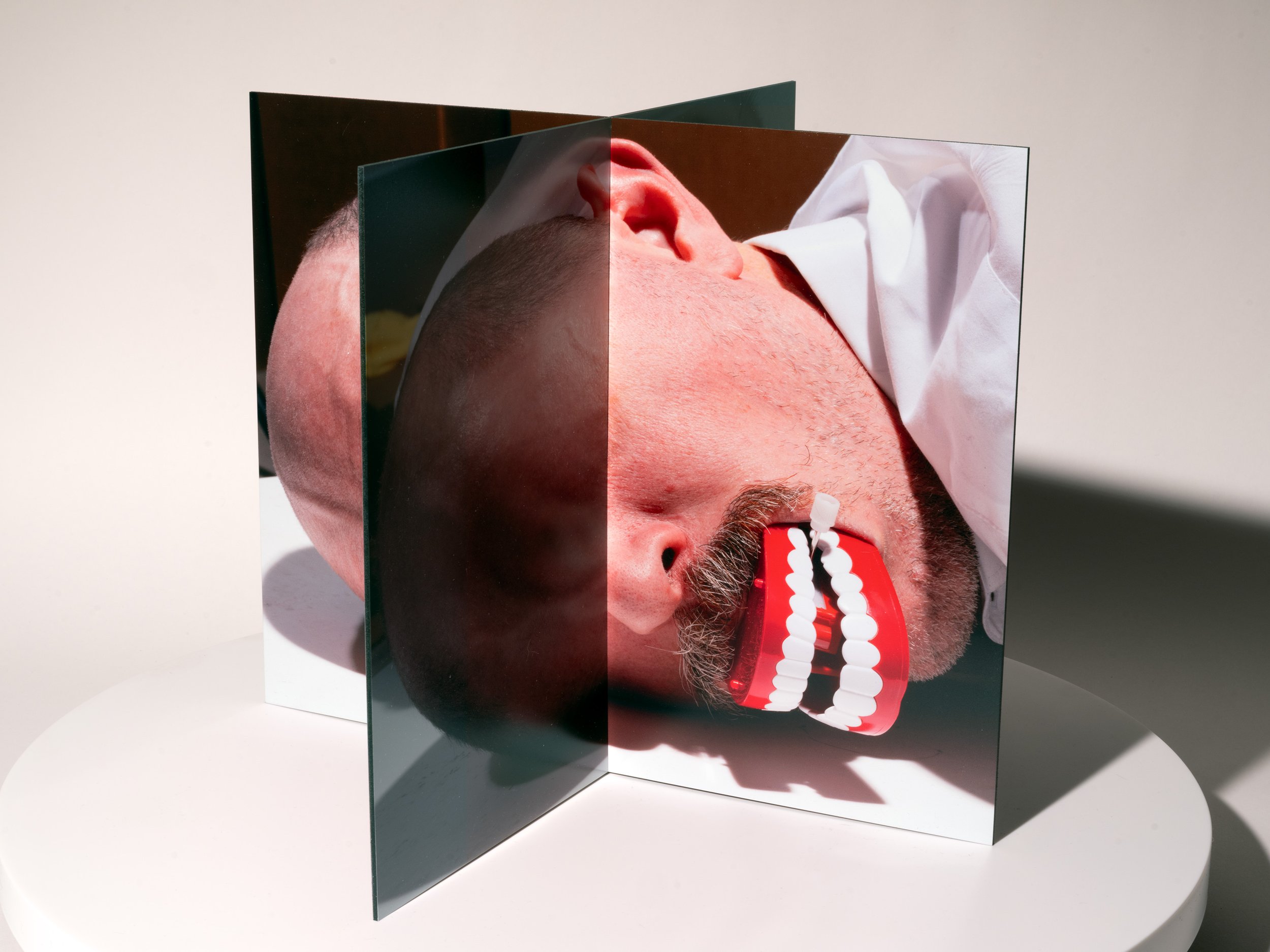
As Lucas Blalock points out, there’s some delicious irony in the fact that “GAG” is being presented by the oldest photography museum in the world. Blalock’s own practice is founded on his curiosity about the way our world changed as the camera rose to prominence in the nineteenth century. At the Eastman, Blalock is showing what he describes as “a productive misunderstanding of a zoetrope,” in which his bisected head is served up on five slowly rotating platters. It’s a resurrected ancestor of the motion picture camera, and it’s also an abject deconstruction of the selfie videos we now create with the tap of a finger. Installed just a few hundred yards from the literal home of George Eastman, the Kodak King himself, Blalock’s “Tête-à-tête-à-tête-à-tête-à-tête” is a sniggering yet salient illustration of the way cameras have been shaping our self-image for more than 200 years.
Colin Beattie is an artist and curator whose work will be included in “Art at the Edge of Empire,” opening this February at the Dorksy Museum in New Paltz, New York.
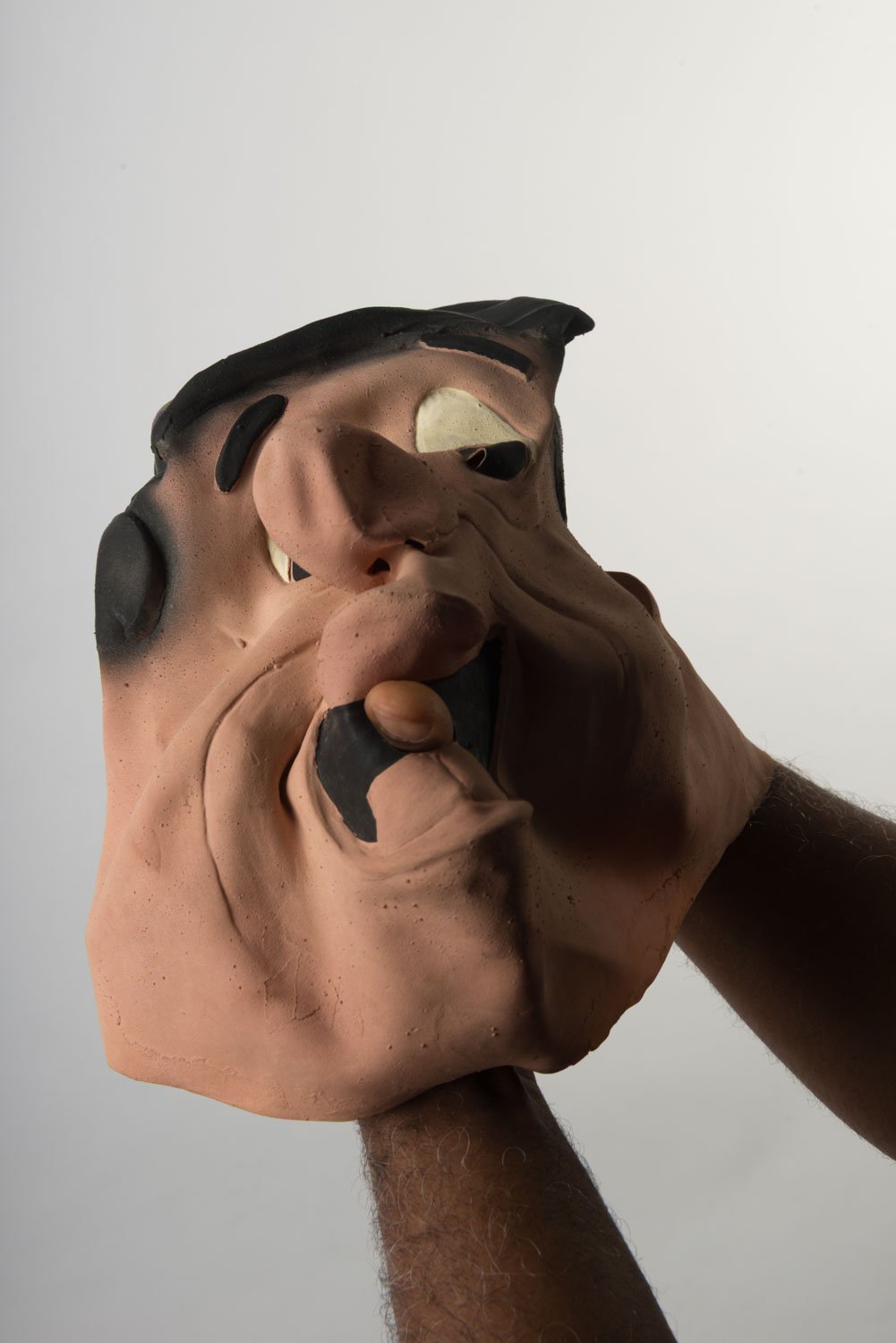
ARNOLD J.KEMP "Funny House (speech Acts)" 2019.
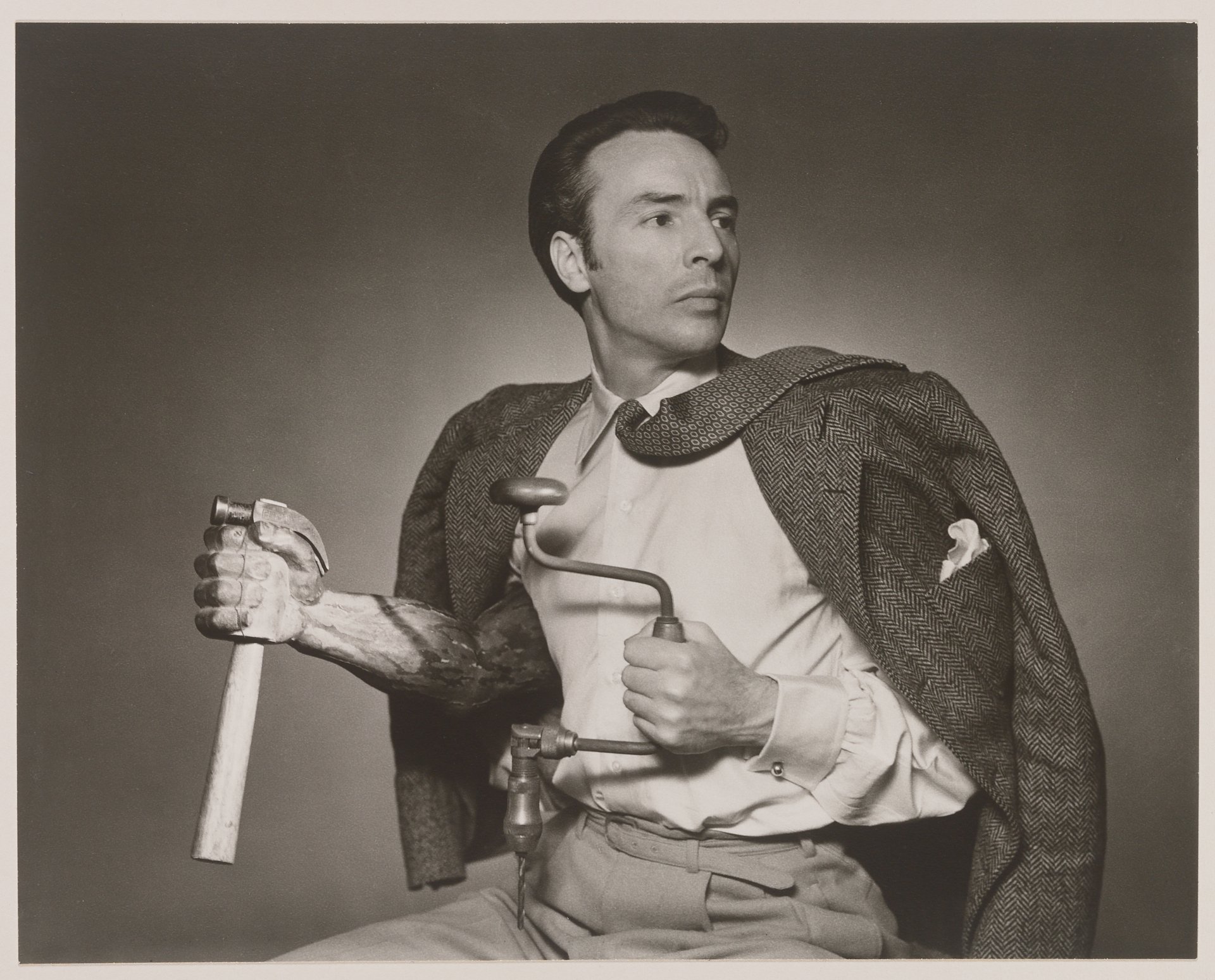
GEORGE PLATT LYNES "George Balachine" 1941.

JOSEPHINE PRYDE "Cabinets (Three)" 2019. Courtesy of the artist and Reena Spaulings Fine Art, New York.
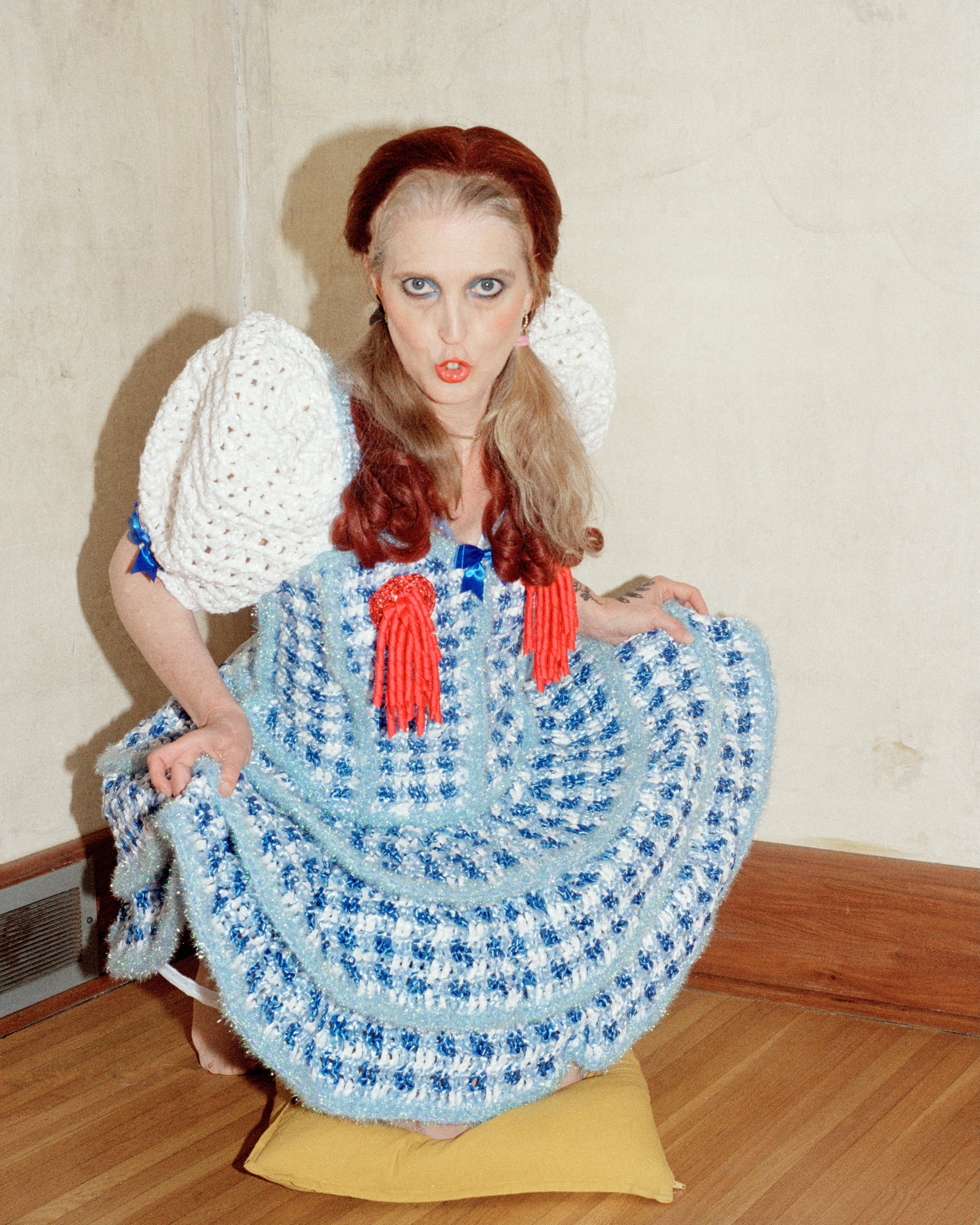
WHITNEY HUBBS "Playing Pretend as Dorothy" 2025.

POPE.L. "Loving Nanny, Loving Master, Loving Artist" 2015. Courtesy of the Estate of Pope L. and Mitchell-Innes & Nash, New York.