By Hector R. Membreno-Canales, November 10, 2026
The pyre in the corner of the gallery is built to fire code. Weathered boards lean against the corner of a black wall, scorched at the edges. A few pink boxes of matches lie beneath a sign that boldly reads, “WHAT APPEARS TO BE INSPIRED BY BLACK RAGE IS REDUCED TO SIMULACRA. STATED PLAINLY, BLACK PEOPLE DO NOT OWN OUR RAGE. MORE PRECISELY, WE ARE ROBBED OF OUR RAGE WITH THE COERCIVE AIM TO LEGITIMIZE THE STATE.”
The work is “Master’s Tools/Master’s House (Exclusion & Extraction)” (2025), featured in Zora J Murff’s first museum show, curated by Terence Washington. Its title borrows Audre Lorde’s 1979 warning: “The master’s tools will never dismantle the master’s house.” The wall label finishes her thought: art and museums “limit their challenge to power when any risk to property or wealth is reduced to an illusion.” A small card thanks the art fabrication team. The fabricators at MASS MoCA built a pyre meant to burn the museum down, then made sure it couldn’t.
The building has its own history of extraction. MASS MoCA occupies the former Arnold Print Works, which printed cotton cloth and prospered on Union Army contracts during the Civil War. Its successor on the site, Sprague Electric, made components for weapons systems in World War II, including, by the museum’s own account, the atomic bomb. The exhibition occupies rooms with a history of serving the very institutions Murff scrutinizes.
In the gallery I overheard a visitor say, “a lot of art is used for tax fraud, but this work would make such results difficult.” It was a sharper reading than it sounded. The sign on the pyre quotes, in addition to Audre Lourde, Rasul Mowatt’s “Laundering Black Rage”, and laundering is the show’s subject: how anger, like money, gets washed into an economy of exchange. Much of what is presented here would be uncomfortable to buy, even if it does match your luxury leather sofa. That friction with the market is one of the show’s greatest achievements.
If RACE/HUSTLE has a target audience, it’s people like me and, likely, like you: artists who show in galleries, people who draw salaries from institutions, people who love art, buy the catalog and assume (or hope) museums are on the right side of history. You don’t need to share Murff’s politics to feel the show’s pull.
Murff began his practice as a documentary photographer, and the strongest single images here are still photographs. “Gas Money (Affirmation #1)” (2019) hangs alone on a long white wall and lit like a religious altarpiece. Two Black hands meet in black and white: a lit cigarette, a folded $20 bill passing between them, Andrew Jackson’s face half lost in the crease. Murff has said he made it as a memory of his childhood allowance, and that the first time he showed it, a viewer could only think of George Floyd’s counterfeit twenty. The picture holds both readings with ease, which is what photographs can do that a wall text can’t.
Murff uses beauty deliberately. Several of the prints are rich and precise. The neon at the entrance glows the warm red of a bar sign. Yet Murff uses pleasure the way Dave Chappelle uses a joke: to warm you up just before you wince.
Not everything is polished, however. The cross above the altar is made up of six Xerox sheets held up with pushpins. The work borrows the slick finished aesthetic of the market; roughness arrives where he uses the look of the flyer and the zine. Even the roughness is manufactured, like the pyre’s charred lumber, arranged with a fabricator’s care.
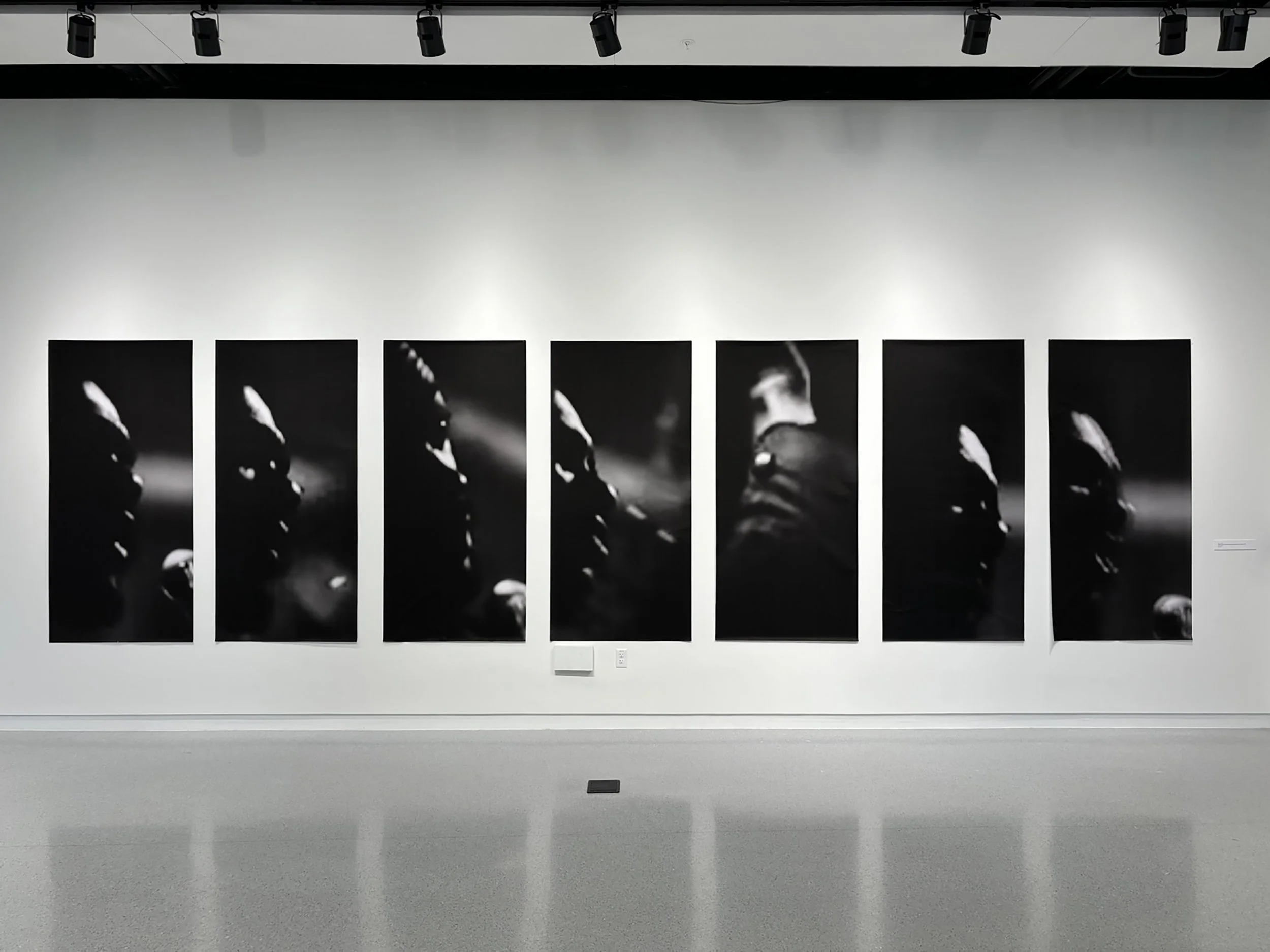
The most difficult photographs to look at are “I Woke Up Today Want’n to Kill Me a White Man (N.H.I.)” (2022). Four heavily pixelated photographs, spaced across a long white wall, show the 1992 beating of truck driver Reginald Denny in South Central L.A. following the Rodney King verdict. “N.H.I.” stands for “No Humans Involved,” an acronym used by the Los Angeles Police for cases involving young Black men. The label paraphrases bell hooks: collective Black rage, it says, “could be productive if it were organized and channeled toward liberatory ends.”
Murff is his own harshest critic on this point. On the podcast ‘Saturdays with Renee”, he describes his first project, “Corrections”, made while he monitored juveniles on probation in Iowa, as extractive. He says he now keeps some earlier work out of circulation and uses it only for teaching. That framing raises the stakes for every borrowed image of violence in this show.
Several of these works appear in “True Colors (or Affirmations in a Crisis)”, Murff’s 2021 Aperture monograph. That book, much like this exhibition, plays like a Wu-Tang album: a crew of artists with their own solo careers, each taking a verse, and the whole still one sound. Murff describes his own method in the book as “iconography, sampling, and motivic development.” RACE/HUSTLE works the same way: the curator, the video artist and the collaborators are the same crew, and the show is their record.
The exhibition’s only painting, “The Necessary Machinery of Survival (Lincoln Heights, OH)” (2025) renders a cable-news frame in oil: armed Black men in tactical gear and face coverings stand beside a news reporter on a suburban street. The scene is Lincoln Heights, a majority-Black village north of Cincinnati, where residents began armed patrols after neo-Nazis showed up at the edge of their community.
The composition is tight, with figures cropped by the frame’s edge. It recalls Gustave Caillebotte’s “Paris Street; Rainy Day” (1877), a canvas celebrated for its photographic cropping. Murff’s painting is a literal still, taken from cable news. Caillebotte’s well-dressed walkers stroll Haussmann’s new boulevards, streets widened, historians argue, to prevent barricades from being built and to allow faster movement of troops and cannons. Zora Murff’s street scene is the inverse: a majority-Black village, its police department disbanded in 2014, arming to protect themselves. Both paintings use the photographic crop to ask who controls the streets, but they arrive at radically different answers.
At the center of the gallery sits “Metaspectacle (Race/Hustle)” (2023). On a white and green stage, on one side is Murff’s own International Center of Photography (ICP) Infinity Award, resting on a pair of black Isotoner gloves, the brand made famous by the O.J. Simpson trial. The opposite side holds a copy of John McWhorter’s “Woke Racism” which lies on a folding church fan, a Klansman’s manual tucked underneath. Two ceramic figurines, a mammy and a cook in the style of Jim Crow kitchen collectibles, stand on the top left corner of a Zenith television. On its screen loops Jay Simple’s “Through the Water (Libations)” (2018), a single-channel video showing Simple undergoing waterboarding while a black devotional gospel song muffles his labored breathing.
Simple’s video isn’t found footage. “Jay Simple” is the former name of Jabari Zuberi, Murff’s longtime interlocutor and collaborator. This fall Zuberi is researcher-in-residence at the University of Oregon’s Center for Art Research, which Murff directs. Inside “Metaspectacle” a friend’s ordeal sits among trophies and figurines, and the viewer must decide whether they’re watching testimony or spectacle.
The ICP award is the most ambivalent object in the room, because Murff puts his own career on the altar. The label then ends with questions: “How does watching feel? What will you do with that feeling?”
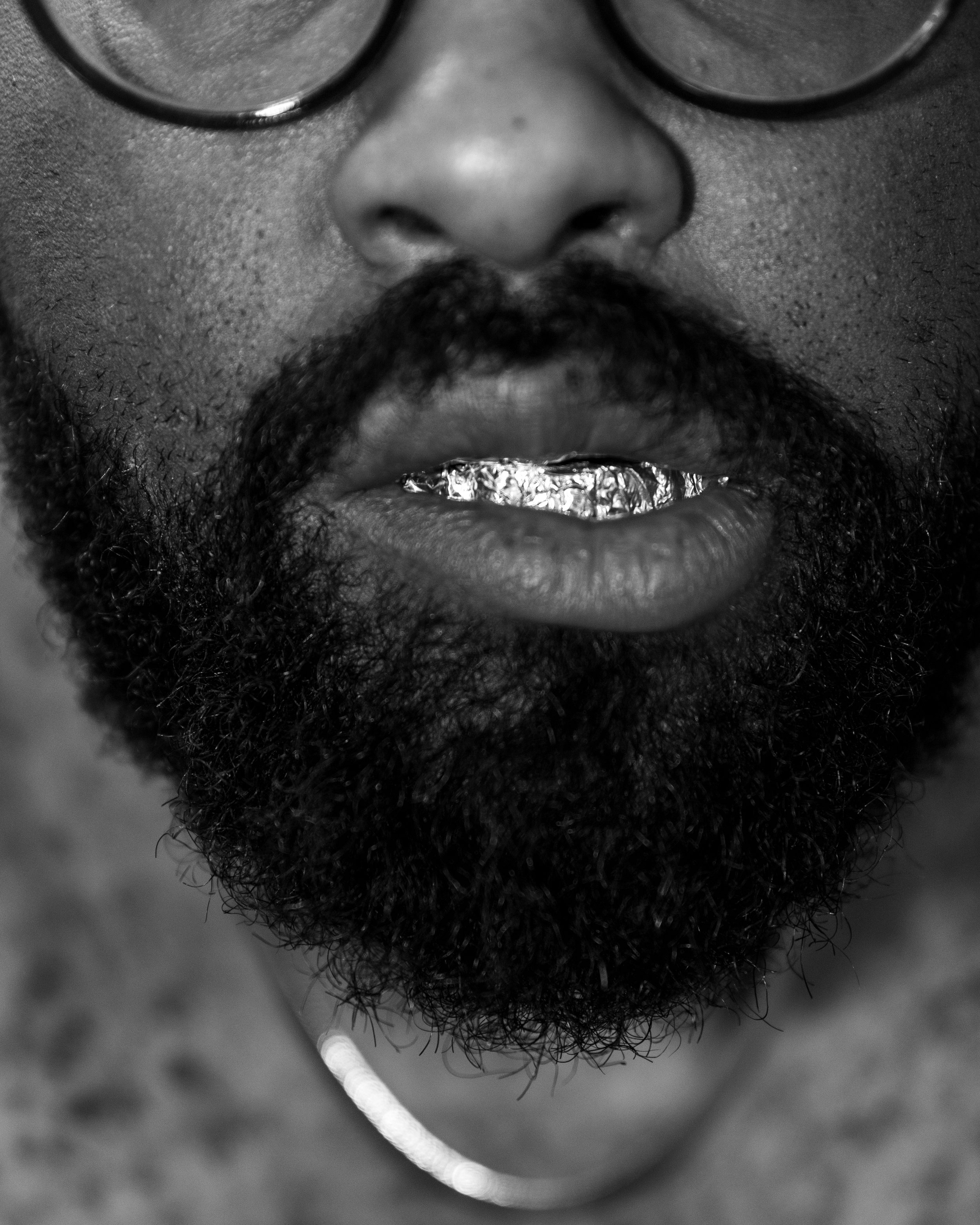
The artist has been known to wear a real gold grill from time to time, yet, in “Fronting (Affirmation #4)” (2020), his teeth are in a grill made of tinfoil. The title works as a double entendre. Fronts is slang for a grill, and fronting means faking it, or to showboat wealth or toughness you don’t have. A foil grill is a knockoff of a status symbol, made at home. Much like the ICP award on the altar, it turns the joke on Murff himself, and on the promise that the right accessories add up to arrival.
RACE/HUSTLE draws on a long tradition of Black oratorical power, from the sermon to the street-corner speech to the Panther rally, where speech is meant to move a crowd from listening to acting. The gospel hymn and church fan in “Metaspectacle” belong to the same tradition.
Collage and text fill the middle of the show, and here Murff's ambition might outrun his editing. References to popular culture, media, literature, and academia accumulate until looking at the work feels like reading its bibliography. I found myself returning to the photographs and objects, where Murff is less declarative.
Murff has described betraying the value of one’s own work as the price of admission: “that betrayal is a prerequisite of being a part of the industry.” If he enters a space knowing he is “the most palatable, acceptable Black artist that [is] within arm’s reach,” he says, “me choosing to participate is me disrespecting what I do.” RACE/HUSTLE is the record of that choice, made in public, at the scale of a museum gallery.
“Jackson Smoothies (Impractical Risk #1)” is a red vitrine of revolutionary books. Its wall label explains that Murff, heeding Assata Shakur’s warning against recklessness, “realized that not every venue is the best one for certain ideas.” The show narrates its own capture at the pyre, at the altar, and at the vitrine. Some viewers will see that as a shrug, but Murff arrives in the museum refusing to let the institution escape scrutiny. I read that as the show’s real proposition: honesty about the trap is where resistance begins.
Hector R. Membreno-Canales is an artist, educator, and researcher living and working in Massachusetts. He is the Francis C. Robertson Chair of the Art Department at Phillips Academy Andover and Lecturer in the Art, Culture and Technology (ACT) program at The Massachusetts Institute of Technology (MIT)
ZORA J. MURFF ."Bobby said blow the Pigs away (rearranging the social order)", 2022.
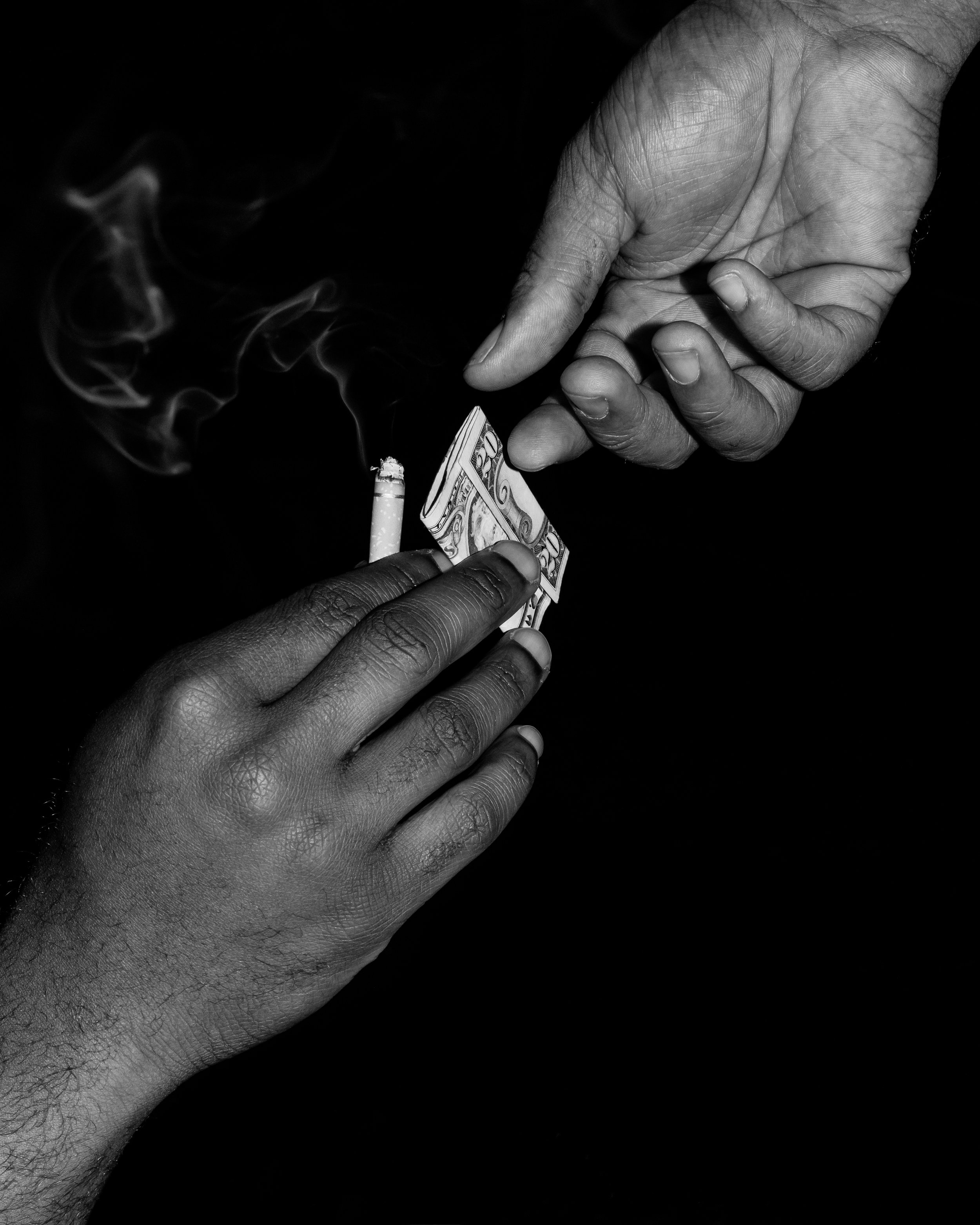
ZORA J. MURFF "Gas Money (Affirmation #1)” 2019.

ZORA J. MURFF "I Woke Up Today Wanting to Kill A White Man (N.H.I)” 2022.
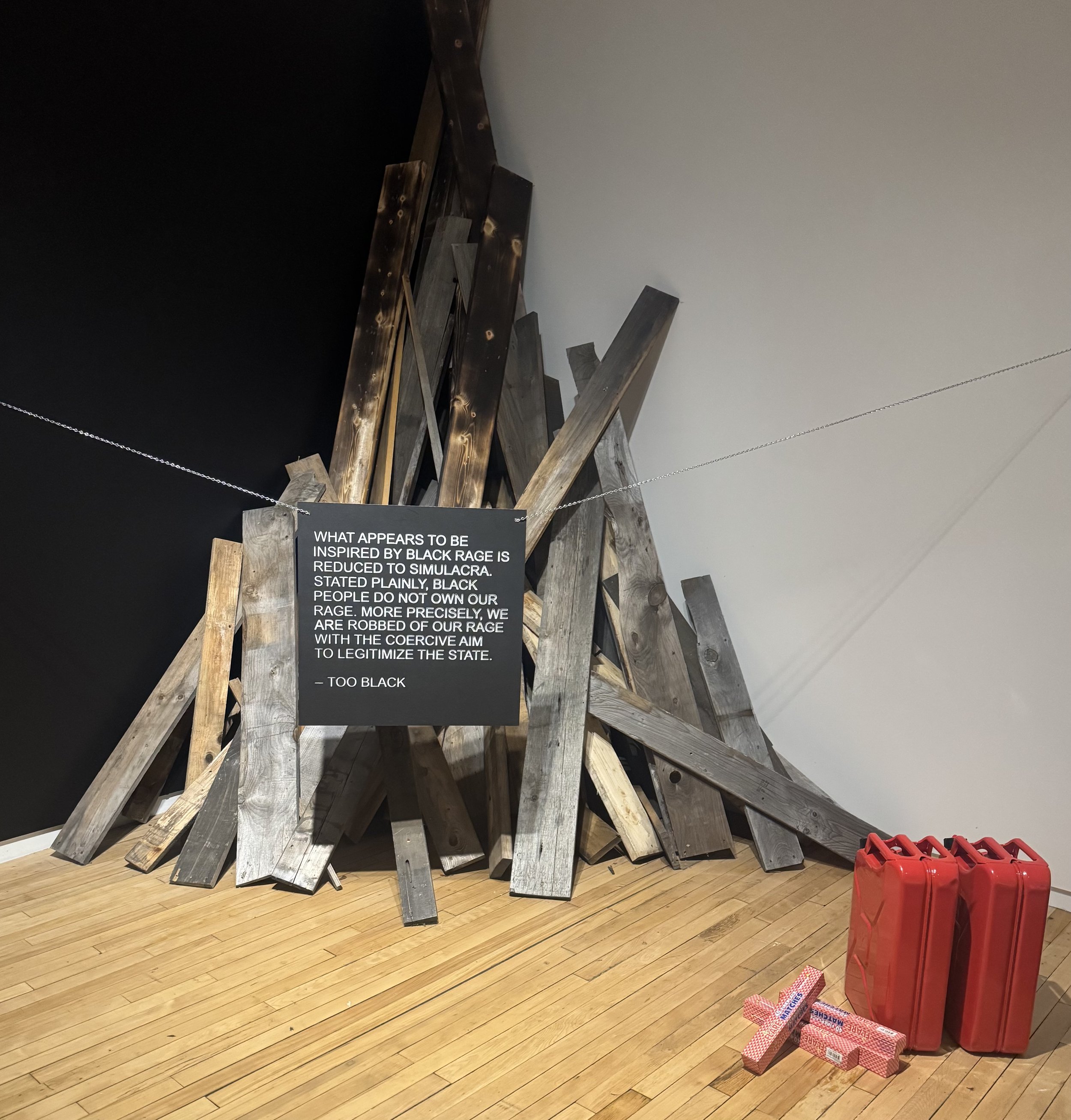
ZORA J. MURFF “Master’s Tools/Master’s House (Exclusion & Extraction)” 2025.