
By Lyle Rexer, May 10 2026
In one of his stories, Italo Calvino, the comic philosopher disguised as a novelist, described the perfect progress of a photographer. His protagonist starts out casually and reluctantly snapping for friends, then obsessionally making portraits of his love interest, then photographing absence of one sort or another, and finally photographing his own photographs, sliced up. Tim Maul’s miniretropsective at Leslie Tonkonow reminds us that many contemporary photographers – and artists using photography – followed this path in reverse. Maul began with making pictures and videos about the two mediums and then moved on to deeper fascinations.
Like so many photographs and videos created between the late 1960s and the early 1980s, the examples in this exhibition can appear almost simple-minded, their humor and the paradoxes they explore obvious. But that simplemindedness serves to break habits and renew awareness. The standard art historical narrative of this period describes the intrusion of artists into the photo world in order to highjack the camera’s deadpan descriptiveness for subversive documentary projects at the very moment when “real” photographers were desperately seeking conventional validation for fine (or, alternatively, innovative) photography. In fact, many traditional darkroom habitués were just as radically re-examining their medium.
“Prism/Puzzle” from 1974 sets the terms. The sequence of c-prints documents a performance of sorts, of Maul using several objects, including a prism, to cast light impressions on a piece of paper. Lest we forget, in the digital age – or in that earlier time of fancy Leicas and Nikons – photography is a game played with light and shadow on whatever material can catch and hold it. Nothing more, yet the most fascinating aspect of the medium is exactly the one most taken for granted.
This is the kind of experiment was pursued relentlessly by Mel Bochner, who spent the years 1966-69 doing nothing except trying to understand what photographs do and how we respond to them. One result was a series of note cards titled: “Misunderstandings: a Theory of Photography” (1970) which underscored the irony of ascribing truth to a mechanical process.
Many of Maul’s videos work in a similar way, using a simple set up and the facts of duration and perspective to subvert the given-ness of the image. One of the more intriguing ones is “Fly on Window” (1974). This close-up view out the window of a cruddy New York apartment follows the progress of a fly. As it moves up the window, it appears to the camera to be climbing out of the cityscape, only to reach the open sky – and keep climbing. The camera, doesn’t register the transparent window and, of course, can’t tell what the fly is actually doing. It looks like it is walking on air. It is we who must interpret what we see, something far more miraculous than flying.
A more ominous and complex example is “Mouse Space” (1973), which results from the placement of a video camera at the opening of a box containing a live mouse. It’s really a prison, and for five minutes the mouse darts back and forth around the space, sniffing, exploring, looking for something, food? A way out? Inevitably, the mouse bumps up against the lens, obscuring everything. At those instants, the moral obliquity of confining an animal becomes unavoidable and deeply disturbing. This unease is apart from whatever associations we might make about contemporary surveillance.
I am reminded of the many videos from this period in which ordinary actions are attempted – bouncing a ball for example, or running into a wall – then repeated, and repeated again. The obvious goal, if it really is a goal, is to dramatize duration as the essential element of video, and repetition and endurance as the essential elements of human activity. We might also add patience, which audiences need in good measure to stick with the videos. Maul’s have something else going on, even with goofy ones that reflect his fascination with magic tricks and games. I can’t exactly tell what is happening with “Ball and Vase Trick” (1974) but as with many of his videos I find myself waiting in anticipation. What happens next? The question is so fundamental we stop asking it about reality generally except in more extreme circumstances. But, as Samuel Beckett reminds us, it is the basis of narrative and the source of metaphysical anxiety: we can’t in fact ever know what’s going to happen next.
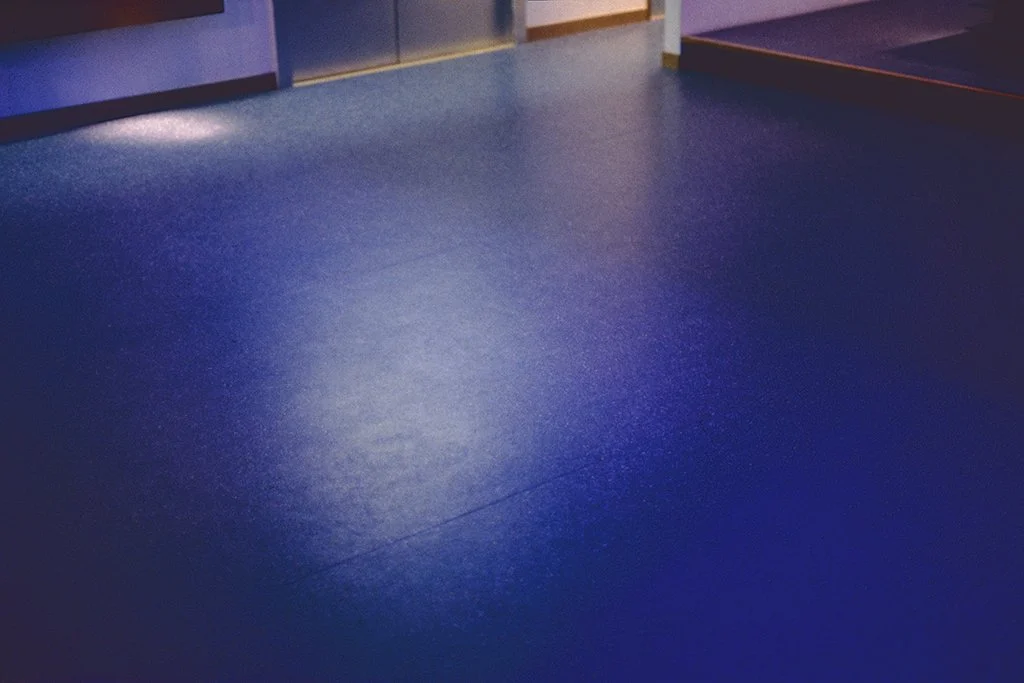
This brings me back to the photographs, especially those from the 1990s and later. It seems by then Maul has become attuned to the overlooked aspects of the world that the camera can isolate. His sequence of photographs of the floor of the Centre Pompidou, “Blue Floor Beaubourg”(1995) track the play of light on a surface. Things are more complicated than they first appear, for the light comes from more than one source. The effect is engrossing, even hypnotic, and sends us back to the world with recalibrated eyes.
The sequence aspect notwithstanding, such photographs of near-nothing link Tim Maul with a younger generation of photographers who find in the ordinariness of things compensation in a time of anxiety and diminishing expectations. In the face of much uncertainty, light on a blue floor, whether actually blue or only apparently so, offers a haiku of awareness and even joy.
Lyle Rexer is a writer, critic and educator who lives in Brooklyn. His novel, ‘The Book of Crow’, has been recently published by Spuyten Duyvil.
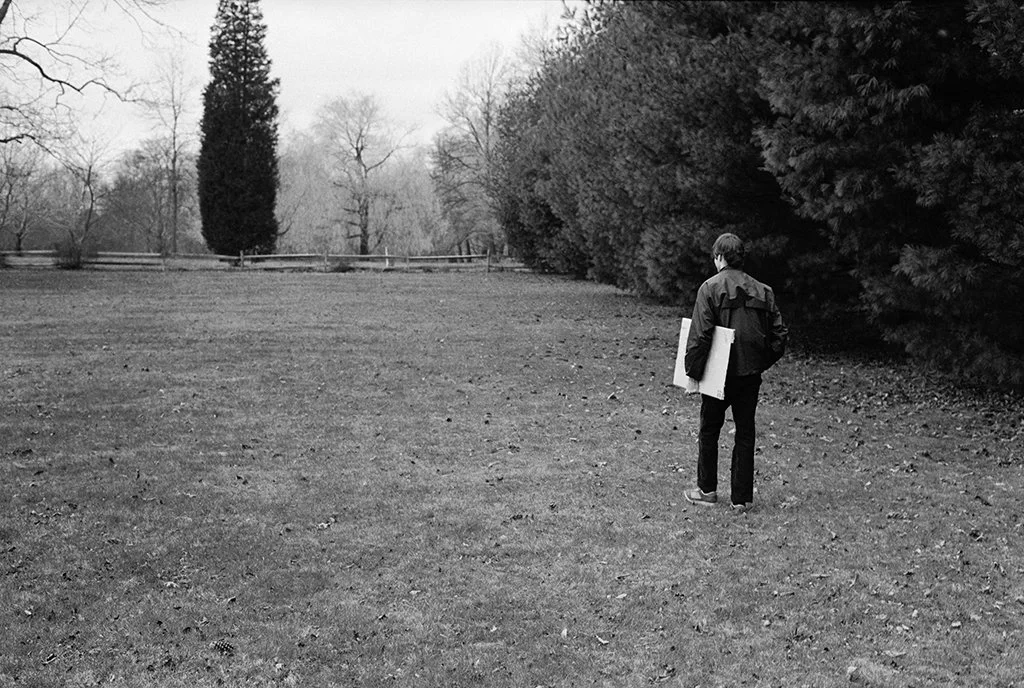
TIM MAUL "Gus Van Sant/Kodak Box (trees)", 1981.
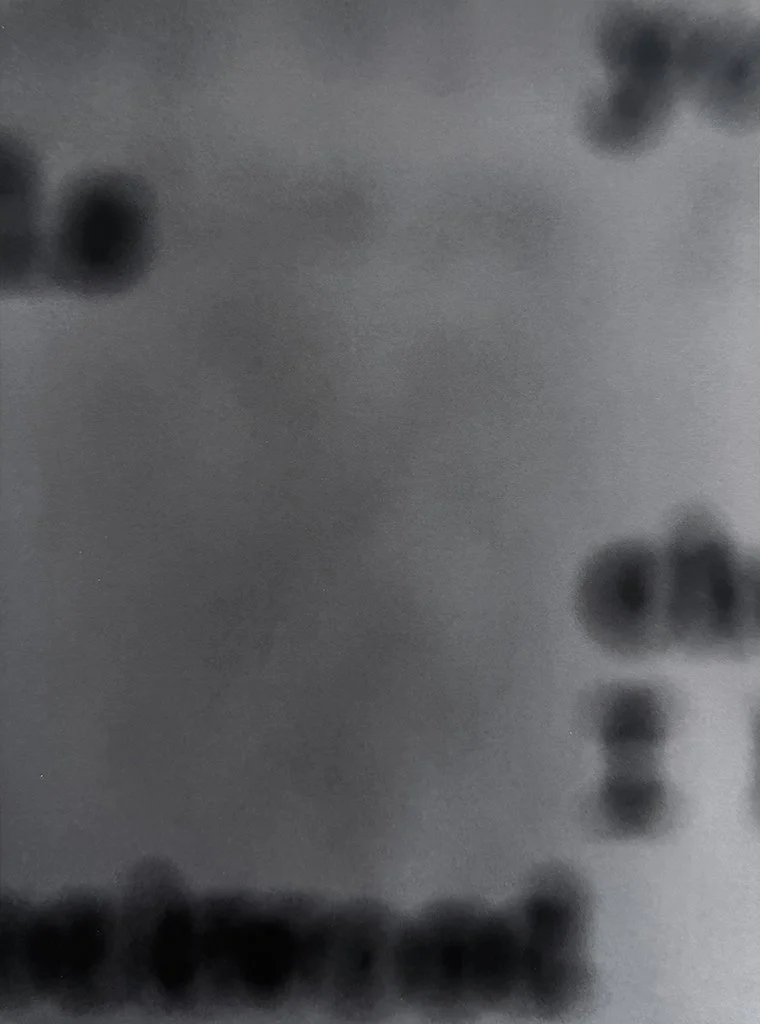
TIM MAUL "Poetry Collected 1966-9 (Odell)" 2024.
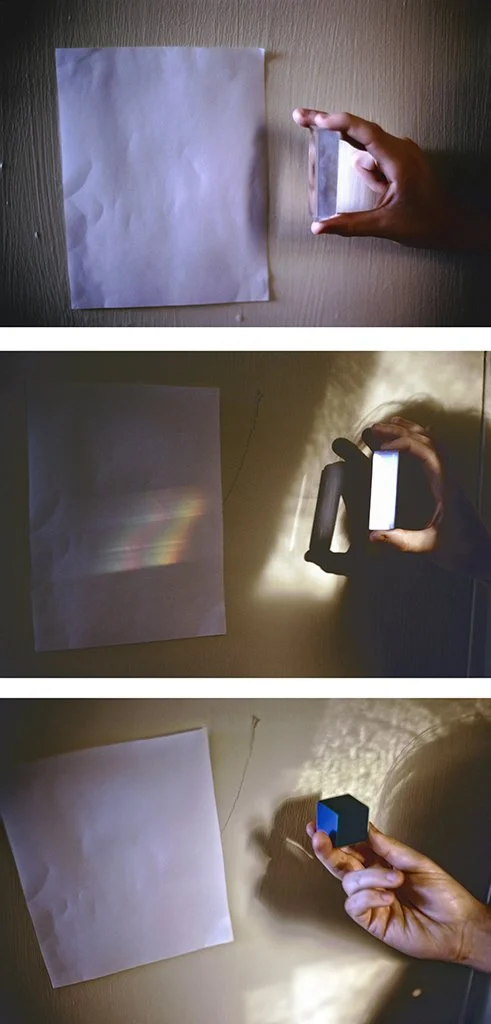
TIM MAUL "Prism/Puzzle", 1974.