

By Eleanor Oakes, September 10, 2026
“My memories fascinate her. She listens with astonishment as I describe the shadows in Baba’s house and what they meant to me, the way the moon entered an upstairs window and created new ways for me to see dark and light.”
- bell hooks, belonging: a culture of place
In a dream I have, the moon is continually eclipsed by spinning grey circles, creating a pulsing pale blue light that passes across my son’s room, illuminating his vulnerable, outstretched body asleep on the bed and casting the long shadows that frighten him at night. He wakes and asks me to turn on his nightlight. I flick the switch and the shock of bright yellow throws the room into chaos. The quiet magic of darkness is broken.
Darkness is not an absence; it is a teacher that allows us to see anew. Walking into ‘Beneath the Moonlight', Mickalene Thomas’ solo presentation at The Shepherd on Detroit’s East Side, the dim lighting immediately invites slow contemplation. The Shepherd sets an appropriate stage for the exhibition. The gallery itself is an impressively renovated century-old Romanesque church that is part of a growing creative campus amid a long-neglected neighborhood. On opening nights, cars overspill the streets for blocks, parking in front of derelict houses and vacant lots. These contradictions are felt in Detroit’s cultural landscape and reverberate in Thomas’ works: the coexistence of neglect and reverence, investment and decay, marginalization and care.
It is not the space alone that creates sanctuary; it is the loving attention given to every detail of this exhibition. Candles flicker, images glow, wicker baskets of salt are anointed with essential oils and sage every morning by gallery attendants, and vessels of Florida water nestled in plants are refilled each day. Thomas invites us to open ourselves, engaging all our senses through ceremony and reflection, transforming the gallery into a ritual sanctuary that welcomes us to sit, contemplate, perhaps worship.
The exhibition's most notable claim is that it is Thomas’ first time focusing on the male figure and masculinity. And yet, the works employ such layering, depth, and expansiveness that they refuse confinement by gender. Each piece generates its own light, making the Black body glow. I find myself looking for clues to masculinity rather than encountering a familiar performance of it. There are exuberant colors, sparkling crystals, pinks, purples, and blues. Surfaces accumulate signs without resolving into a stable category, each element coalescing in a quiet celebration of multifaceted beauty that exceeds the convenient boxes of gender tropes.
The center of the exhibition is anchored by “I’m Here” (2026), a 14-foot work of acrylic, oil, and rhinestones that occupies the space of the altar. The subject is pieced together in Thomas’ signature style, geometric elements blending photographic collage and painted panels, visually joined by strips of blue painter’s tape rendered in rhinestones. The subject lies prone on shag carpet, one arm outstretched, top surgery scars visible, their eyes looking out at us with a knowing gaze. They address a visual history of crucifixion and martyrdom, invoking the wounded body without being reduced to its suffering. The stained-glass windows atop The Shepherd’s sanctuary contain figures from Catholic narratives that look down on Thomas’ subject, who in turn returns our gaze. Their body is simultaneously vulnerable and monumental, offered to our view but not passive beneath it.
I think of bell hooks’ call for a Black aesthetic capable of challenging and transforming dominant ways of seeing, “an aesthetic that focuses on the purpose and function of beauty… one that seeks to explore and celebrate the connection between our capacity to engage in critical resistance and our ability to experience pleasure and beauty.” While Thomas’ practice has always engaged with the language of Western art history, here it comes into direct contact with Western religion without being defined by it. Against long histories of scrutiny, regulation, and violence directed at Black, queer, and trans bodies, Thomas presents her subjects as vast, adorned, and at rest. Their beauty and repose become forms of resistance.
In the central area of the nave are rugs and a soft seating area that encourage the viewer to sit with the work, to stay in its presence. Soft music moves through the space, curated by Detroit’s own Sterling Toles, with gentle jazz rhythms wrapping the cavernous ceiling in a familiar comfort. To the left of the altar is a library filled with influences that reverberate throughout Thomas’ work, where you could linger for hours with hooks, Lawrence, Baldwin, Basquiat, Warhol, and many more; study tables and niches adorned with wooden masks and figurative sculptures suggestive of African ceremonial objects. Each layered detail makes me feel that I am a welcome guest, invited to linger and explore. The exhibition makes space for our bodies as viewers as much as it makes space for the bodies within the work.
The design of The Shepherd includes two white-box galleries inside the central and side areas of the church. This separation can sometimes disconnect the art on view from the structure of the building, but not in this exhibition. Each area is considered and fluid. Light dances off the surfaces of the works, luring the viewer in further. The second gallery functions as a side chapel that offers space for reflection. The room is darkened almost to black. Thomas' modestly scaled abstractions are individually lit, each one creating an energetic visual dance of bright geometric rhythms as they appear to radiate from within. Like stained glass windows, they do not simply receive light but transform it, absorbing it into areas of exposed bare wood and refracting it across glossy jeweled surfaces. Light becomes material, altered by each surface it encounters.
I delight in the three large-format photographs in the exhibition for their simplicity and subtlety, the light glistening off the shimmering print surface. Each straight image plays upon Thomas’ dimensional paintings: the subjects are painted, scarred, and tattooed, each mark signaling the multiplicity of our beings, a layering like the nature of our own skin, simultaneously regenerating, protecting, and sagging. The body is a surface that accumulates, containing evidence that changes over time. I am drawn to the setting in each image; the spaces are simple, raw, and imperfect. They are mundane, with walls that crack, chip, smudge, and fade, each flaw creating lustrous depth and texture. Light skims their surfaces, allowing reverence and reality to coexist.
An unassuming vitrine near the library holds small collages, revealing the artist’s sketches for the works on view and a moment of personal intimacy. While the artist’s hand might be lost at a grand scale, here it feels like connective tissue. The photographs and collages serve as a key to deciphering the larger paintings, reminding us of the ingenuity of making, and of Thomas’ particular genius for transforming material. The studio is a lesson in creative reuse, transfiguring the ordinary into the extraordinary: tape becomes jeweled, flooring becomes pattern, hair becomes stars. A photograph becomes a collage becomes a painting; a church becomes a gallery becomes a sanctuary. We are led across this threshold, transforming without concealing, illuminating without erasing. Nothing here exists as a single surface; the works echo each other, reappearing like ancestors on the faces of children.
A moment in “I’m Here” lingers long after leaving the altar. The subject’s outstretched arm, represented as a black-and-white photograph, is subtly reiterated in paint, the painted hand appearing almost to hold the photographic one. It is another echo, one version of the self tenderly caressing another. The embrace becomes a complex invitation to look beyond a passing glance and remain long enough to encounter our many shifting facets. As our eyes adjust to the darkness, the soft illumination of moonlight can reveal what brightness obscures: a vibrant multiverse of possibilities that were there all along.
Eleanor Oakes is an artist and educator based in Detroit. She is Associate Professor and Section Lead of Photography at the College for Creative Studies and President of Creative Body Institute, a research platform dedicated to embodied creative practice across disciplines.
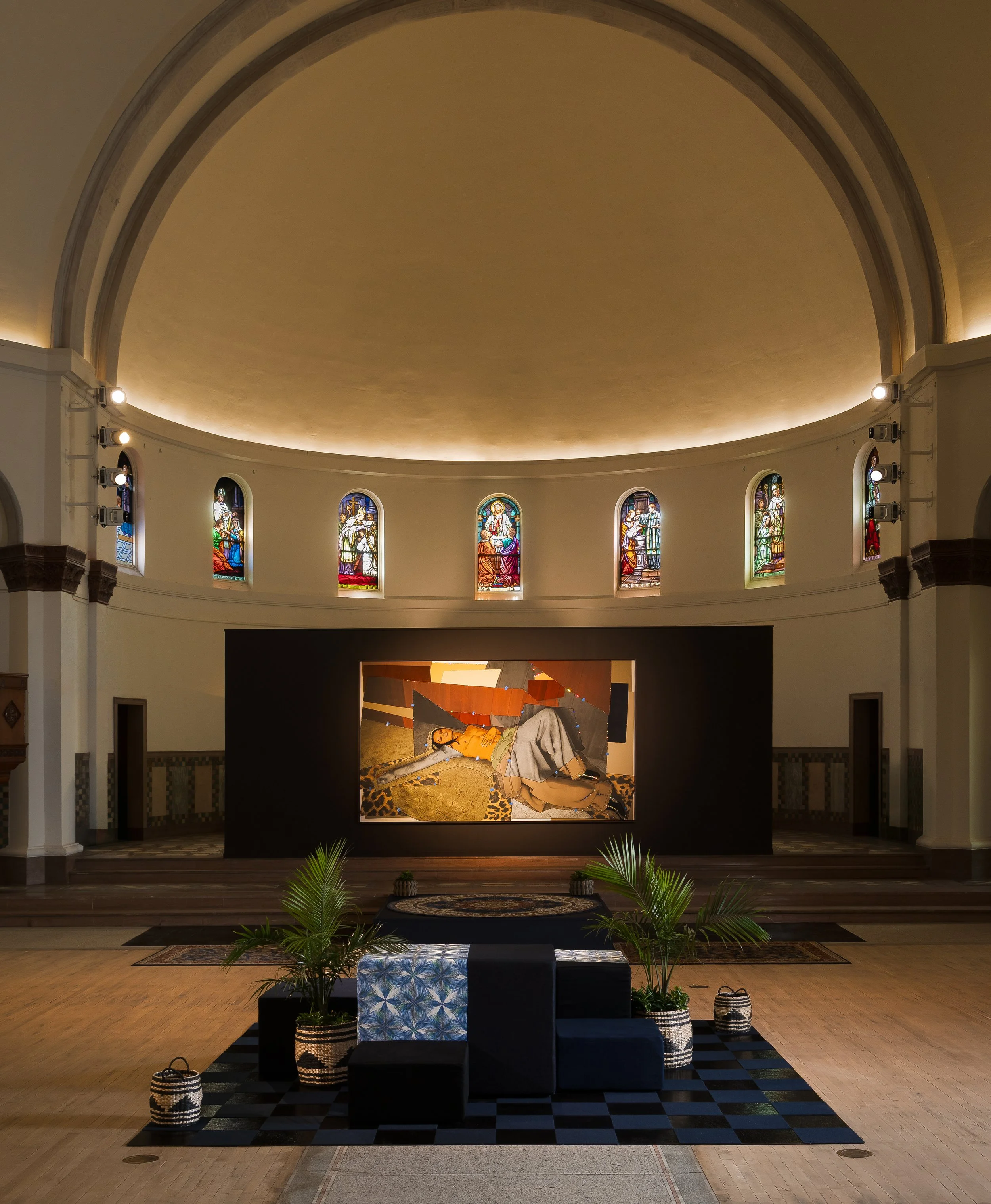
Installation view of “Mickalene Thomas: Beneath the Moonlight “ at the Shepherd, presented by Library Street Collective, Photos by Joseph Tiano. Courtesy of Library Street Collective and the Shepherd.
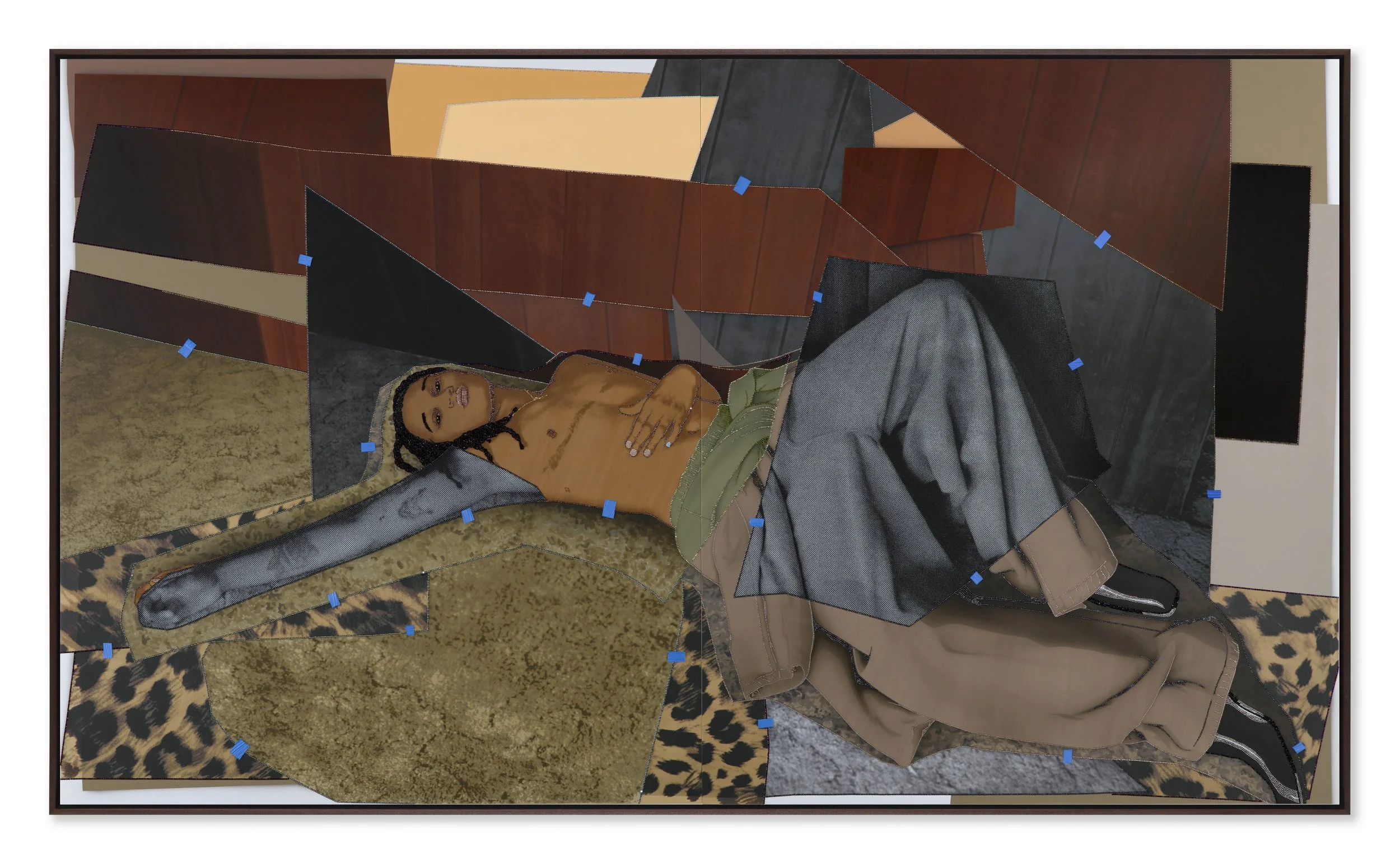
MICKALENE THOMAS "I'm Here" 2026. Courtesy of the Artist.

MICKALENE THOMAS "Dream Sidways with Red Lips", 2026. Courtesy of the Artist.

MICKALENE THOMAS "In Blue the Odalisque" 2026. Courtesy of the Artist.

MICKALENE THOMAS "In Blue the Thinker", 2026. Courtesy of the Artist.