
By Kathi Hofer September 10, 2026
This summer, Richard Prince was the subject of a major survey exhibition at the Albertina in Vienna, the first of its scope to focus solely on his photographic practice of nearly six decades. Conceived by the Albertina’s chief curator of photography, Walter Moser, it brought together around 150 works within a curatorial framework that sought to present photography not merely as Prince’s first – and most widely recognized – medium, but as the underlying method and conceptual platform of his artistic project as a whole.
The exhibition opened, in quasi-cinematic movement, with an ‘establishing shot’: as one descended via an escalator into the galleries, a scene slowly unfolded, defining Prince’s referential coordinates. On the far wall, an anonymous cowboy seemed to bow in greeting in a larger-than-life photograph, his face obscured by his hat (“Untitled (Cowboy)” 1999). A series of 18 photographs, arranged in two rows on a wall to the right, depicted scenic views of landmarks – castles, bridges, monuments – and cityscapes recognizable as Paris, Vienna, or Berlin. They form the series “The Magic Castle”, which a 19-year-old Prince created during a study tour through Europe in 1968/69, mixing postcard images he found in souvenir shops with photographs he took himself. It is the earliest work in the show, and a terrain seemingly unfamiliar to an artist we have come to see as quintessentially ‘American’. Yet these views of Europe, shot (or gleaned) merely in passing, capture some lasting traits of Prince’s photography: an eye for the motif, a penchant for myth.
A heightened sense of motion was maintained throughout the exhibition. Prince’s large-scale series of the 1980s and ‘90s – the Cowboys, Gangs, Girlfriends – depict galloping horses, cars and motorbikes, emblems of an early and late capitalist desire for expansion, rephotographed from commercial imagery. Some of the cropped and blown-up Cowboys were mounted on free-standing walls in the exhibition space. There, their grainy, painterly presence seemed picturesque, nostalgic, and strangely alluring. The writer Rebecca Solnit has described the role that early photography played in the seizure and appropriation of American land, pictured as ‘open space’, as a terrain of fabricated originality – a process for which she coined the term “the technological Wild West”. Prince was evidently never buying into the Western myth; he preferred to steal it from the Marlboro Man. Movement, in this oeuvre, is stretched to the point where it turns into its absence or opposite: the loss of momentum, the frozen pose, the interrupted circulation of images. On another free-standing wall, a photograph from the (faux-) documentary series “Upstate”(1995-99) shows an empty road with skid marks. Somewhere within this spatial setting, as the pictures become one another’s neighbors and backdrops, it is suddenly evident that Prince’s gesture of appropriation is not one of overview or domination. His images tend to escape.
A particular strength of the curatorial gesture lay in its groupings. The exhibition culminated in a focused setting in the third gallery room, where Prince’s most recent photographic works were contextualized by some of his earliest. “New Portraits” titles a series created since the mid-2010s that has been heavily criticized – and legally contested – since its first presentation at Gagosian in New York in 2014. It comprises Instagram selfies of private individuals and public figures screen-grabbed and printed on large canvases. Their legal status is decidedly more precarious than that of Prince’s appropriations of unlicensed print ads – as currently demonstrated by a broader debate surrounding digital abuse on the internet – while the very act of ‘redistribution’ has shifted its power balance. In its spatial arrangement, this body of work was simultaneously affirmed, reflected, and subverted by Prince’s own method. A display case facing the “New Portraits” showed an arrangement of photo collages and snapshots from the late 1970s, in which handwritten annotations repeatedly question the integrity and autonomy of the photographic image. Also in the room were Prince’s 1984 “Portraits” of friends from the New York art scene; here, giving consent to reproduce was part of the artistic concept.
As questions of authorship, ownership, and consent remain crucial in Prince’s photographic intrigue, the work gains momentum and continued relevance in our current and contested image culture.
Kathi Hofer is an artist and writer based in Berlin and Vienna. Her essayistic and critical writing has appeared in springerin, Camera Austria International, Texte zur Kunst, and Frieze, among other publications.

RICHARD PRINCE "Cowboy" 1989. Courtesy of Richard Prince Studio © Richard Prince

RICHARD PRINCE "Flames, Dragons, Titles (Gang)" 1986-1986. Courtesy of Richard Prince Studio © Richard Prince

RICHARD PRINCE "Untitled (Cowboy)" 1999 Courtesy of Richard Prince Studio © Richard Prince

RICHARD PRINCE "Untitled (Upstate)" 1995-1999 Courtesy of Richard Prince Studio © Richard Prince
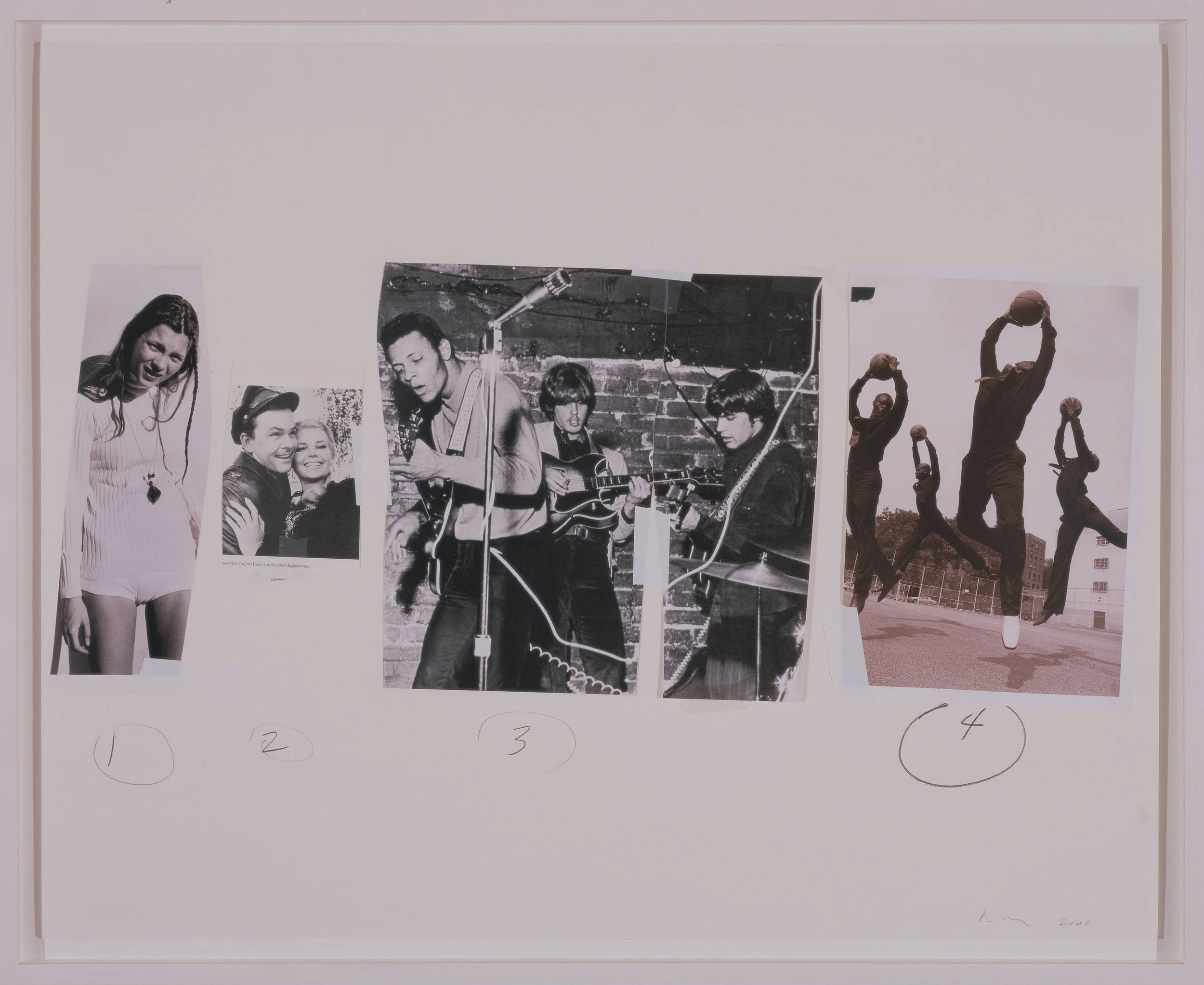
RICHARD PRINCE "Untitled 1-2-3-4" 2008